
Guides / Mixing and injecting
How to reconstitute a peptide, step by step
A plain walkthrough of mixing freeze-dried peptide powder with a diluent, using sterile technique guidance from CDC, FDA and approved-product labels. Includes what no authority has established.
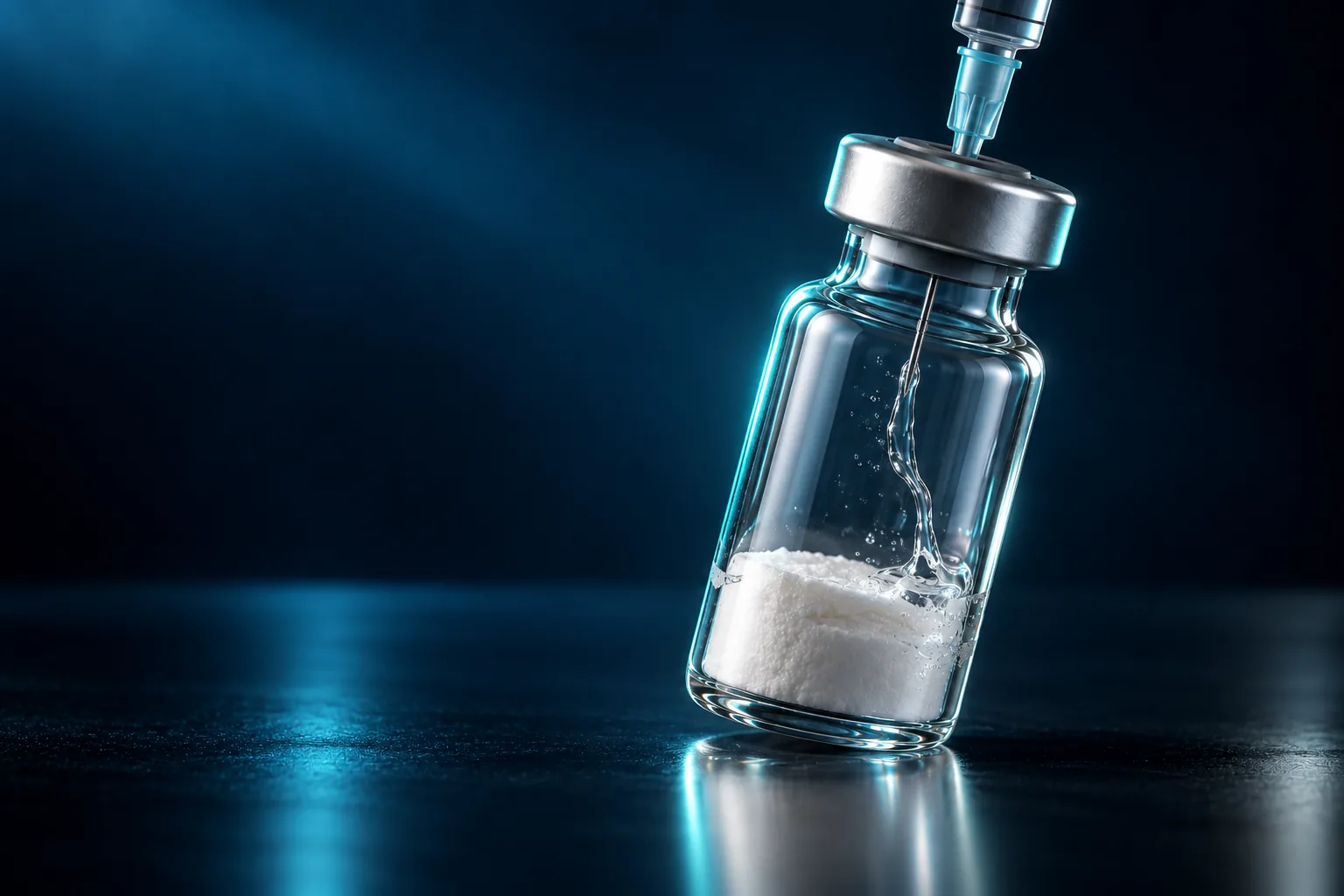
Short answer. To reconstitute means to dissolve a freeze-dried powder in a liquid so it can be measured and used. The general steps come from sterile technique guidance and from the labels of approved products: clean hands, a clear sealed diluent, a disinfected stopper, a new sterile needle and syringe, gentle mixing, and a visual check. Some popular tips, like exactly how to aim the water or how long to wait, have no authoritative source.
On this page
What you are doing, in plain terms
Many peptides are sold as a dry white powder in a sealed glass vial. The powder is stable in that form. Adding a liquid (the diluent) turns it into a solution that can be drawn into a syringe. For what the powder is and why it looks the way it does, see what lyophilized means. For which liquid, see bacteriostatic water vs sterile water. For how much, see how much water to add.
The steps
- Wash your hands. The CDC says to wash with soap and water for at least 20 seconds, or use a hand sanitizer with at least 60% alcohol if soap is not available.
- Check the diluent. The label for Bacteriostatic Water for Injection, USP says to use it only if the solution is clear and the seal is intact, and to inspect for particles and discoloration.
- Disinfect the stoppers. The CDC says to wipe each vial stopper with an alcohol pad and let it dry, every time you access a vial.
- Use a new sterile needle and syringe. The CDC rule is “one needle, one syringe, only one time.” Changing only the needle is not enough, because the syringe is contaminated after use. Do not leave a needle sitting in a vial.
- Draw the diluent. The MedlinePlus method for liquid vials is to draw air into the syringe equal to the volume you plan to withdraw, push the air into the vial, then withdraw the liquid slowly. Tap the syringe to move bubbles up and push them back in, then redraw if needed. That page is written for liquid insulin vials, not powder, but the air-displacement idea is the same.
- Add the diluent to the powder vial. Add the volume you planned for. Write that exact volume on the vial label, with the date.
- Mix gently. The FDA label for tesamorelin says to move the vial in a circle to mix and not to shake it. MedlinePlus also says not to shake insulin suspensions because shaking causes clumping.
- Look at it. The tesamorelin label says the mixed solution should be clear and colorless, and not used if solid particles appear or the liquid is cloudy or colored. See what looks wrong.
- Store it as directed. What “as directed” means for a research peptide is a real gap. See how to store peptides.
What nobody has established
We searched FDA, USP, NIH, CDC and peer-reviewed sources for these common tips and found no authoritative support for any of them:
- That you must aim the water down the side of the vial rather than at the powder.
- How many minutes to wait for the powder to dissolve.
- That gentle swirling protects short peptides specifically. The agitation research we found covers large therapeutic proteins and antibodies. A research-reagent supplier, R&D Systems, says vigorous shaking can cause foaming and denaturation of lyophilized proteins, but that is a supplier note about proteins, not a regulator statement about peptides.
Gentle mixing is low cost and consistent with the one FDA label that addresses it, so it is a reasonable habit. It is not a proven requirement.
A caution about the diluent bottle
Bacteriostatic water contains benzyl alcohol, and its label says it is not for use in newborns. The label also warns that giving water without any dissolved solute into a vein can rupture red blood cells. Reconstituted peptide solutions are for the route the product is labeled for, which for most is under the skin.
Common questions
Should you shake a peptide vial?
The one FDA label we found that addresses it, for tesamorelin (Egrifta WR), says to move the vial in a circle and not to shake it. No authority has addressed other peptides.
How long does the powder take to dissolve?
No authoritative source gives a time. The tesamorelin label describes the mixed solution as clear and colorless, which is the check that matters.
Can you reuse a needle or syringe?
The CDC rule is one needle, one syringe, only one time. Changing only the needle is not enough.
Keep reading
- How much water to add to a peptide vialThe math behind concentration, with a worked table.
- Bacteriostatic water vs sterile waterWhat is in each bottle and what the labels say.
- What lyophilized means, and what looks wrongThe freeze-dried cake, and what to check after mixing.
- How to store peptidesWhat approved labels say, and where the guidance stops.
Sources
- Preventing Unsafe Injection Practices, CDC
- Bacteriostatic Water for Injection, USP (label), DailyMed, Hospira
- EGRIFTA WR prescribing information, FDA
- Subcutaneous (SQ) injections, patient instructions, MedlinePlus
- Hand hygiene guidance, CDC
Educational reference, not medical advice. This page describes what public health and regulatory sources say. It does not tell you what to take or do.