
Guides / Storage, quality and routes
What lyophilized means, and what looks wrong
What freeze-dried peptide powder is, why the cake can look different from vial to vial, what approved labels say to check after mixing, and what no source can tell you from looks alone.
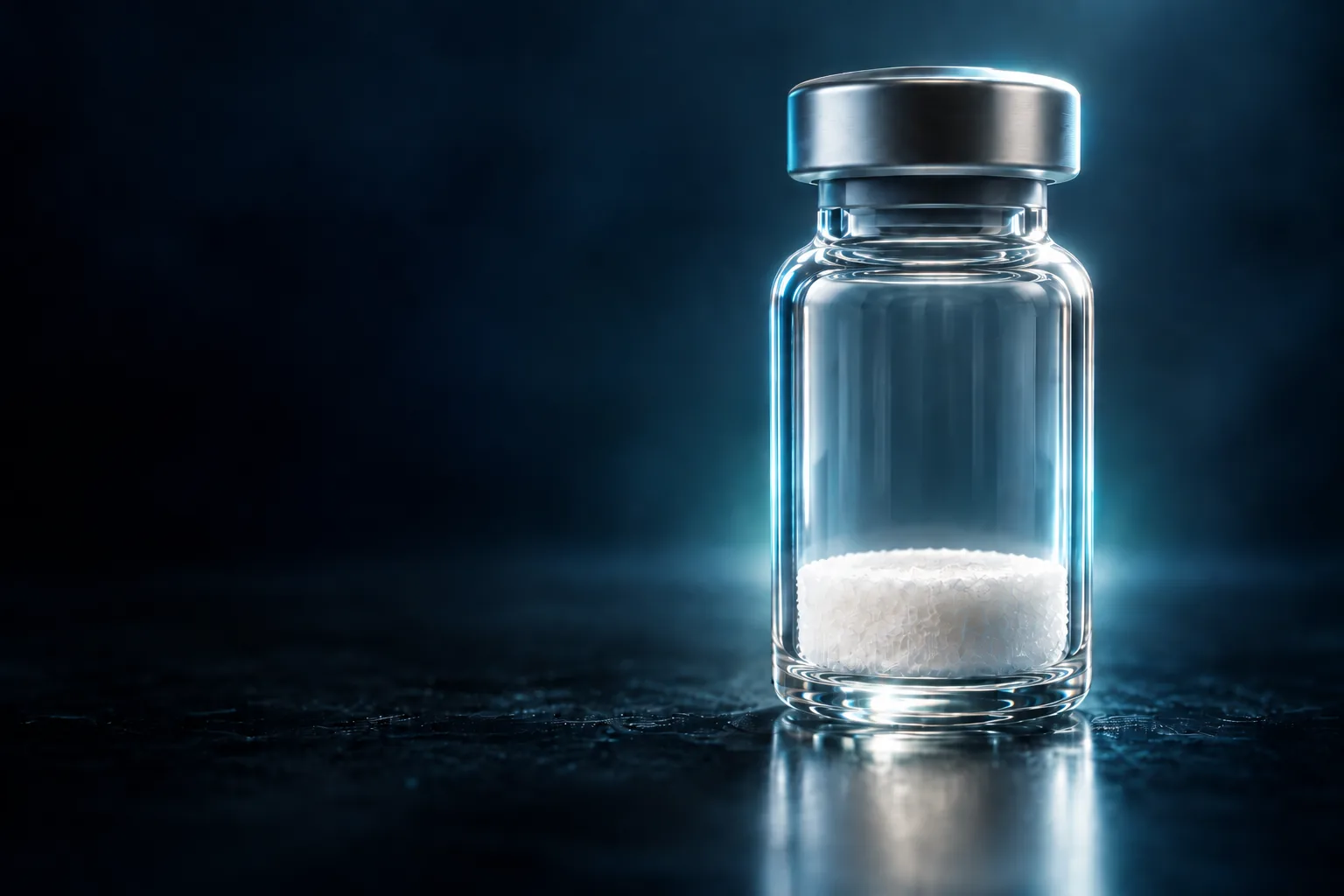
Short answer. Lyophilized means freeze-dried. Water is removed from a frozen solution under vacuum, leaving a dry solid (“cake”) that is more stable than a liquid. The cake can look different from vial to vial, and in pharmaceutical literature a shrunken cake is a known visual issue. Approved labels say to check a mixed solution for clarity and particles. We found no authoritative source that says an odd-looking cake is harmless, or that a normal-looking one proves quality.
On this page
What lyophilization is
A peptide is dissolved in a liquid, frozen, then dried in a vacuum chamber so the ice turns directly into vapor. What remains is a dry solid in the vial, often a white fluffy plug, a thin film or a few flakes. A Fresenius Kabi white paper on lyophilization says the frozen-state structure determines how the cake looks, and that bulking agents are added to make a “pharmaceutically elegant” cake. Removing water slows many of the reactions that break peptides down, which is why powder is generally the more stable form and liquid is the more delicate one. See how to store peptides.
Why cakes look different
- Amount of solid. A small amount of peptide in a large vial can look like a thin film or a few specks, or even like an empty vial. Our reasoning
- Formulation. Added ingredients such as bulking agents change structure and appearance.
- Cycle conditions. A white paper from Fresenius Kabi describes cake collapse as happening when drying temperature during the main drying step goes above the formulation’s collapse temperature.
- Shipping and handling. A dry cake is fragile and can crack or break apart in transit. Our reasoning
What the pharmaceutical literature says about shrunken cakes
A review in American Pharmaceutical Review (Johnson and Lewis, 2011) names a macroscopically collapsed, shrunken cake as the visible concern. It also says collapse does not necessarily reduce quality when residual moisture is low enough for the solid to stay in a glassy state, and that stability “must be demonstrated on a case by case basis.” In other words, appearance is a clue and not a verdict, and you cannot do that case-by-case testing at home.
What to check after mixing
This part has real label support. The tesamorelin (Egrifta WR) label says the mixed solution should be clear and colorless, and not to use it if solid particles appear or the liquid is cloudy or colored. The bacteriostatic water label says to inspect for particles and discoloration before use. The FDA’s draft guidance on visible particulates in injectables defines particulates as mobile, undissolved particles that are unintentionally present, and lists risks such as infection, emboli, abscesses and inflammation of veins.
| What you see | What sources say |
|---|---|
| Clear, colorless liquid | Matches what an approved peptide label describes as acceptable. It does not prove sterility or strength |
| Cloudy liquid | The approved label says not to use it |
| Colored liquid | The approved label says not to use it |
| Floating specks or particles | The approved label says not to use it. FDA guidance lists particulates as a safety issue in injectables |
| Cake is shrunken, cracked or looks different from another vial | Known as a visual issue in the literature. We found no source saying it is harmless or harmful for a given peptide |
| Vial looks nearly empty | Can be a small amount of solid, per our reasoning. A COA and the label amount are the way to check what should be there |
What looking cannot tell you
You cannot see purity, strength, sterility or endotoxin. Purity and strength are only measured in a lab. See how to read a peptide test report for what the tests are and what they miss. If something looks wrong, the cautious reading is the one the approved labels give: do not use it. A new vial costs less than the uncertainty.
Common questions
Should the powder look fluffy?
Cakes vary with formulation, fill amount and shipping. We found no authoritative source saying an odd-looking cake is harmless or that a normal one proves quality.
What if the mixed liquid is cloudy?
The approved tesamorelin label says not to use a solution that is cloudy or colored or has solid particles.
Does a shrunken cake mean the peptide is ruined?
The literature says collapse does not necessarily reduce quality, and that stability must be shown case by case.
Keep reading
- How to read a peptide test report (COA)Purity vs content, endotoxin, and what a report cannot prove.
- How to store peptidesWhat approved labels say, and where the guidance stops.
- How to reconstitute a peptide, step by stepThe sterile-technique steps, and what nobody has established.
- Bacteriostatic water vs sterile waterWhat is in each bottle and what the labels say.
Sources
- Lyophilization Development of Pharmaceutical Products (Schenck et al., white paper), Fresenius Kabi CMO
- Collapse During Freeze-Drying of Protein Pharmaceuticals: A Review (Johnson and Lewis), Am Pharm Rev 14(3), 2011, American Pharmaceutical Review
- Inspection of Injectable Products for Visible Particulates: Guidance for Industry (Draft, December 2021), FDA
- EGRIFTA WR prescribing information, FDA
- Bacteriostatic Water for Injection, USP (label), DailyMed, Hospira
Educational reference, not medical advice. This page describes what public health and regulatory sources say. It does not tell you what to take or do.