
Guides / Measuring and the math
How much water to add to a peptide vial
The amount of water does not change how much peptide is in the vial. It changes concentration. Here is the simple math, with a worked table and the mistakes that cause errors.
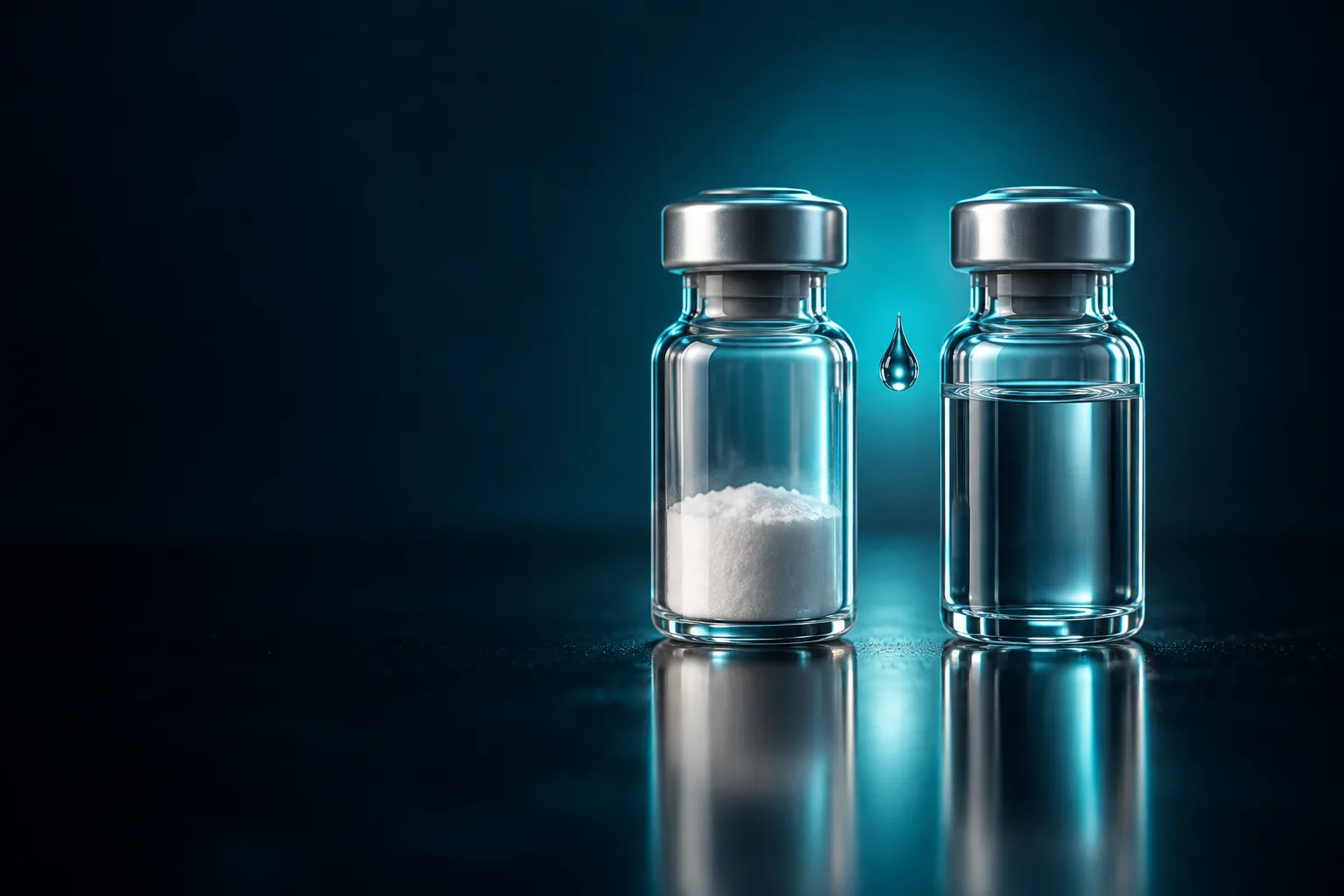
Short answer. The amount of water you add does not change how much peptide is in the vial. It only changes how concentrated the liquid is. Less water gives a stronger liquid and a smaller volume to measure. More water gives a weaker liquid and a larger volume. We did not find any regulator, pharmacopeia or journal that sets a standard water volume for research peptides. Approved products with a labeled mixing procedure follow their own prescribing information.
On this page
The one formula you need
Concentration is the amount of peptide divided by the volume of liquid it is dissolved in.
A vial that holds 5 mg of powder, mixed with 1 mL of water, makes a liquid with 5 mg in every 1 mL. Mixed with 2 mL, the same vial makes 2.5 mg in every 1 mL. The vial still holds exactly 5 mg either way. Nothing was added or lost. The peptide is just spread through more or less liquid.
Worked table (arithmetic only)
These numbers use a made-up 5 mg vial and a made-up 10 mg vial purely to show the math. They are not a dose, and they are not a suggestion for any compound. One syringe unit on a standard U-100 insulin syringe is 0.01 mL (see units explained).
| Vial contents | Water added | Concentration | Peptide per 0.1 mL (10 syringe units) |
|---|---|---|---|
| 5 mg | 1 mL | 5 mg/mL (5,000 mcg/mL) | 500 mcg |
| 5 mg | 2 mL | 2.5 mg/mL (2,500 mcg/mL) | 250 mcg |
| 5 mg | 3 mL | 1.67 mg/mL (about 1,667 mcg/mL) | about 167 mcg |
| 10 mg | 1 mL | 10 mg/mL (10,000 mcg/mL) | 1,000 mcg |
| 10 mg | 2 mL | 5 mg/mL (5,000 mcg/mL) | 500 mcg |
| 10 mg | 4 mL | 2.5 mg/mL (2,500 mcg/mL) | 250 mcg |
To work out the amount in any volume, multiply the concentration by the volume. To work out the volume for a target amount, divide the amount by the concentration. The reconstitution calculator does both and shows every unit on screen so you can check it.
What actually changes when you use more or less water
- Smaller volume of water: the liquid is more concentrated, so any given amount fits in a very small volume. Tiny volumes are hard to read on a syringe, and a small misreading becomes a large percentage error.
- Larger volume of water: the liquid is more dilute, so the same amount takes more volume. That is easier to measure, but it fills the syringe faster and means more liquid per injection.
The practical limit is the syringe. Common U-100 insulin syringes hold 0.3 mL, 0.5 mL or 1 mL, and their smallest marks are different sizes (see how to read an insulin syringe). Our reasoning
What the authorities say about volume
For approved peptide products, the volume of liquid is fixed by the prescribing information, because the labeled dose was tested at that concentration. For example, the FDA label for tesamorelin (Egrifta WR) gives its own mixing instructions and says the mixed solution should be discarded 7 days after mixing. Those instructions belong to that product only.
For unapproved research peptides there is no label. That means no authoritative body has published a “correct” volume. Anyone who tells you there is one is giving an opinion, not a standard.
Mistakes that cause real errors
- Mixing up mg and mcg. One milligram is 1,000 micrograms. The Institute for Safe Medication Practices (ISMP) warns that the symbol for micrograms can be mistaken for “mg”, which is a 1,000-fold difference, and recommends writing “mcg”.
- Mixing up units and milliliters. The Institute for Safe Medication Practices documents units being mistaken for milliliters as a source of insulin dosing errors.
- Using the wrong syringe. ISMP and the FDA describe errors that come from measuring a high-strength insulin with a syringe built for a different concentration.
- Changing the water volume after doing the math. If you add a different amount of water than you calculated with, every number downstream is wrong. Write the volume you actually added on the vial.
What this guide does not answer
It does not say how much of any peptide anyone should use. Reported amounts, with their sources and evidence tier, are on each compound page. Start from the A to Z index, and read how we grade evidence so you know what a “reported” amount does and does not mean.
Common questions
Does adding more water make the peptide weaker?
It makes the liquid more dilute. The vial still holds the same amount of peptide, now spread through more liquid. Concentration drops, the total does not.
Is there a correct amount of water for research peptides?
We found no regulator, pharmacopeia or journal that sets one. Approved products follow the mixing instructions in their own prescribing information.
Why do very small volumes cause problems?
A small misreading is a large share of a small volume. On a syringe, one unit out of 5 is a 20% error, while one unit out of 50 is 2%.
Keep reading
- mg, mcg, IU and syringe units explainedmg, mcg, IU and syringe units. They are not interchangeable.
- How to read an insulin syringe0.3, 0.5 and 1 mL syringes, and why scales differ.
- How to reconstitute a peptide, step by stepThe sterile-technique steps, and what nobody has established.
- Bacteriostatic water vs sterile waterWhat is in each bottle and what the labels say.
Sources
- ISMP List of Error-Prone Abbreviations, Symbols, and Dose Designations (2024), ISMP/ECRI
- CORRECTION: ISMP warns about insulin administration errors (Aug 16, 2011), Drug Topics, reporting ISMP
- How to Avoid Medication Errors with Pen Injectors, FDA Drug Topics
- Insulin Basics: The Types of Insulin, ADCES
- EGRIFTA WR prescribing information, FDA
Educational reference, not medical advice. This page describes what public health and regulatory sources say. It does not tell you what to take or do.