
Guides / Storage, quality and routes
How to store peptides
Storage rules from approved peptide product labels, side by side, and an honest note on what no authority has published for research peptides in powder or mixed form.
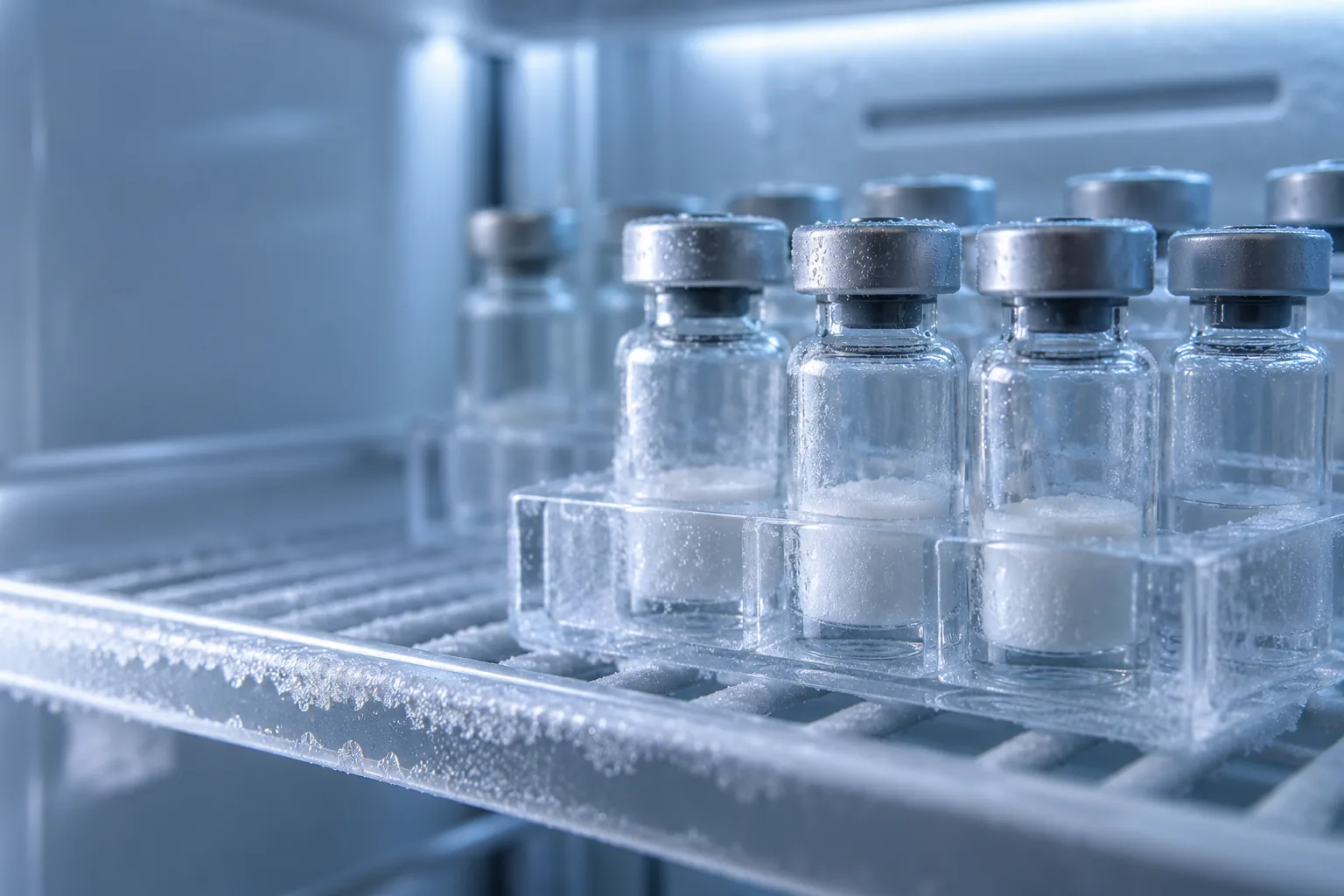
Short answer. Approved peptide medicines each have their own storage rules. Most are kept in a refrigerator at 2 to 8°C (36 to 46°F), never frozen, with a limited time out of the fridge and a limited time after first use. We found no authoritative source that gives storage rules for research peptides, either as powder or after mixing. So what follows is what labels say for approved products, and where that stops.
On this page
What approved labels actually say
These are different products with different formulations. Do not apply one row to another compound.
| Product (peptide) | Before first use | After first use or mixing |
|---|---|---|
| Ozempic (semaglutide) pen | Refrigerator, 2 to 8°C, in the carton. Do not freeze | Pen in use: 56 days, either at room temperature (15 to 30°C) or in the fridge. Protect from light |
| Mounjaro (tirzepatide) pen and single-dose vial | Refrigerator, 2 to 8°C. Do not freeze | Up to 21 days total unrefrigerated at or below 30°C |
| Mounjaro multi-dose vial and KwikPen | Refrigerator, 2 to 8°C. Do not freeze | Discard after 30 days at room temperature, 30 days after first use, or after 4 weekly doses |
| Forteo (teriparatide) pen | 2 to 8°C at all times except when injecting. Do not freeze | Discard each pen 28 days after first use |
| Egrifta WR (tesamorelin), a powder you mix | See the product label | After mixing: discard unused solution 7 days after mixing. Store the mixed solution at 20 to 25°C. Do not freeze |
Two patterns worth noticing
- Freezing is specifically warned against on every approved pen and vial listed here, because freezing can damage the product.
- Mixed products come with a short, specific clock. The Egrifta WR clock is 7 days at room temperature. The multi-dose vial clock for opened vials generally is 28 days unless the maker says otherwise, per the CDC. Neither is a number you can move to a different peptide.
What no authority has published
- How long a research peptide stays good as a dry powder, at what temperature.
- How long it stays good after you mix it, in a fridge or anywhere else.
- Whether the freezer is better, worse or the same for a given powder.
Peptides and proteins can break down chemically and physically. A standard pharmaceutical review (Manning and colleagues, 2010) describes the general mechanisms and how drying and formulation affect stability, but it covers proteins and says stability is specific to each product. Without the manufacturer’s stability data for your exact compound, any day-count is a guess. Compound pages on PeptideBlog.net list what sources report, with their evidence level.
Practical notes that follow from the labels
- Write the mixing date and the exact amount of liquid on the vial. The CDC says opened multi-dose vials should be dated.
- Keep track of how long anything has been out of the fridge. Approved labels count that time.
- If something was frozen, or looks different from when you mixed it, see what looks wrong.
These are habits drawn from how labels are written. They do not make a research peptide’s shelf life known.
Common questions
Can a mixed peptide be frozen?
Every approved label in the table says not to freeze. No authority has published guidance on freezing mixed research peptides.
How long does a mixed peptide last?
It depends on the product. Tesamorelin (Egrifta WR) is labeled for 7 days after mixing. We found no authoritative discard time for mixed research peptides.
How should the powder be stored?
No authority has published storage rules for research peptide powder. Approved products follow their own labels.
Keep reading
- What lyophilized means, and what looks wrongThe freeze-dried cake, and what to check after mixing.
- Bacteriostatic water vs sterile waterWhat is in each bottle and what the labels say.
- How to reconstitute a peptide, step by stepThe sterile-technique steps, and what nobody has established.
- How to read a peptide test report (COA)Purity vs content, endotoxin, and what a report cannot prove.
Sources
- Ozempic prescribing information, Novo Nordisk
- Mounjaro prescribing information, Eli Lilly
- Forteo prescribing information, Eli Lilly
- EGRIFTA WR prescribing information, FDA
- Preventing Unsafe Injection Practices, CDC
- Stability of protein pharmaceuticals: an update (Manning et al., Pharm Res 2010), Pharmaceutical Research
Educational reference, not medical advice. This page describes what public health and regulatory sources say. It does not tell you what to take or do.