
Guides / Mixing and injecting
Subcutaneous injection basics
What "subcutaneous" means, where public health sources say injections go, how to rotate sites, why needles and syringes are never reused, and how to dispose of sharps.
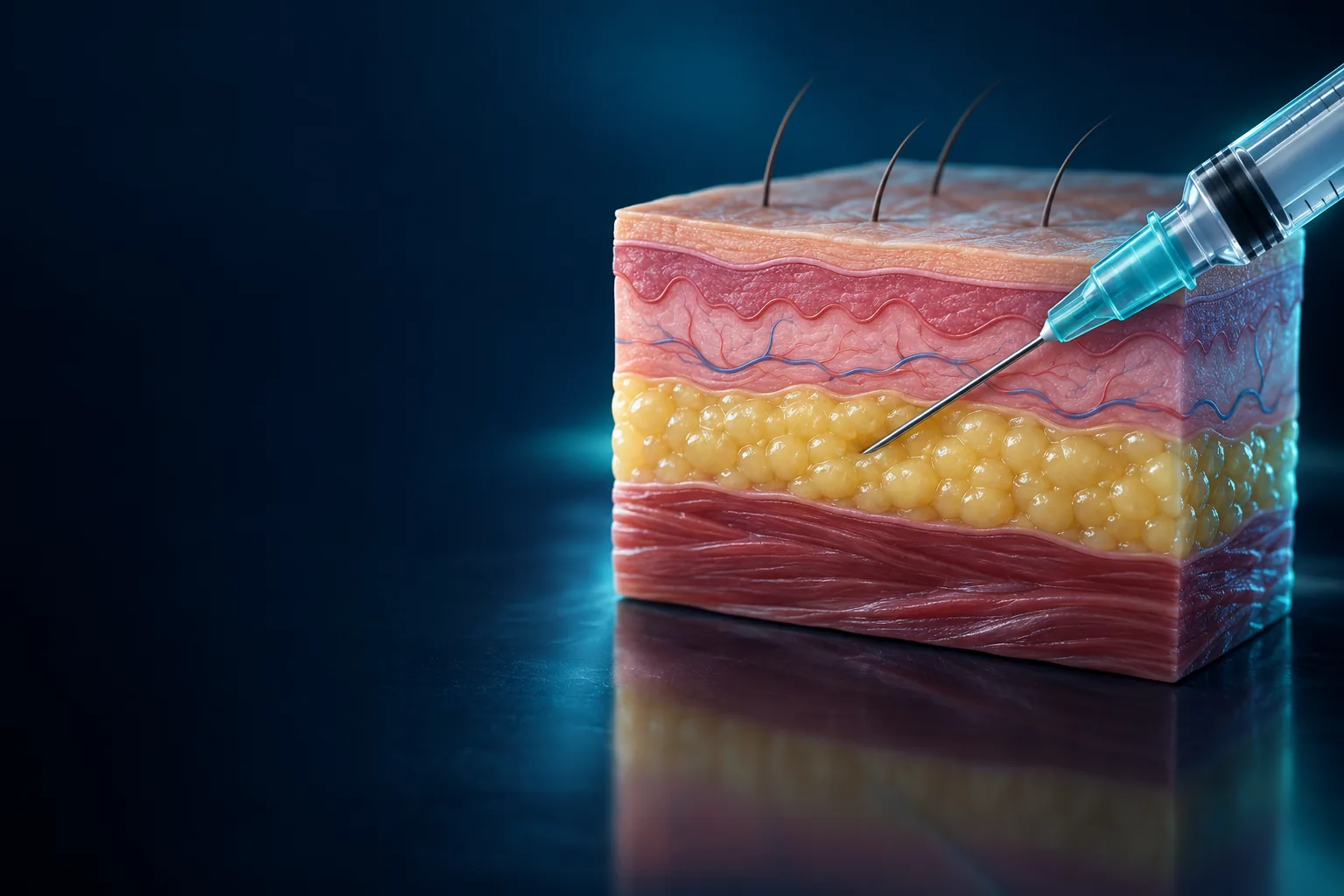
Short answer. Subcutaneous (sub-Q) means into the fatty layer just under the skin, not into muscle or a vein. Sources like MedlinePlus, the CDC and the FDA describe the same basics: clean hands, a clean site, a new sterile needle and syringe every time, a different spot each time, and a sharps container for disposal. This page covers general technique, not what any compound requires.
On this page
What subcutaneous means
Skin sits on top of a layer of fat, and muscle sits under that. A subcutaneous injection puts a small amount of liquid into the fat layer. Many approved peptide medicines, such as semaglutide and teriparatide, are labeled for this route. Whether a given peptide is meant to go this way depends on its own evidence and label. See why most peptides are injected.
Where injections are described as going
MedlinePlus lists the abdomen, upper arm, thigh and hip for insulin and other subcutaneous injections. It says to keep injections at least 1 inch (about 2.5 cm) apart from one another. This is general guidance from a patient-instruction page, and an approved product’s label may name its own sites.
Rotating sites
MedlinePlus says it is important not to always use the same site, because that can reduce how well insulin works. The FDA’s consumer insulin page says not to inject the exact same spot every time because the skin can thicken or thin. The semaglutide patient page says to use a different site for each injection. All three are about approved products, and the same logic is reasonable for any under-the-skin injection. It is not a peptide-specific rule.
The technique steps public sources describe
- Wash your hands. Soap and water for at least 20 seconds, per the CDC.
- Clean the site with alcohol and let it dry. MedlinePlus says this directly.
- Pinch the skin gently to lift the fatty layer.
- Insert the needle at 90 degrees. MedlinePlus says to use 45 degrees if there is little fatty tissue.
- Inject slowly, then withdraw the needle.
- Put the used needle and syringe straight into a sharps container.
Ask a clinician or pharmacist to show you the technique in person if you have never done it. A page cannot replace that, and the right needle length and angle depend on the person and the product.
One needle, one syringe, one time
The CDC states the rule plainly: “One Needle, One Syringe, Only One Time.” Changing only the needle is not enough, because the syringe is contaminated once it has been used. Do not leave a needle sitting in a vial, and do not share any needle, syringe or pen.
Sharps disposal
- The FDA says to put used needles and syringes immediately in a sharps container. It describes an FDA-cleared container, or a heavy-duty household container such as a laundry detergent bottle.
- Never put loose sharps in the trash or recycling.
- Disposal rules differ by place. The FDA directs people to their community and state disposal programs, so check with your local waste authority or pharmacy.
- After an accidental needlestick, the FDA says to wash the area with soap and water and get medical care.
What this page does not cover
It does not cover muscle (intramuscular) injections, injecting into a vein, or what to do about a reaction. A rash, spreading redness, severe pain or other concerning symptom is a question for a licensed clinician, not for a guide. For the syringe itself, see how to read an insulin syringe.
Common questions
How far apart should injection sites be?
MedlinePlus says to keep subcutaneous injections at least 1 inch (about 2.5 cm) apart and to rotate sites.
Can a needle be used more than once?
No. The CDC says one needle, one syringe, only one time.
Where do used needles go?
Straight into a sharps container. The FDA also describes a heavy-duty household container such as a laundry detergent bottle, and says to check community disposal programs.
Keep reading
- How to read an insulin syringe0.3, 0.5 and 1 mL syringes, and why scales differ.
- How to reconstitute a peptide, step by stepThe sterile-technique steps, and what nobody has established.
- Why most peptides are injectedWhy swallowing most peptides does not work well.
- How to store peptidesWhat approved labels say, and where the guidance stops.
Sources
- Subcutaneous (SQ) injections, patient instructions, MedlinePlus, National Library of Medicine
- Diabetes: insulin therapy, MedlinePlus
- Insulin (consumer page), FDA
- Semaglutide injection: drug information, MedlinePlus
- Preventing Unsafe Injection Practices, CDC
- Safely Using Sharps (Needles and Syringes) at Home, at Work and on Travel, FDA
- Disposal of Sharps Outside Health Care Facilities, FDA
Educational reference, not medical advice. This page describes what public health and regulatory sources say. It does not tell you what to take or do.