
Guides / Storage, quality and routes
Why most peptides are injected
Why swallowing most peptides does not work well, how the one approved oral peptide gets around it, and what the evidence does and does not show for other routes.
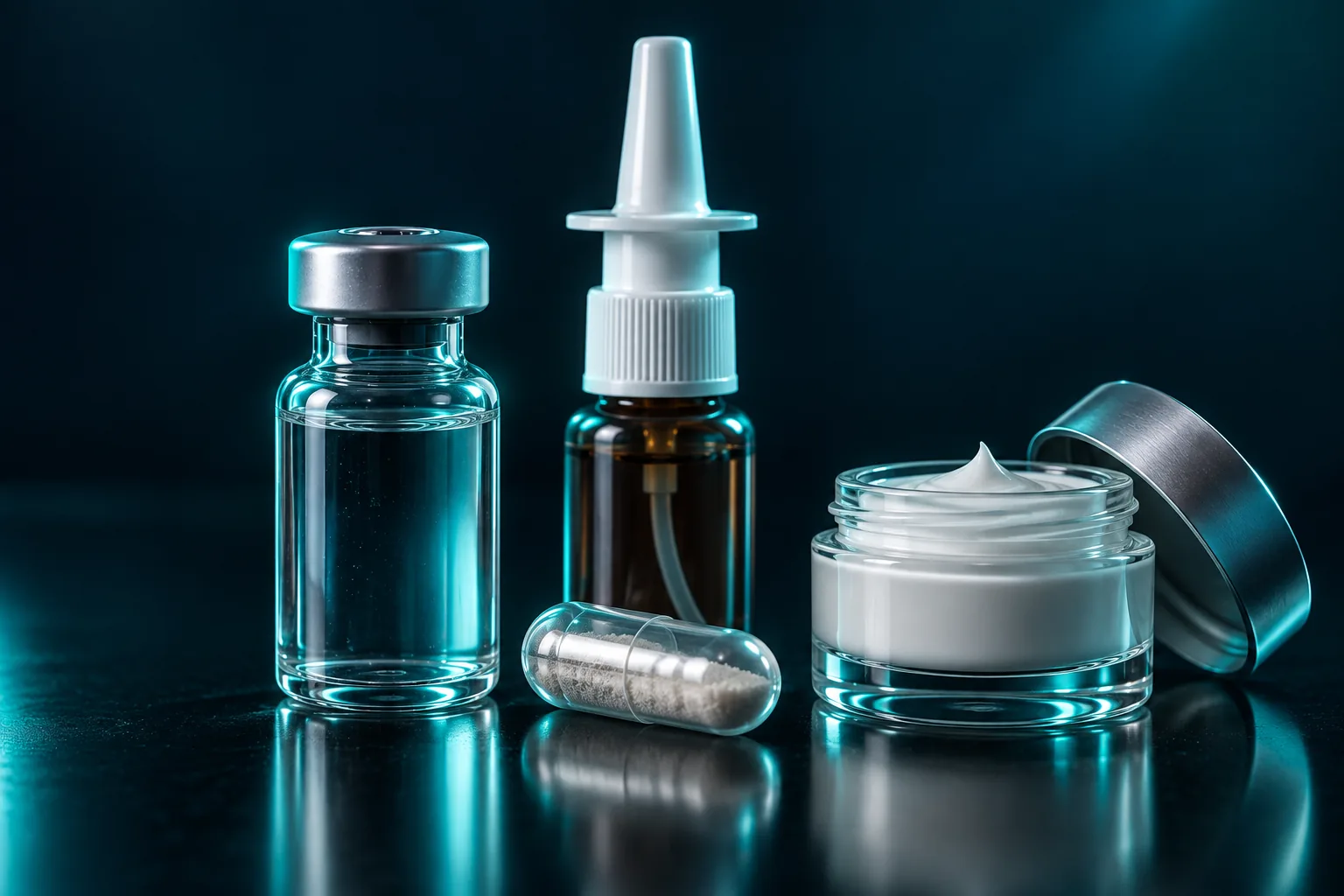
Short answer. Peptides are chains of amino acids, and the digestive system is built to break those chains down and keep large molecules out of the blood. That is why most peptide drugs are given by injection. Oral semaglutide shows it can be done, but only with a special absorption helper and strict rules about timing. For other routes, we found no controlled human evidence for the popular research peptides.
On this page
Why swallowing is a problem
A review of oral peptide therapeutics by Drucker (Nature Reviews Drug Discovery, 2020) explains that most peptide drugs have to be given by injection because digestive enzymes degrade them and because they struggle to cross the gut lining. Researchers have tried many fixes, including absorption enhancers, enzyme blockers and chemical changes to the peptide.
In plain terms: stomach acid and enzymes chop the peptide up, and what survives is often too large to pass through the intestinal wall in useful amounts.
The one approved oral example
Rybelsus is oral semaglutide, a peptide in tablet form. The label sets tight rules: take it on an empty stomach with no more than 4 ounces of plain water, wait at least 30 minutes before eating, drinking or taking other oral medicines, and swallow the tablet whole. Those rules exist because the tablet’s design depends on them. This is a result of a large development program for one specific product. It does not show that other peptides work as capsules, powders or drops.
Other routes: what the evidence shows
| Route | What we found |
|---|---|
| Injection under the skin | The labeled route for many approved peptide drugs. See subcutaneous injection basics |
| Oral (swallowed) | Works for one approved peptide with a special formulation. Generally limited by enzymes and permeability |
| Under the tongue | No controlled human evidence found for the popular research peptides |
| Nasal spray | Some approved peptide products exist, but we did not find controlled evidence for the popular research peptides sold as nasal sprays |
| On the skin (topical) | No controlled human evidence found for absorption of the popular research peptides |
“No evidence found” means our search of public sources turned up none. It does not prove a route cannot work. It does mean claims about those routes rest on something weaker than controlled human data. Compound pages on PeptideBlog.net show the route reported for each source, and its evidence level.
Why this matters for beginners
- A product described as “oral” or “sublingual” can be a different thing from the injectable version, with no data showing it reaches the blood in a useful amount.
- An approved oral peptide’s rules, such as the water and waiting time, belong to that tablet only.
- If a source gives different amounts for different routes, ask what the amount was measured against, and where it came from. See how we grade evidence.
Common questions
Why are most peptides injected?
Digestive enzymes break peptides down and the gut lining blocks large molecules, so most peptide drugs are given by injection.
Does oral semaglutide prove peptides can be swallowed?
It shows it can be done for one product with a special formulation and strict timing rules. It does not apply to other peptides.
Is there evidence for under-the-tongue or skin use?
We found no controlled human evidence for the popular research peptides by these routes.
Keep reading
- Subcutaneous injection basicsSites, rotation, one-time-use rule and sharps disposal.
- How to reconstitute a peptide, step by stepThe sterile-technique steps, and what nobody has established.
- mg, mcg, IU and syringe units explainedmg, mcg, IU and syringe units. They are not interchangeable.
- How to read a peptide test report (COA)Purity vs content, endotoxin, and what a report cannot prove.
Sources
- Advances in oral peptide therapeutics (Drucker DJ), Nature Reviews Drug Discovery
- Rybelsus prescribing information, Novo Nordisk
- Rybelsus approval label (2019), FDA
Educational reference, not medical advice. This page describes what public health and regulatory sources say. It does not tell you what to take or do.