


In a study of 13,725 adults who started semaglutide or tirzepatide in routine care, 17 semaglutide users with a rare, predicted-damaging GLP1R variant lost an average of 2.4 percent of body weight, against 8.8 percent for matched adults without one. Among 19 tirzepatide users with such variants, the figures were 13.3 and 15.2 percent. The paper is observational, the carrier groups are tiny, and 8 of its 21 authors work for the company behind the dataset. It generates a hypothesis. It does not give anyone a reason to be tested or to change a medicine.
Ask PeptideBlog about any peptide
Research snapshot
| Category | Current information |
|---|---|
| Subject | Rare variants in GLP1R, the gene for the receptor that semaglutide and tirzepatide both act on (see the semaglutide entry and the tirzepatide entry) |
| Primary research interest | Whether rare gene variants change weight loss on semaglutide differently from tirzepatide |
| Highest available evidence | Published human observational research (Tier 2): a peer-reviewed real-world cohort with replication in two other datasets |
| Human research available | Yes: one paper with replication cohorts. The paper describes no prospective or genotype-guided trial |
| Development status | A research association. The paper proposes no clinical test |
| Regulatory status | Semaglutide and tirzepatide are each approved on their own. The paper does not address labeling or approval |
What the study did
The paper, “Rare GLP1R variants attenuate weight loss with semaglutide but not tirzepatide,” appeared in Nature Metabolism as a Brief Communication on November 11, 2026. It uses the Helix Research Network (HRN), a program that links exome sequencing (a read of the protein-coding part of a person’s DNA) to health records at North American health systems. The network had sequence data for 351,818 people. From them, the authors picked 13,725 adults with a BMI of 25 or higher who started injectable semaglutide or tirzepatide in routine care and had weights recorded across at least six months.
A variant counted as rare if it occurs in fewer than 1 in 1,000 people. Three kinds counted as predicted damaging. Loss-of-function variants (stop-gained, frameshift or canonical splice changes) break the gene outright. Missense variants swap one amino acid for another, and two computer scores, AlphaMissense and REVEL, rated how likely the swap is to harm the protein. A second, weaker tier was labeled “possibly damaging.” The main analysis combined all three. Non-carriers had no rare coding variant of any kind in the gene.
Each carrier was matched to up to 10 non-carriers with the same drug, dose category, sex, genetic similarity group, type 2 diabetes status and earlier GLP-1 use, plus similar starting BMI and follow-up time. The outcome was the percentage change from starting weight to each person’s lowest recorded weight between 6 and 12 months. That measures the best weight reached, not the weight at a fixed date. Evidence label: published human observational research (Tier 2).
The main result, with carrier counts
| Group | Carriers | Carriers: average loss | Matched non-carriers: average loss | Ratio (P value) |
|---|---|---|---|---|
| Either drug | 33 | 8.2% | 12.5% (274 people) | 0.65 (P = 0.0007) |
| Semaglutide | 17 | 2.4% | 8.8% (149 people) | 0.27 (P = 0.0007) |
| Tirzepatide | 19 | 13.3% | 15.2% (154 people) | 0.88 (P = 0.23) |
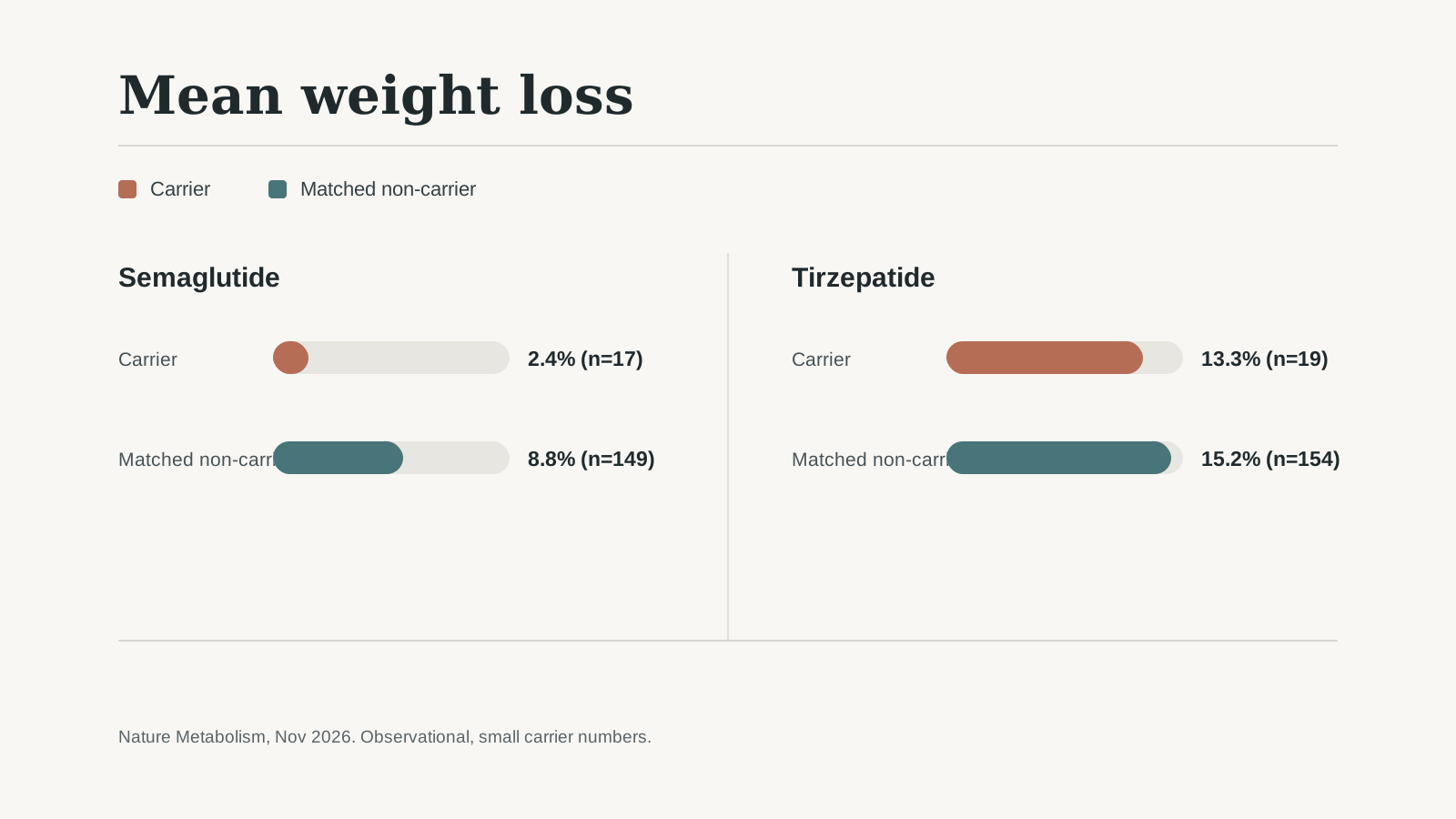
The ratio is the carriers’ average loss divided by the non-carriers’. A ratio of 0.27 means carriers lost about a quarter as much. On semaglutide that is a gap of 6.4 percentage points of body weight (8.8 minus 2.4). On tirzepatide it is 1.9 points (15.2 minus 13.3). Both differences are this page’s arithmetic from the paper’s group averages.
The test of whether the two drugs differ gave a carrier-by-drug interaction of minus 4.4 percentage points (95 percent confidence interval minus 7.7 to minus 1.1, P = 0.009). The same test in a whole-cohort analysis restricted to people of European genetic similarity gave P = 0.085, which is not significant. The overall effect looks real. How different the two drugs are is less settled.
Who the 33 carriers are
| Variant class | Carriers |
|---|---|
| Predicted loss of function (pLoF) | 6 |
| Predicted damaging missense | 5 |
| p.Arg421Trp (rs146868158), a single missense variant | 15 |
| Other possibly damaging missense | 7 |
Fifteen of the 33 carriers, about 45 percent, share one variant. p.Arg421Trp is very rare (allele frequency 0.045 percent in the gnomAD database) and the computer scores rate it only “possibly damaging” (AlphaMissense 0.150, REVEL 0.304). The authors include it because they cite earlier cell experiments showing it weakens receptor signaling in response to GLP-1 and to drugs in the class. On its own it showed a ratio of 0.38 on semaglutide and 1.13 on tirzepatide (interaction P = 0.027). The 7 other possibly damaging carriers gave 0.44 and 0.97 (interaction P = 0.015).
So a third to a half of the signal rests on one variant that the computer scores doubt. The cleanest biology, genes that are plainly broken, comes from the 6 pLoF carriers plus the 5 predicted damaging missense carriers: 11 people across both drugs, with a combined ratio of 0.46 (95 percent confidence interval 0.20 to 0.72). The authors also report that carriers of missense variants predicted to be tolerated showed no attenuation, which works as a negative control, although the text gives no counts or numbers for that group.
Is “but not tirzepatide” fair?
The paper’s title says the loss of weight was attenuated with semaglutide “but not tirzepatide.” The data support a narrower statement: the tirzepatide gap is smaller and not statistically distinguishable from zero in 19 people. Several things keep “preserved” from being the right word.
The tirzepatide point estimate is still below 1 (0.88), meaning carriers lost 12 percent less on average. Nineteen people cannot rule out a modest effect, and the P value of 0.23 says only that chance could explain a gap this size. In the most severe variant class, tirzepatide carriers had a ratio of 0.67 (P = 0.015), which the authors call a trend in a small subgroup and describe as hypothesis-generating. Across other cuts the tirzepatide numbers scatter around 1: 0.96 in the European-similar analysis, 1.13 for p.Arg421Trp, 0.97 for the other possibly damaging variants and 1.19 in the second Helix cohort. A single clean pattern does not emerge from 19 people.
That leaves a cautious reading. Semaglutide carriers lost much less in every dataset checked, and tirzepatide carriers lost somewhat less or about the same depending on the cut. A real difference between the drugs is plausible. Proof that tirzepatide is unaffected is not on offer.
Mostly different people, and not a switching study
The two drug comparisons were run separately: semaglutide starters matched to semaglutide non-carriers, tirzepatide starters matched to tirzepatide non-carriers. Follow-up stopped if someone switched drugs. The 17 semaglutide carriers and 19 tirzepatide carriers are largely different people. They are not the same group of people measured twice.
The overlap is not zero. The Methods allow someone who used both drugs one after the other to contribute an episode to each drug-specific analysis, and 17 plus 19 is 36 against 33 carriers overall, so at least 3 carriers must appear in both rows (this page’s arithmetic). The paper does not report how many. It also does not compare a person’s own weight loss on semaglutide with their weight loss on tirzepatide. The study therefore cannot say what happens when a carrier who responded poorly to one drug moves to the other.
Replication: small, consistent in direction, mostly internal
| Dataset | Semaglutide carriers | Tirzepatide carriers |
|---|---|---|
| Second group from the same network (3,969 semaglutide and 4,144 tirzepatide users) | 7 carriers: loss of 4.1% vs 7.5% (ratio 0.54, P = 0.004) | 11 carriers: ratio 1.19 (P = 0.43); drug interaction P = 0.036 |
| All of Us research program (4,432 semaglutide users) | 8 carriers: loss of 2.6% vs 5.7% (ratio 0.46, P = 0.12) | 1 carrier among 332 users, so no analysis |
| Whole-cohort regression, European genetic similarity (about 11,300 people) | Ratio 0.42 (P = 0.005) | Ratio 0.96 (P = 0.80); drug interaction P = 0.085 |
The second group is internal validation, because it comes from the same research network. Only All of Us is an outside dataset, and its 8 carriers did not reach statistical significance. Seven and eight people can point in a direction. They cannot confirm a size.
The GIPR comparison and the GIP idea
Semaglutide acts only on the GLP-1 receptor. Tirzepatide acts on that receptor and on a second one, the GIP receptor, whose gene is GIPR. The authors raise the possibility that the second route partly compensates when the GLP-1 receptor is weak. They label it speculative and say direct experimental testing is needed. This study did not test it.
The authors did check GIPR. There were 63 rare-variant carriers (12 loss-of-function, 19 predicted damaging missense, 32 possibly damaging), 60 of them matched to 438 non-carriers. The overall ratio was 0.85 (95 percent confidence interval 0.70 to 0.99, P = 0.043), and the paper notes it did not hold up after adjusting for population structure. In the high-confidence group (loss-of-function plus predicted damaging) the ratio was 1.04 (0.87 to 1.21). Ratios were 0.83 on semaglutide and 0.85 on tirzepatide, with no difference between drugs (interaction P = 0.68). Neither replication cohort showed a drug-specific GIPR effect.
Two readings of that null matter. The faint overall signal came from the lower-confidence variant tiers, so only the high-confidence null is clean. And the GIPR result asks whether broken GIP receptors blunt either drug, which is a different question from whether GIP signaling rescues a weak GLP-1 receptor. In this page’s reading, the GIPR data neither support nor refute the compensation idea.
Higher-dose subgroups
The paper also reports results by dose. Among semaglutide users at 1.7 mg or more, the carrier ratio was 0.41 (P = 0.044). Among tirzepatide users at 10 mg or more, it was 0.84 (P = 0.18). The text does not give how many carriers sit in these subgroups, so these should be read as hints. These figures document what the paper reported and are not recommendations or personal instructions. For the dose schedules themselves, see the semaglutide dosage page and the tirzepatide dosage page. Evidence label: published human observational research (Tier 2).
How this differs from the April 2026 23andMe study
In April 2026, Su and colleagues at the 23andMe Research Institute published a genome-wide association study in Nature (volume 653, pages 770 to 775). It asked a different question: which common DNA differences, carried by many people, nudge weight loss up or down. The Helix paper asks what happens in the few people who carry a rare variant that may disable the receptor. Helix also checked the April paper’s lead variant in its own data and found the same direction.
| Feature | Helix paper (Nature Metabolism, Nov 2026) | 23andMe paper (Nature, Apr 2026) |
|---|---|---|
| Variants studied | Rare coding variants in GLP1R and GIPR, each under 0.1% frequency, predicted damaging | Common variants across the genome. Lead GLP1R variant: p.Pro7Leu (rs10305420) |
| Data source | Exome sequencing linked to health records at 13 health systems | An online survey of 23andMe research participants (launched August 2024) |
| Weight data | Weights recorded in routine care, lowest value at 6 to 12 months | Self-reported. In 195 people with both, self-report averaged 14.14% loss against 8.43% in records |
| Size | 13,725 treated adults; 33 GLP1R carriers (17 on semaglutide, 19 on tirzepatide) | 27,885 people; 15,237 of European ancestry in the weight-loss analysis |
| Main GLP1R weight result | Carriers lost less: 2.4% vs 8.8% on semaglutide, 13.3% vs 15.2% on tirzepatide | Each T allele at rs10305420 linked to 0.641% more BMI loss, about 0.76 kg (P = 2.9 x 10^-10) |
| Direction | Damaging variants, less weight loss | Common variant, somewhat more weight loss |
| GIPR | No drug-specific weight effect (interaction P = 0.68); faint overall signal did not survive adjustment for population structure | rs1800437 (p.Glu354Gln) tied to vomiting on tirzepatide only, about 1.8 times the odds; not to weight loss |
| Replication | Second network cohort; All of Us (8 semaglutide carriers, P = 0.12) | All of Us (P = 0.001); not UK Biobank, which the authors say was underpowered |
| Authors | 8 of 21 are Helix employees | Authors are affiliated with the 23andMe Research Institute |
Helix reports that p.Pro7Leu, which has an allele frequency of 36 percent in its cohort, points the same way in its data: a ratio of 1.05 per T allele in people of European genetic similarity (95 percent confidence interval 1.02 to 1.09, P = 0.0047). It also reports a second common variant, p.Ala316Thr (rs10305492, frequency 1.7 percent), linked to a lower response of 0.87 per allele in that group (P = 0.00036). In All of Us the direction matched but did not reach significance (0.77, interval 0.51 to 1.04, P = 0.091, 89 carriers).
The size of the effects differs sharply. A 0.64 percent gain per allele is a small nudge spread across many people. A gap of 6.4 points on semaglutide in carriers is roughly ten times larger, but it sits in 17 people. That comparison is this page’s arithmetic, across two different designs. The April authors also described the overall genetic effects on weight loss as modest, with a model combining clinical and genetic factors explaining about 25 percent of the variation, most of it non-genetic.
How common are these variants, and what does that say about non-responders?
Thirty-three carriers among 13,725 treated adults is about 0.24 percent, or roughly 1 in 400. The paper itself says about 0.2 percent of treated people, and cites aggregate frequencies of about 0.1 to 0.4 percent in population cohorts. The study was designed to find carriers, not to explain why a given person responds poorly.
If rare GLP1R variants affect about 1 in 400 treated adults, they cannot account for most cases of a weak semaglutide response. The paper does not claim to explain non-response in general, and it does not define non-response. Many other factors that this study did not measure may matter, and the April study found that most of the explainable variation was non-genetic.
Limits the authors name
- The carrier groups are small, especially within each drug.
- Adherence and weights from routine care are imperfect, and unmeasured differences between carriers and non-carriers may remain after matching.
- The carriers are mostly of European genetic similarity, and the authors call for more treated carriers from other ancestries.
- Computer predictions of harm are less reliable for receptors of this type (G protein-coupled receptors), and non-coding and structural variants were not assessed. The authors reason that mislabeled variants should dilute an effect rather than create one.
- With many subgroup comparisons on 11 to 19 people, a P value of 0.015 or 0.044 deserves caution. That comment is this page’s, not the paper’s.
Who ran it and who paid
The paper has 21 authors. Its competing-interests statement names 8 of them as Helix employees, and the other authors, who are listed with partner health systems and universities, declare no competing interests. The authors state they received no specific funding. Helix runs the research network that supplied the data. The data are not public: qualified researchers can request de-identified data through the network’s governance process, and All of Us data are available to registered researchers. The peer-review file is listed with the paper.
What the study does not show
- It does not show that a person with a weak semaglutide response carries one of these variants. About 1 in 400 treated adults did.
- It does not test switching. Follow-up stopped at a switch, and the drug comparisons are made between different people’s treatment episodes.
- It does not show tirzepatide is unaffected, for the reasons above. The authors write that carriers “may be preferentially suited to tirzepatide or other agents engaging non-GLP-1R pathways.” No trial has tested that, and this page does not endorse it.
- It does not demonstrate that GIP signaling compensates. That is the authors’ stated hypothesis.
- It does not prove the variants caused the difference. It compares routine-care records and is not a trial.
- It does not support genetic testing before treatment. The paper recommends no testing or switching protocol and describes no outcomes of genotype-guided care.
- It does not cover other drugs. Only semaglutide and tirzepatide were studied. Whether the pattern applies to other medicines that act on the GLP-1 receptor, such as retatrutide or survodutide, has not been tested.
Regulatory and development status
The paper reports a research association and proposes no clinical test. Semaglutide and tirzepatide are approved on their own, and nothing in the paper changes that. The findings are as of the November 11, 2026 publication.
Frequently asked questions
Do rare GLP1R variants reduce weight loss on semaglutide?
In this study, yes: 17 carriers lost an average of 2.4 percent of body weight against 8.8 percent in matched non-carriers. The result pointed the same way in a second network cohort (7 carriers) and in All of Us (8 carriers, not statistically significant). The groups are small and the data are observational.
Do these variants affect tirzepatide?
The 19 tirzepatide carriers lost 13.3 percent against 15.2 percent, a gap that chance could explain. The most severe variant class showed a ratio of 0.67 (P = 0.015) that the authors call a trend. The evidence cannot say that tirzepatide is unaffected.
Does this mean tirzepatide works for semaglutide non-responders?
The study did not test that. It compared carriers with non-carriers within each drug, and it did not follow people through a switch. A different study design would be needed.
How common are rare GLP1R variants?
About 0.2 percent of treated adults in this study, which is 33 of 13,725. The paper cites 0.1 to 0.4 percent in population cohorts.
How is this different from the 23andMe GLP-1 genetics study?
The 23andMe study (Nature, April 2026) looked at common variants using self-reported survey data from 27,885 people and found a GLP1R variant linked to somewhat more weight loss. The Helix study looks at rare, predicted-damaging variants using sequencing linked to health records, and finds less weight loss in carriers, mainly on semaglutide.
Is there a genetic test that predicts GLP-1 response?
This paper does not describe one, and its authors do not recommend a testing or switching protocol. They say the work shows how sequencing combined with treatment records could support precision approaches in the future.
Does dose change the picture?
Among semaglutide users at 1.7 mg or more the carrier ratio was 0.41 (P = 0.044), and among tirzepatide users at 10 mg or more it was 0.84 (P = 0.18). The subgroup sizes were not in the text, so these are hints only.
Who funded the study?
The authors report no specific funding. Eight of the 21 authors are Helix employees, and Helix runs the research network behind the data.
Bottom line
This is a credible first look at an interesting question. The semaglutide signal is large, appears in three datasets and fits the biology: a damaged GLP-1 receptor should matter most for a drug that uses only that receptor. The size of the effect rests on 17 people, and about 45 percent of all carriers share one variant that computer scores doubt.
The tirzepatide story is weaker than its title. The data show a smaller gap that is still there, plus a trend in the most severe class. The GIP explanation remains the authors’ hypothesis, the GIPR data do not test it, and the study is not a switching study. It supports no testing, no drug change and no claim about non-responders. A larger sequenced cohort, a within-person comparison or a prospective trial would settle more than this paper can. Educational reference only: this page documents what a published study reported and does not tell any reader what to take.
Sources
- Levy ME, Schiabor Barrett KM, Telis N, et al. (21 authors; last author Cirulli ET). Rare GLP1R variants attenuate weight loss with semaglutide but not tirzepatide. Nature Metabolism. Brief Communication, open access. Published online November 11, 2026. https://www.nature.com/articles/s42255-026-01656-z (DOI 10.1038/s42255-026-01656-z). Evidence category: published human observational research (Tier 2), peer reviewed, company-affiliated authors.
- Su QJ, Ashenhurst JR, Xu W, et al. Genetic predictors of GLP1 receptor agonist weight loss and side effects. Nature. 2026;653:770-775. Published online April 8, 2026. https://www.nature.com/articles/s41586-026-10330-z (DOI 10.1038/s41586-026-10330-z). Evidence category: published human observational research (Tier 2), genome-wide association study with self-reported outcomes, authors affiliated with the 23andMe Research Institute.
Related reading on this site: the CAMEO-SEMA analysis and the TOGETHER-PsA analysis read other single studies the same way. On The Weight Loss Atlas: the semaglutide guide on The Weight Loss Atlas, the tirzepatide guide on The Weight Loss Atlas, and what the labels and studies say about switching between Wegovy, Zepbound and Mounjaro.
Update history: November 11, 2026, first version, based on the Nature Metabolism paper published that day.