
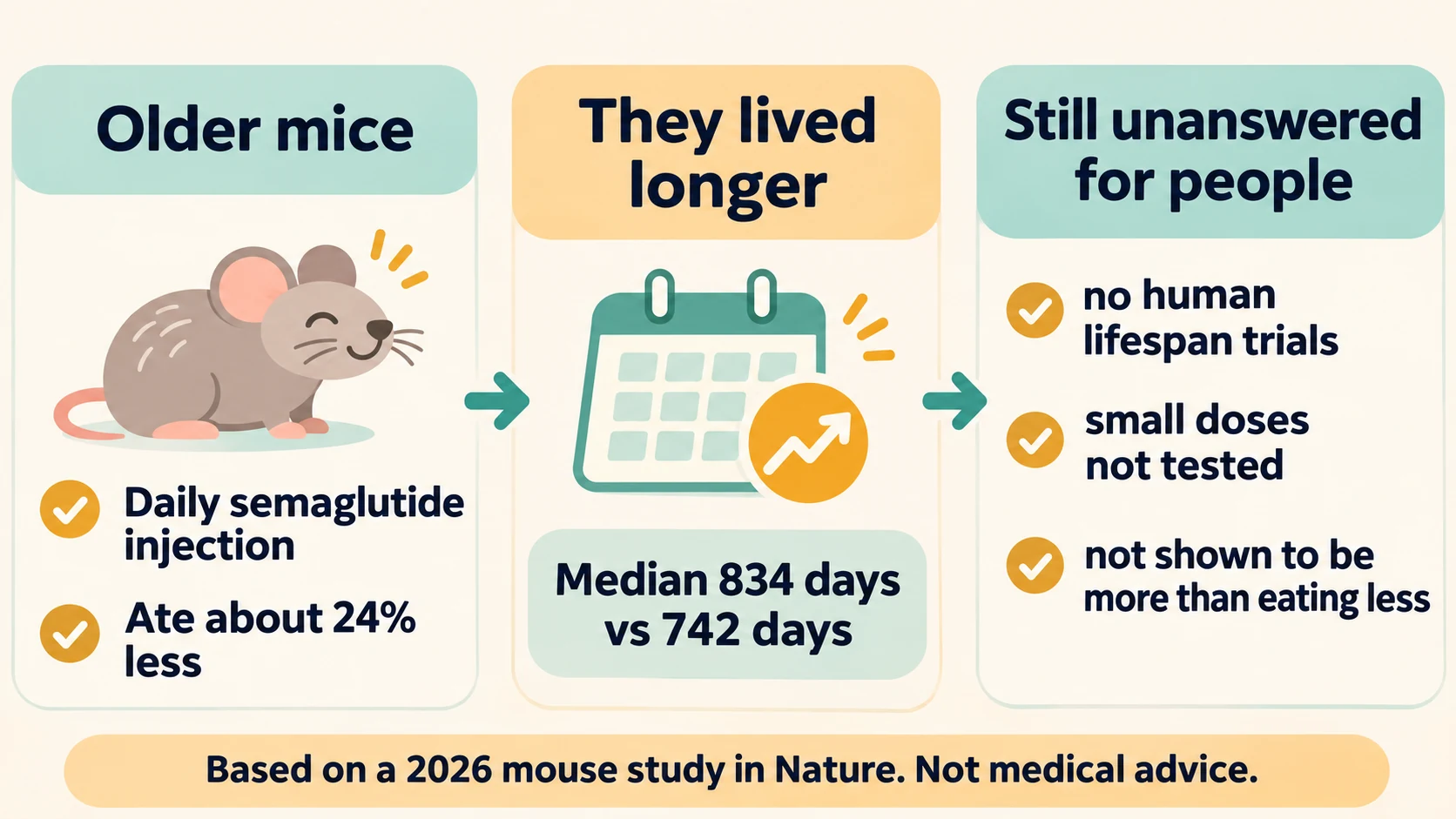

Short answer: A September 2026 study in Nature found that daily semaglutide extended the median lifespan of old female mice from 742 to 834 days, about 12 percent. The dose was large enough to cut food intake by 24 percent, so it was a full pharmacologic dose and not a microdose. No human lifespan data exist, and the study cannot say whether the effect goes beyond eating less.
Ask PeptideBlog about any peptide
Research snapshot (as of Nov 12, 2026)
| Category | Current information |
|---|---|
| Study | Feng et al., Nature 657(8131):469-476, published Sept 2, 2026 (DOI) |
| Evidence tier | Tier 3: published animal evidence |
| Species and sex | Female C57BL/6 mice, treatment started at 20 months old |
| Human data | None on lifespan or aging |
| Microdosing tested | No |
| Regulatory status | Semaglutide is approved for diabetes and weight management. Nothing is approved for slowing aging. |
| Last reviewed | November 12, 2026 |
What the study actually tested
The corresponding author is Danica Chen at UC Berkeley, and the paper appeared in Nature on September 2, 2026. According to the NIH release, the work was NIH funded. The authors treated old female mice with semaglutide and followed them in three ways: a lifespan group, a three-month function cohort, and a separate comparison against calorie restriction.
| Design element | What the paper reports |
|---|---|
| Animals | Female C57BL/6 mice from the National Institute on Aging, starting at 20 months old. Females were used to avoid injuries from male fighting. |
| Drug and route | Semaglutide, 10 nmol/kg, one subcutaneous injection daily |
| Effect on eating | Food intake fell by 24 percent, with lower body weight and fat mass |
| Lifespan arm | 39 saline mice vs 40 semaglutide mice, treated until death |
| Lifespan result | Median 742 days (saline) vs 834 days (semaglutide), about 12 percent longer |
| Function cohort | Separate three-month cohort, with tests of open-field activity, Barnes maze, rotarod, inverted screen, treadmill and glucose tolerance |
| Calorie restriction comparison | Separate cohort, 10 mice per group, 5 months, restriction matched to the 24 percent drop in intake. No lifespan group. |
| Safety | No adverse effects attributable to semaglutide in the endpoints the authors monitored |
The amount is shown in the units the paper used, for a mouse. It has not been converted to a human amount, and this page does not give one. Mouse metabolism and drug handling differ from ours, and crude scaling would be a guess presented as a number.
What it found
- Lifespan: semaglutide-treated mice lived longer, with median survival of 834 days against 742 days on saline. The exact test result is in the paper’s figure.
- Function: in the three-month cohort, treated mice did better on the movement, memory, strength and glucose tests listed above, with lower markers of inflammation and cell senescence, higher NAD+ and lower IGF1.
- Against calorie restriction: many outcomes were comparable. Semaglutide did better on open-field centre time, Barnes maze and glucose tolerance.
- Authors’ framing: they call semaglutide a calorie restriction mimetic, and say that whether it slows aging or extends lifespan in people needs long-term clinical studies.
In plain terms, this is a well-run mouse study that points the same way as calorie restriction research. It is one study in one sex of one strain, and its own authors say the human question is open.
Claims people make versus what this study tested
| Claim you may see | What the study tested | Verdict |
|---|---|---|
| Semaglutide extends lifespan | Female mice, 39 vs 40, daily injection from 20 months | Supported in this mouse model only |
| Microdosing GLP-1 helps you live longer | A dose that cut food intake by 24 percent | Not tested. This was not a low dose. |
| It works independently of calories or weight loss | Lifespan arm had no calorie-restricted group. The physiology comparison was 10 mice per group over 5 months. | Not shown for lifespan. Some physiology measures differed from calorie restriction. |
| It reverses aging | Better scores on some function tests and lower aging markers | Overstated. The authors raise the possibility of reversing decline in some measures only. |
| It works in people, or in men | Female mice only | Not tested. The authors call for long-term clinical studies. |
| It is safe long term | No attributable adverse effects in monitored endpoints in mice | Narrow, and not a human safety finding |
The calorie restriction problem
Calorie restriction is the best-known way to extend lifespan in lab animals. The headline question is whether semaglutide does something more than make animals eat less.
The paper gives a partial answer. In the separate five-month cohort, restriction was matched to semaglutide’s 24 percent drop in intake, and the two groups looked alike on many outcomes. Semaglutide came out ahead on three: open-field centre time, Barnes maze performance and glucose tolerance. The abstract says this reveals effects beyond those attributable to reduced calorie intake.
That conclusion rests on a small physiology comparison. There were 10 mice per group, the follow-up was five months, and nobody tracked survival in the calorie-restricted animals. So the study does not show that semaglutide lengthens life by a route other than eating less, and a reader who needs that answer should treat it as open.
Is there a low-dose aging study?
Yes, and it is a different experiment. A Hong Kong team at the Chinese University of Hong Kong published in Cell Metabolism on November 19, 2025 (DOI). They treated aged male mice with a GLP-1 receptor agonist from 11 months of age for 30 weeks. The abstract says the dose was relatively low and minimally affected food intake or body weight. The paper lists exenatide among its keywords.
| Feature | Feng et al., Nature 2026 | Huang et al., Cell Metabolism 2025 |
|---|---|---|
| Drug | Semaglutide | A GLP-1 receptor agonist (exenatide is a listed keyword) |
| Sex | Female | Male |
| Dose effect | Cut food intake by 24 percent | Minimal effect on food intake or body weight |
| Main readouts | Lifespan, function tests, aging markers | Multi-omic aging signatures and selected physical functions |
| Lifespan reported | Yes, in mice | Not in the abstract |
| Evidence tier | Tier 3: animal | Tier 3: animal |
Taken together, one mouse study found a lifespan effect at a full dose, and another found molecular changes at a low dose in a different drug and sex. Neither tested microdosing in people, and neither shows that a low dose extends life.
The human evidence gap
- No randomized trial tests GLP-1 drugs for lifespan or for slowing aging in humans.
- PB’s semaglutide dosage page found no label, randomized trial or registered trial that supports microdosing. The main study it identified is observational, in people who kept filling 0.25 mg prescriptions.
- Cardiologist Eric Topol called microdosing a craze that is not substantiated, and Daniel Drucker said there is no consensus on what a microdose is, both as reported by The Independent in September 2025 from a Washington Post story.
- Lilly told The Independent that splitting doses of Zepbound and Mounjaro is not covered by the FDA label and may carry safety risks. That statement is about Lilly’s products, not semaglutide.
For where these drugs sit in practice, see PB’s piece on off-label and lifestyle use of GLP-1 drugs. Treated mice lost fat mass along with weight, which raises the human question of what happens to muscle. That is covered in what happens to muscle when GLP-1 drugs get more powerful.
What circulates online versus what studies used
Online discussion of GLP-1 microdosing uses a range of fractions and schedules, and there is no agreed definition of the term. No established or reliably sourced dosing information for lifespan or longevity use was identified, and this page does not offer any. The only longevity-related amount in the literature reviewed here is the mouse figure above, which is not a human amount.
| Source | What it used | Evidence class |
|---|---|---|
| Feng et al., Nature 2026 | 10 nmol/kg daily in mice, a dose that cut intake by 24 percent | Published animal research |
| Huang et al., Cell Metabolism 2025 | A relatively low dose of a GLP-1 agonist in male mice, with minimal effect on intake or weight | Published animal research |
| Online microdosing discussions | Varied, with no shared definition | Community reported, no identifiable original source |
Limits of this analysis
- This page used the paper’s text and the abstract. The competing interests statement, extended data figures and peer review file were not read.
- The statistical value for the lifespan comparison sits in a figure and is not quoted here.
- The calorie restriction comparison is physiology only. A matched calorie-restriction lifespan group does not exist in this paper.
- The Huang et al. summary comes from its abstract.
- Press quotes are secondary sources. They are included to show the range of expert caution, not as evidence.
Frequently asked questions
Does semaglutide extend life?
In one mouse study, yes: old female mice lived about 12 percent longer on median. No study has shown it in people.
Does microdosing GLP-1 help you live longer?
Not tested. The mouse study used a dose that reduced food intake by 24 percent, and PB found no label, randomized trial or registered trial that supports microdosing.
Was the semaglutide lifespan study done in humans?
No. It used female C57BL/6 mice that were 20 months old at the start.
Is semaglutide a calorie restriction mimetic?
The authors describe it that way. Their calorie-restriction comparison was a five-month physiology study, so it does not settle the question for lifespan.
What dose of semaglutide was used in the mouse study?
The paper used 10 nmol/kg by daily subcutaneous injection in mice. That is a mouse figure and not a human amount.
Has anyone studied low-dose GLP-1 and aging?
A Cell Metabolism paper from Hong Kong tested a relatively low dose of a GLP-1 agonist in aged male mice and reported molecular aging effects. It did not report lifespan in its abstract.
Bottom line
The semaglutide lifespan result is real, and it is a mouse result. It came from a full pharmacologic dose in old females, and it cannot show that microdosing does anything. The calorie restriction question is partly answered for physiology and unanswered for lifespan. The human question needs trials that do not yet exist. PB found no reliable dosing information for longevity use, and everything online beyond the mouse figures is unverified.
Sources
| Source | Authors or organization | Publication | Date | Category |
|---|---|---|---|---|
| Late-life semaglutide treatment slows ageing and extends lifespan in female mice | Feng Y et al. | Nature 657(8131):469-476 | Sept 2, 2026 | Published animal research |
| Body-wide multi-omic counteraction of aging with GLP-1R agonism | Huang J et al. | Cell Metab 37(12):2362-2380 | Nov 19, 2025 | Published animal research |
| GLP-1 treatment late in life extends lifespan in animal model | National Institutes of Health | NIH news release | Sept 2026 | Institutional release |
| Scientists say there is no link between microdosing weight-loss drugs and living longer | The Independent, citing the Washington Post | News report via Yahoo | Sept 4, 2025 | News, expert commentary |
Update history: November 12, 2026, first version.