

Quick answer: REDEFINE 9 gave adults without diabetes CagriSema at 1.7 mg/1.7 mg or 1.0 mg/1.0 mg once weekly for 68 weeks. Both groups lost about 19 to 21 percent of body weight, depending on how Novo Nordisk counted. Which dose came out ahead changes with the method, and the trial was not designed to compare them. It also had no group on the 2.4 mg/2.4 mg dose in the pending FDA application.
Ask PeptideBlog about any peptide
Updated 14 November 2026. Company-reported results from Novo Nordisk’s release, published the same day in The Lancet Diabetes & Endocrinology. The paper itself was not read for this article; see “What this article did not check” below.
What was studied
Figures below summarize amounts and schedules reported in published research or circulating online. Listing a figure documents what is reported; it is not a recommendation and does not show a regimen is safe, effective, or appropriate for any person.
| Trial | Regimens studied (mg of cagrilintide / mg of semaglutide, once weekly) | Duration | Route | Population | Source category |
|---|---|---|---|---|---|
| REDEFINE 9 (NCT06388187) | 1.7/1.7 and 1.0/1.0, each against placebo | 68 weeks | Subcutaneous | 309 adults per Novo (the registry lists 300), obesity or overweight with a weight-related condition, no diabetes | Company-reported phase 3, same-day journal publication (paper not read) |
| REDEFINE 1 (NCT05567796) | 2.4/2.4 | 68 weeks | Subcutaneous | 3,417 adults, no diabetes | Published human clinical trial (Tier 1), NEJM 2025 |
Amounts are per component and per weekly administration. The titration schedule for the lower doses is not in the sources that could be read. These figures are not converted or combined with anything else. For the full list of amounts studied for the amylin component, see the cagrilintide dosage page.
The results, both ways
REDEFINE 9 randomized people 2:1:2:1 to CagriSema 1.7/1.7, its placebo, CagriSema 1.0/1.0, or its placebo. The two placebo groups were pooled, giving analysis groups of 104, 103 and 102. Everyone got lifestyle support. The average starting weight was 109.5 kg.
| Average weight change at week 68 | CagriSema 1.7/1.7 | CagriSema 1.0/1.0 | Placebo |
|---|---|---|---|
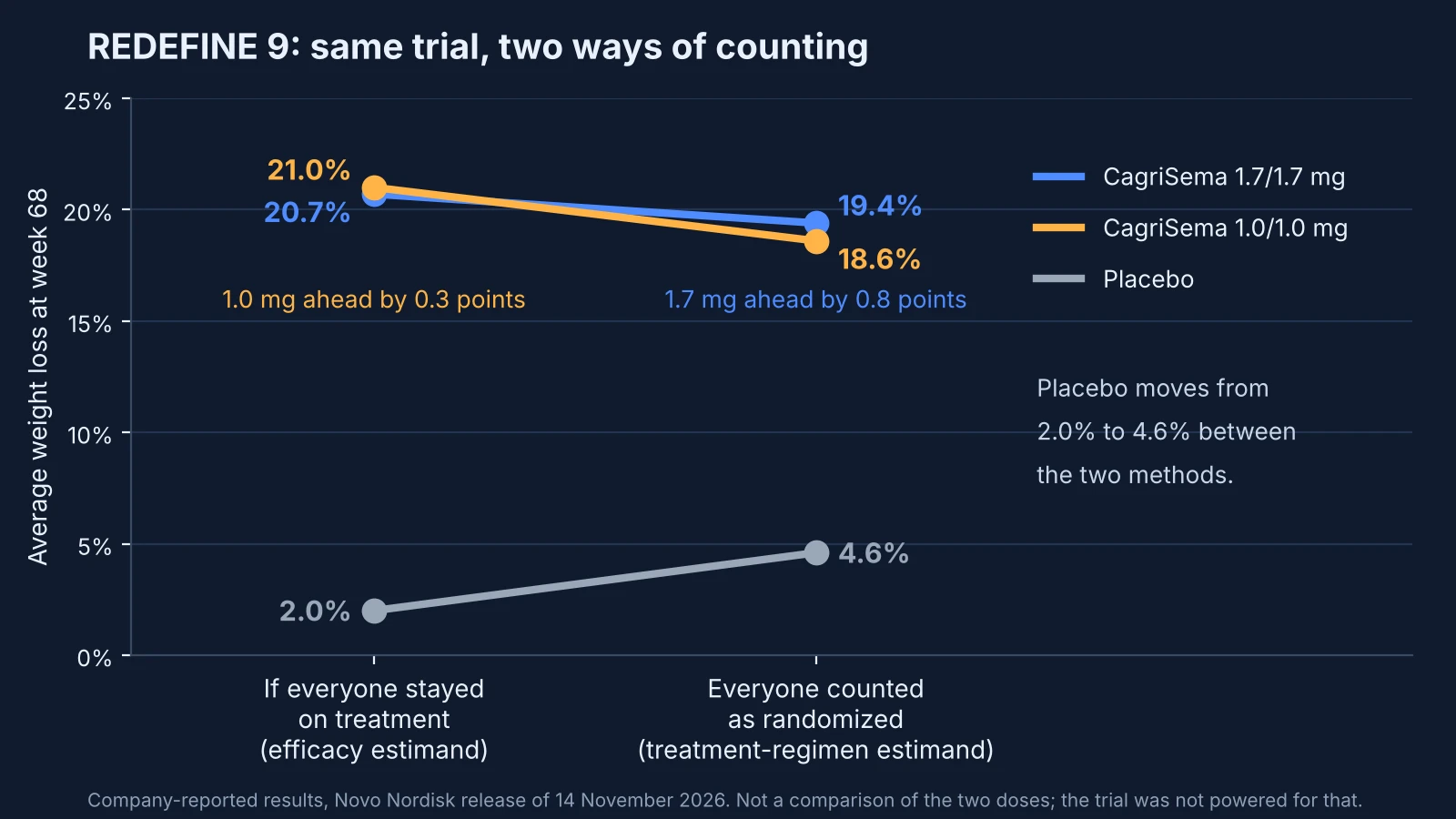
| If everyone had stayed on treatment (efficacy estimand) | minus 20.7% | minus 21.0% | minus 2.0% |
| Everyone counted as randomized (treatment-regimen estimand) | minus 19.4% | minus 18.6% | minus 4.6% |
Source: Novo Nordisk release, 14 November 2026. Company-reported.
Read across the first row and the lower dose is ahead by 0.3 points. Read across the second row and the higher dose is ahead by 0.8 points. The ranking of the two doses flips with the method. Novo says the trial was not powered to compare them, so neither gap means anything on its own.
Why the method moves the numbers
An estimand is the exact question a trial’s analysis answers. The efficacy estimand asks what would have happened if everyone had taken the treatment as planned. The treatment-regimen estimand asks what happened to everyone as randomized, including people who stopped early or needed another weight treatment. The second is closer to how a medicine performs in practice, and it gives smaller numbers. The same logic applies to the retatrutide figures covered in this analysis of triple agonists.
Two things drive the shift here:
- The placebo number more than doubles, from 2.0% to 4.6%. People randomized to placebo who left the study or started other treatment count in the second method, and their weight change lifts the placebo average. Compared with placebo, the estimated differences are 18.8 and 19.0 percentage points on the first method and 14.7 and 13.9 on the second, for the 1.7 and 1.0 mg doses.
- People who stop treatment are handled differently. The efficacy estimand reflects results as if everyone had stayed on treatment. The treatment-regimen estimand keeps everyone in the analysis as randomized. The release does not give the share of people still on treatment at week 68.
Neither method is wrong. They answer different questions. The trap is quoting one number and letting readers assume it answers both.
The headline had already been out for weeks
Novo gave the 1.0/1.0 figure in a release on 21 September 2026: 21.0% against 2.0% for placebo, footnoted “based on efficacy estimand.” On 4 November its third-quarter report repeated “21% at week 68” for the 1.0/1.0 dose with no estimand named in that sentence. So the number readers have been seeing is the more favorable of the two, on the lower dose. The 14 November release adds the 1.7 mg dose and the treatment-regimen figures, which tell a more cautious story.
What the trial cannot say
- That the lower dose is as good as the higher one. The trial was not powered for that comparison, and the two averages sit within a point of each other on either method. Similar averages do not show equivalence. Showing that two doses work equally well needs a trial built for it, with a pre-set margin.
- That the lower doses match 2.4 mg/2.4 mg. No group took 2.4 mg/2.4 mg, the dose in Novo’s FDA application. In REDEFINE 1 that dose produced minus 20.4% against minus 3.0% with placebo, on the treatment-policy method (Garvey et al., NEJM 2025). The figures look alike, but different people in different trials cannot be lined up. Populations, sites and dose-adjustment rules differ. See the comparison hub for how this site handles cross-trial comparisons.
- That the lower dose is better tolerated. Adverse-event discontinuation was 2.9% on 1.7/1.7, 4.9% on 1.0/1.0 and 4.9% on placebo. The release gives no serious adverse event rates and no per-dose rates for nausea, vomiting or other stomach and bowel effects, so a tolerability case for the lower doses is untested in what is public. In REDEFINE 1, stomach and bowel events affected 79.6% on CagriSema and 39.9% on placebo. More on this class is in the GLP-1 and obesity peptides overview.
- What happens to a given person. These are group averages from about 300 adults without diabetes in one 68-week trial that the manufacturer sponsored.
Regulatory status
CagriSema is not approved anywhere. Novo filed a US application in December 2025 for 2.4 mg/2.4 mg and has said a decision is expected in the fourth quarter of 2026. Its 4 November report says it is preparing a US launch in early 2027, subject to approval. The sources reviewed do not say whether the lower doses are part of the filing. Date verified: 14 November 2026. See also FDA status of peptides.
The Atlas has a plain-language summary of the same results: CagriSema at two lower doses: REDEFINE 9 results.
Questions people ask
What was REDEFINE 9?
A phase 3, 68-week trial of two lower CagriSema doses against placebo in adults with obesity or overweight and no diabetes, sponsored by Novo Nordisk (NCT06388187).
Which doses were tested?
1.7 mg/1.7 mg and 1.0 mg/1.0 mg of cagrilintide and semaglutide, once weekly. The dose in the pending FDA application, 2.4 mg/2.4 mg, was not in this trial.
Did the lower dose work as well as the higher one?
On the averages, they were within a point of each other. On one method the lower dose was ahead, on the other the higher dose was. The trial was not designed to tell them apart.
What is an estimand?
The precise question an analysis answers. The efficacy estimand assumes everyone stayed on treatment. The treatment-regimen estimand counts everyone as randomized.
Why do the two methods give different numbers?
People who stop treatment or start another weight treatment are handled differently, and the placebo average moves from 2.0% to 4.6%.
Is the 21% figure new?
No. Novo reported 21.0% for the 1.0/1.0 dose, on the efficacy estimand, on 21 September 2026 and again in its 4 November report.
Why does the registry say 300 and the release say 309?
That could not be determined from the sources reviewed. Both are reported here. The paper may explain it.
Is lower-dose CagriSema approved?
No. CagriSema is investigational everywhere.
Bottom line
REDEFINE 9 shows that two lower CagriSema doses produced average weight loss near 20 percent over 68 weeks in adults without diabetes, according to the manufacturer. It does not show the doses are equal, because the trial was not built to compare them and their order reverses between the two ways of counting. It does not show the lower doses match 2.4 mg/2.4 mg, because nobody took that dose. And it leaves tolerability by dose open. The number to remember is the treatment-regimen row, about 19 percent against 4.6 percent for placebo, because it is the one closest to real life.
What this article did not check
The Lancet Diabetes & Endocrinology paper was not read, so titration, the number of people still on treatment, per-dose adverse events and the authors’ limitations are not covered. The registry lists 300 participants and Novo’s release says 309; that difference is unreconciled. The release was read directly on 14 November 2026 and the figures in the tables match it.
Sources
- Novo Nordisk, CagriSema 1.0 mg/1.0 mg REDEFINE 9 release, 21 September 2026. Company announcement.
- Novo Nordisk, Q3 2026 financial report, company announcement 65/2026, 4 November 2026. Company announcement.
- Novo Nordisk, release on lower-dose CagriSema in REDEFINE 9, 14 November 2026. Company announcement, not peer reviewed.
- Wharton S, Broholm C, et al. REDEFINE 9: effect of CagriSema 1.7 mg/1.7 mg and 1.0 mg/1.0 mg in adults with overweight or obesity. The Lancet Diabetes & Endocrinology, online 14 November 2026. Paper not read for this article.
- ClinicalTrials.gov, NCT06388187. Trial registry (Tier 2).
- Garvey WT, et al. Coadministered cagrilintide and semaglutide in adults with overweight or obesity (REDEFINE 1). N Engl J Med 2025;393:635-647. PMID 40544433. Published human clinical trial (Tier 1).