
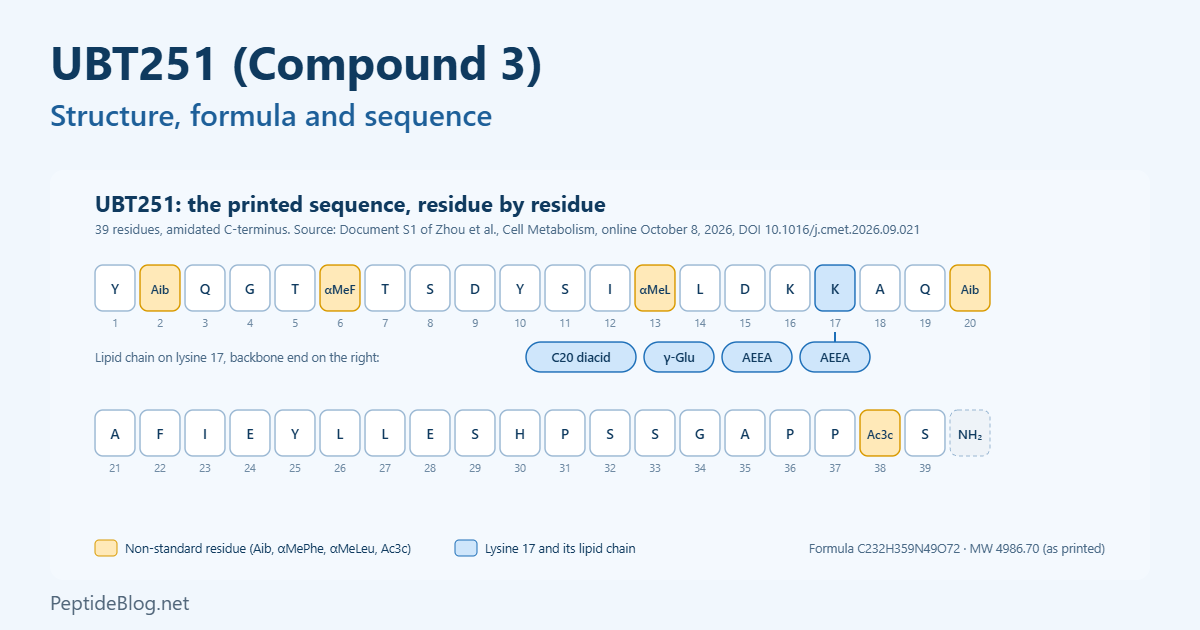

Quick answer. UBT251, also searched online as Compound 3, is a 39-residue peptide with a lipid side chain on lysine 17, a formula of C232H359N49O72 and a printed molecular weight of 4986.70. The developers’ Cell Metabolism supplement lists all of it. Document S1 prints the structure, the formula, the mass and the full sequence, and this page reproduces them with the page reference.
Ask PeptideBlog about any peptide
Searching for “Vistrutide”? Some sellers list a product under that name. It is not an official name, the paper never uses it, and whether those listings match the UBT251 structure has not been established. This page shows the published structure and what an identity check would have to show. Jump to the Vistrutide section.
The receipts. We opened the supplement itself, not a repost of it. We recomputed the average mass from the printed formula (4986.695, which matches the printed 4986.70), counted the residues (39) and located the lipid on lysine 17. Every number on this page carries its source, and the source files are linked at the bottom. For the wider UBT251 picture, see the UBT251 entry and the Cell Metabolism phase 2 write-up.
Research snapshot
| Category | Current information |
|---|---|
| Peptide category | Triple receptor agonist (GLP-1, GIP and glucagon receptors), lipid-modified |
| Primary research interest | Obesity and type 2 diabetes |
| Highest available evidence | Tier 1, published human clinical evidence (two phase 2 trials) |
| Human research available | Yes, 24-week phase 2 trials in Chinese adults |
| Development status | Phase 3 trials registered in China |
| Regulatory status | Not approved anywhere |
| Last reviewed | November 16, 2026 |
Technical identity
| Technical property | Information | Source |
|---|---|---|
| Primary name | UBT251 (development code) | Cell Metabolism paper |
| Alternative names | UBT-251. Compound 3 (the label community analysts use for this sequence, taken from the developer’s patent filings; the paper and supplement never use it, see the section below). Some sellers list a product as “Vistrutide”. That is not an official nonproprietary name, the paper never uses it, and whether those listings match the UBT251 structure has not been established. Some sources list NN9559, which the paper does not mention. | Paper; seller listings |
| Peptide sequence (three-letter, as printed) | Tyr-Aib-Gln-Gly-Thr-αMePhe-Thr-Ser-Asp-Tyr-Ser-Ile-αMeLeu-Leu-Asp-Lys-Lys(AEEA-AEEA-γ-Glu-CO(CH2)18COOH)-Ala-Gln-Aib-Ala-Phe-Ile-Glu-Tyr-Leu-Leu-Glu-Ser-His-Pro-Ser-Ser-Gly-Ala-Pro-Pro-Ac3c-Ser-NH2 | Document S1, page 2 |
| One-letter sequence | Not given. Several residues are non-standard and have no standard one-letter code. | n/a |
| Amino acid length | 39 residues, C-terminal amide (counted from the printed sequence) | Document S1 |
| Molecular formula | C232H359N49O72 | Document S1 |
| Molecular weight | 4986.70 as printed. The average mass computed from the formula is 4986.695. | Document S1; our arithmetic |
| Chemical modifications | Aib at positions 2 and 20, αMePhe at 6, αMeLeu at 13, Ac3c at 38, C-terminal amide, lipid chain on Lys17 | Document S1 |
| Lipid chain | AEEA, AEEA, γ-Glu, then a C20 diacid, on the side chain of lysine 17 | Document S1 |
| CAS number, PubChem CID, UNII, DrugBank ID | Not reliably established | n/a |
| Developer | United Bio-Technology (Hengqin) Co., Ltd. and Zhuhai United Laboratories. Novo Nordisk is reported to hold rights outside Greater China, and two Novo Nordisk employees are authors on the paper. | Paper |
| Form | The printed formula and weight describe the single free molecule as drawn. Salt and hydrate forms are not described. | Document S1 |
What does “Compound 3” mean?
Many people search for this molecule as “Compound 3”. The label does not come from the paper. The developer’s patent filings describe several numbered compounds, and community analysts working from those filings have identified Compound 3 as the match for the structure printed in the supplement. That identification is a community source (Tier 6): Krysia, Substack and X notes, October to November 2026. The paper and Document S1 call the molecule UBT251 and never use the label, so the printed structure above is the reference, and “Compound 3” is the name to use when searching the patent discussion.
What about the name “Vistrutide”?
Vistrutide appears in some seller listings. It is not an official nonproprietary name, and neither the paper nor the supplement uses it. Whether a product sold under that name matches the printed UBT251 structure has not been established. Settling it takes identity testing of the product itself: intact mass plus fragmentation, tied to a lot number and a dated original report. Until that exists, this page treats Vistrutide as a name people search, not as a confirmed synonym for UBT251 or Compound 3.
What are those odd building blocks?
Most peptides are built from the 20 standard amino acids. UBT251 swaps in a few unusual ones. Aib (aminoisobutyric acid) and the alpha-methyl versions of phenylalanine and leucine add an extra methyl group that makes the backbone stiffer. Ac3c (aminocyclopropane carboxylic acid) is a tiny ring. Peptide makers use these swaps to slow down the enzymes that chew peptides up. The paper itself does not explain the design choices, so treat those reasons as general background, not the authors’ statement.
The lipid chain is the other signature. On lysine 17 a side chain runs out through two AEEA spacers and a γ-glutamic acid to a long 20-carbon diacid. Fatty side chains like this are used in approved once-weekly incretin medicines because they let the molecule bind blood albumin and stay around longer. The paper reports once-weekly dosing but does not report a half-life, so how long UBT251 lasts in the body is not established in the sources reviewed.
What dosage information circulates?
Figures below summarize amounts and schedules reported in published research or circulating online. Listing a figure documents what is reported; it is not a recommendation and does not show a regimen is safe, effective, or appropriate for any person.
Published human trial, obesity phase 2 (NCT07177469, 24 weeks, once weekly, subcutaneous, adults with overweight or obesity and no diabetes):
| Arm | Route | Weekly amount by period | Duration | Evidence label |
|---|---|---|---|---|
| 2 mg | Subcutaneous | Weeks 1 to 4: 0.5 mg; 5 to 8: 1 mg; 9 to 24: 2 mg | 24 weeks | Published human clinical trial (Table S5) |
| 4 mg, initial dose 0.5 mg | Subcutaneous | 0.5 mg, 1 mg, 2 mg, then 4 mg from week 13 | 24 weeks | Published human clinical trial (Table S5) |
| 4 mg, initial dose 1 mg | Subcutaneous | 1 mg, 2 mg, 4 mg from week 9 | 24 weeks | Published human clinical trial (Table S5) |
| 6 mg | Subcutaneous | 1 mg, 2 mg, 4 mg, then 6 mg from week 13 | 24 weeks | Published human clinical trial (Table S5) |
| Placebo | Subcutaneous | Matching schedule | 24 weeks | Published human clinical trial |
Practitioner, community and vendor dosing: no independent, traceable source identified. Seller pages circulate figures, but none traced to a published origin.
Explanation of the reported figures
Every published amount comes from one sponsor-run trial. Each step lasted four weeks. The 4 mg arm that started at 1 mg reached its full amount at week 9 and spent 16 weeks there. The 4 mg arm that started at 0.5 mg and the 6 mg arm reached theirs at week 13 and spent 12 weeks there. The paper does not say whether that difference explains the arm ordering, so that link is ours, not the authors’. No weight-based dosing was used, no animal amounts are translated here, and no injection volumes are given because the paper reports amounts, not concentrations. Only 38 of 54 people (70.4%) in the 6 mg arm ever reached 6 mg, against 90.0% of the 4 mg arms reaching 4 mg (Table S1).
Dose-reduction rules in the trial: 2 mg could drop to 1 mg; 4 mg to 2 mg with a retry after 2 weeks, or to 2 mg for good; 6 mg to 5 mg; also a BMI of 22 or lower. Source: paper and Data S2.
Important published research: the obesity phase 2 trial
Zhou et al., Cell Metabolism, 2026. Design: 286 screened, 205 randomized, adults with overweight or obesity and no diabetes in China (mean age 34.1, 59.0% women, mean weight 92.2 kg, mean BMI 33.1), once weekly for 24 weeks plus 4 weeks of follow-up. Everyone also followed a diet and exercise program. The sponsor was involved in design, data collection and interpretation, and authors include sponsor and Novo Nordisk employees.
Week 24 body weight change (least-squares mean, efficacy estimand):
| Arm | People (n) | Change from baseline | Difference vs placebo |
|---|---|---|---|
| 2 mg | 51 | -13.6% | -11.5 points |
| 4 mg, initial dose 0.5 mg | 25 | -16.2% | -14.1 points |
| 4 mg, initial dose 1 mg | 25 | -19.7% | -17.7 points |
| 6 mg | 54 | -18.7% | -16.6 points |
| Placebo | 50 | -2.0% | n/a |
The largest change was in a 25-person arm, not the highest amount. The authors say the pattern is not a simple dose response, that the starting amount and titration may matter, and that chance is possible. In the strictest sensitivity analysis (assuming missing people behaved like placebo) the 6 mg arm fell to -16.2% and the 4 mg arms combined came to -17.3%. All analyses stayed below p<0.001 against placebo (Table S2).
Proportion reaching a given loss at week 24, UBT251 arms versus placebo: 5% or more, 92.2 to 98.1% versus 23.6%; 10% or more, 70.6 to 89.8% versus 8.3%; 15% or more, 37.1 to 76.0% versus 2.0%; 20% or more, 19.0 to 48.4% versus 0%.
Side effects, risks and limits
Adverse events, all UBT251 arms combined versus placebo (paper Table 3 and text).
| Event | UBT251 (n=155) | Placebo (n=50) |
|---|---|---|
| Any adverse event | 92.3% | 88.0% |
| Grade 3 or higher | 9.0% | 4.0% |
| Serious adverse events | 2.6% | 4.0% |
| Diarrhea | 35.5% | 10.0% |
| Decreased appetite | 23.9% | 8.0% |
| Increased lipase | 14.8% | 2.0% |
| Nausea | 14.2% | 4.0% |
| Vomiting | 13.5% | 4.0% |
| Positive urine ketones | 11.6% | 4.0% |
| Low potassium | 11.0% | 0% |
| Constipation | 9.0% | 0% |
| Muscle pain | 8.4% | 2.0% |
| Sinus tachycardia | 7.1% | 2.0% |
One person stopped for an adverse event (4 mg, initial dose 1 mg arm) and none on placebo. There were no deaths, and the serious events were judged unrelated. Grade 3 or higher events rose with the arm: 3.9% (2 mg), 8.0%, 12.0% (4 mg arms) and 13.0% (6 mg). No acute pancreatitis was reported. Eleven participants (4.0 to 9.8% by arm) developed antibodies to the drug, none neutralizing.
Heart rate (Table S4), change from baseline in beats per minute: placebo stayed between -1.5 and +1.8. On UBT251 the rise peaked between weeks 8 and 16 at about +5 (2 mg), +9 (4 mg, initial dose 0.5 mg), +11 (4 mg, initial dose 1 mg) and +11 (6 mg). At week 28, four weeks after the last amount, changes were between -1.5 and +1.9, close to baseline.
Body composition (Table S3). DEXA scans on small subsets of 9 to 21 people per arm, many missing: total fat fell 16.8 to 29.0% and lean mass fell 8.1 to 16.1% across UBT251 arms, against 1.6% and 4.1% on placebo. These are descriptive numbers from very small groups and should not be read as a measured trial result for the whole arm.
Limits the authors state: China only, mean age about 34, people with diabetes excluded, no active comparator, and weight was still falling at week 24. This is a sponsor-run trial and the sponsor took part in the analysis. Long-term safety is not known.
Why the exact structure matters
A product sold under the name UBT251 is only that molecule if it matches this structure. A mass difference as small as one methylene group is 14 Da, which a routine intact-mass test can see, but intact mass alone does not prove the sequence. Matching a vial to the printed structure takes intact mass plus sequence-level fragmentation (MS/MS or peptide mapping), a check that the lipid sits on lysine 17, and a certificate tied to the batch. A purity percentage on its own says nothing about identity. The paper states that the trial material is proprietary to the sponsor and not available for further distribution.
Frequently asked questions
Does the paper call it “Compound 3”?
No. The paper and the supplement use the name UBT251 only. “Compound 3” is the label used in community comparisons with the developer’s patent filings.
What is the molecular weight of UBT251?
The supplement prints 4986.70, and the printed formula C232H359N49O72 computes to 4986.695.
What is the UBT251 amino acid sequence?
39 residues with a C-terminal amide, listed in the identity table above, as printed on page 2 of Document S1.
Where is the lipid chain?
On lysine 17: two AEEA spacers, γ-glutamic acid and a 20-carbon diacid.
What amounts were studied in humans?
2, 4 and 6 mg once weekly by subcutaneous administration for 24 weeks, with 4-week steps and different starting amounts. See the table above.
Which arm lost the most weight?
The 4 mg arm that started at 1 mg, at -19.7% against -2.0% on placebo, in 25 people. The authors caution the pattern may not be a true dose response.
What side effects were reported?
Diarrhea, reduced appetite, nausea, vomiting and raised lipase led the list. Heart rate rose during treatment and returned toward baseline after stopping.
Is UBT251 the same as Compound 3?
Community analysts comparing the supplement with the developer’s patent filings say yes, and that is why the molecule is widely searched as Compound 3. That identification is a Tier 6 community source (Krysia, Substack and X, October to November 2026). The paper itself does not use the label.
Is Vistrutide the same as UBT251?
Not established. Vistrutide is a name that appears in some seller listings. It is not an official name and the paper does not use it. Only identity testing of a specific product against the printed structure could show whether a listing matches.
Is UBT251 approved?
No. It is investigational.
Bottom line
The structure is no longer a secret: Document S1 prints the sequence, formula, mass and lipid chain, and the numbers are internally consistent. The efficacy and safety data come from one sponsor-run, 24-week trial in Chinese adults. The amounts are trial amounts, not guidance. What remains unknown: half-life, receptor potency, long-term safety, outside-China data and head-to-head comparisons.
Sources
- Zhou Z, et al. UBT251, a novel triple GLP-1, GIP, and glucagon receptor agonist, in adults with overweight or obesity: a multicenter, randomized phase 2 trial. Cell Metabolism. Online October 8, 2026. doi.org/10.1016/j.cmet.2026.09.021 (Tier 1)
- Supplemental information (Document S1): mmc1.pdf (primary document)
- Data S2, study protocol: mmc3.pdf
- PubMed 42843337 and ClinicalTrials.gov NCT07177469 (registration).
- Community analysis linking UBT251 to patent Compound 3: Krysia, notes and posts on Substack and X, October to November 2026 (Tier 6, community).
Educational compilation of publicly available information. Not medical advice. Consult a qualified, licensed healthcare professional about personal medical decisions. Inclusion of a figure documents what is reported and does not establish safety, effectiveness or suitability.