
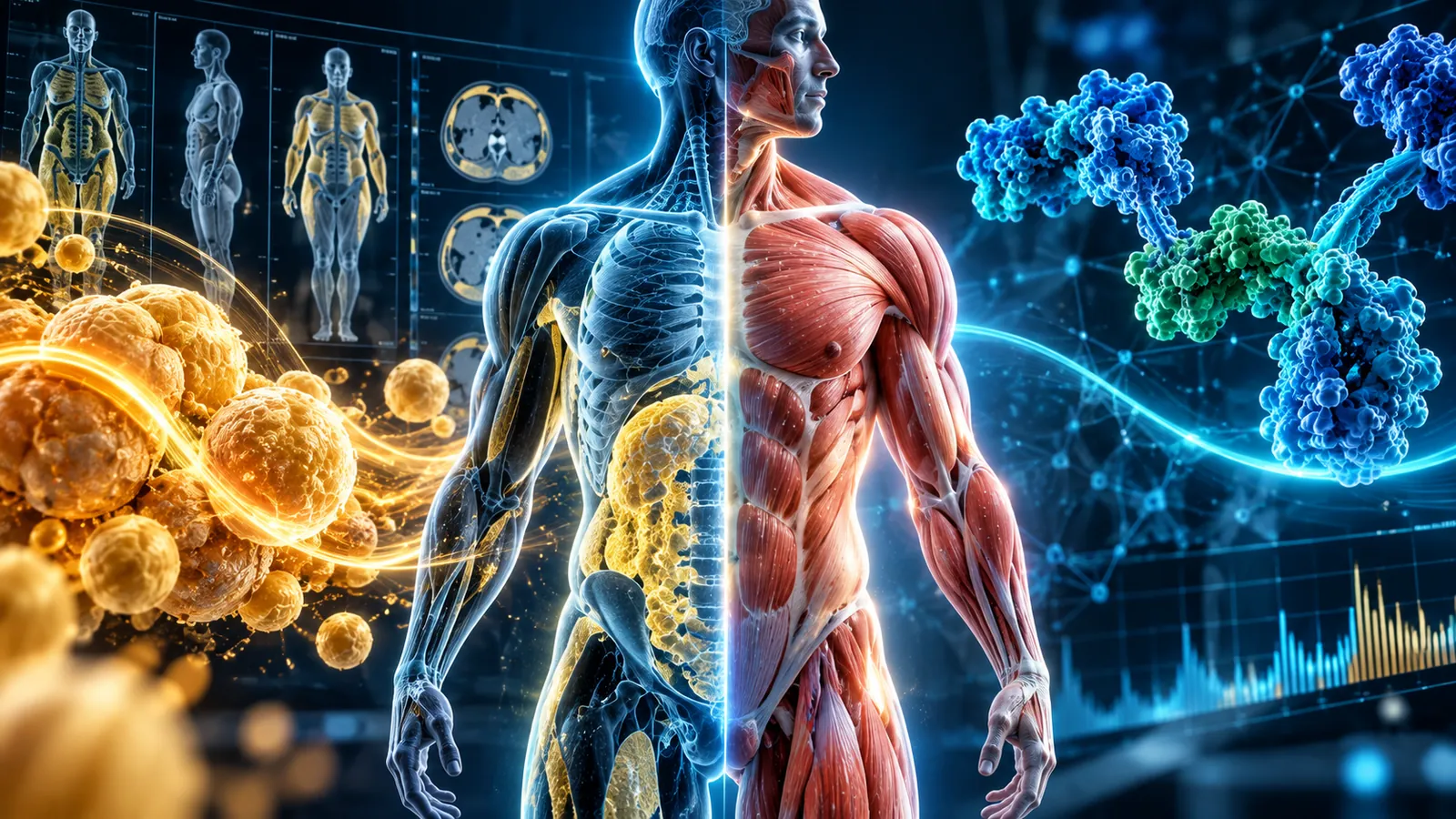

Adding bimagrumab to semaglutide cut more body fat than semaglutide alone in the BELIEVE trial, and lean mass fell by less. Whether that means better muscle, strength or physical function is a separate question, and the trial was not built to answer it.
Ask PeptideBlog about any peptide
The short version. BELIEVE was a sponsor-run Phase 2 randomized trial of 507 adults with obesity or overweight. At week 72, the high-dose combination of bimagrumab and semaglutide produced a 22.1% body-weight reduction, a 45.7% fat-mass reduction and a 2.9% lean-mass reduction. Semaglutide 2.4 mg alone produced 15.7%, 27.8% and 7.4%. Lean mass was measured by DXA, which does not test muscle strength or quality, and grip strength in the high-dose combination group was similar to placebo at week 48. Bimagrumab is still investigational. On this site’s evidence scale, BELIEVE is Tier 1 evidence (a published human trial), with the caveats of an early-phase, company-run study.[1]
What did the BELIEVE trial actually find?
BELIEVE (NCT05616013) randomized 507 adults with obesity (BMI 30 or higher, or 27 or higher with at least one weight-related complication) into nine groups at 26 sites in the United States, Australia and New Zealand. People with diabetes were excluded. Groups received placebo, intravenous bimagrumab (10 or 30 mg/kg every 12 weeks, with extra loading infusions early on), once-weekly semaglutide injections (1.0 or 2.4 mg), or combinations. Bimagrumab versus placebo was double-blind, but semaglutide was open label. Everyone also received monthly counseling on a diet with a daily deficit of about 500 kcal, at least 1.2 g/kg of protein and 150 minutes of weekly physical activity.[1][2]
The blinded primary period lasted 48 weeks, followed by an open-label extension to week 72. The results were published in Nature Medicine on 2 March 2026. In the table below, the “high-dose combination” is bimagrumab 30 mg/kg plus semaglutide 2.4 mg.
| Measure | Semaglutide 2.4 mg | Bimagrumab 30 mg/kg alone | High-dose combination |
|---|---|---|---|
| Body weight | −15.7% | −10.8% | −22.1% |
| Total fat mass | −27.8% | −28.5% | −45.7% |
| Total lean mass | −7.4% | +2.5% | −2.9% |
| Share of weight lost that was fat | 75.6% | 100% | 92.2% |
The efficacy estimand counts only data collected while participants were still taking their assigned treatment. The authors labeled every week 72 analysis post hoc, made no adjustment for multiple comparisons, and had no true placebo group in the extension, so they caution against reading these numbers as definitive treatment effects. Fat and lean mass were measured by DXA. Source: Heymsfield et al., Nature Medicine (2026).[1]
The prespecified primary endpoint was body weight at week 48. Least-squares mean change was −3.3 kg with placebo, −14.2 kg with semaglutide 2.4 mg and −17.8 kg with the high-dose combination, which was greater than semaglutide 2.4 mg alone (P < 0.05). Bimagrumab 30 mg/kg alone produced −9.3 kg. The week 48 body-composition analysis was also prespecified: lean mass changed by −0.8% to −2.3% in the combination groups and by −4.7% to −6.9% in the semaglutide-only groups, and every combination group lost less lean mass than semaglutide 2.4 mg (P < 0.001).[1]
What the 92.2% figure means
The 92.2% is a fat loss index: the share of total weight lost that came from fat mass. It does not mean participants lost 92% of their body fat, and it does not mean they gained muscle. The high-dose combination group still lost 2.9% of its lean mass by week 72.[1]
The comparison point matters too. The authors note that with calorie restriction, including drug-assisted weight loss, roughly 25% to 40% of the weight lost is typically lean tissue. Semaglutide 2.4 mg landed at 75.6% fat, so about a quarter of the weight it removed was lean tissue, at the low end of that range. Bimagrumab alone reached 100% because lean mass rose rather than fell, which also shows why the index can look perfect while total weight loss is lower (−10.8% in that group).[1]
Lean mass is not the same as muscle strength
Dual-energy X-ray absorptiometry (DXA) measures fat mass, bone mineral and lean soft tissue. Lean soft tissue includes skeletal muscle, but it also includes organs and water, so it is a proxy for muscle and not a measurement of how well muscle works. The authors also report appendicular lean mass (arms and legs), a closer proxy for skeletal muscle, with a similar pattern. They point out that earlier bimagrumab studies used MRI to measure muscle volume directly, and BELIEVE did not.[1]
Function was measured in two ways: grip strength with a hand dynamometer, and patient-reported physical function questionnaires (SF-36 and IWQOL-Lite-CT). At week 48, grip strength rose by 4.8 kg in the bimagrumab 30 mg/kg plus semaglutide 1.0 mg group versus 1.7 kg with placebo (P < 0.05). Every other group, including the high-dose combination, was similar to placebo. SF-36 physical functioning did not differ from placebo at week 48, while IWQOL-Lite-CT physical function scores were higher in the combination groups containing bimagrumab 30 mg/kg. At week 72, patient-reported scores were higher in the high-dose combination group than in the others, but that analysis was post hoc and had no placebo comparison.[1]
The authors themselves note the lack of significant improvement in patient-reported outcomes and grip strength across the study, and suggest the broad study population may explain it. They recommend that future studies add MRI and physical function tests in people at risk of low muscle mass.[1]
The open question: can a treatment preserve lean tissue and also protect strength, mobility and long-term function? BELIEVE moves the body-composition discussion forward, but it does not settle that question.
How does bimagrumab work?
Bimagrumab is a human monoclonal antibody that binds activin type II receptors (ActRIIA and ActRIIB) and blocks the signals that normally use them, including myostatin and activin A. In skeletal muscle, that signaling acts as a brake on growth, so blocking it has anabolic effects. The authors also describe a second route: activin signaling through the ALK7 pathway in fat tissue, where blocking it increases the release and breakdown of stored fat.[1]
Semaglutide works differently. It is a GLP-1 receptor agonist that acts mainly on appetite and energy balance, while bimagrumab does not appear to affect food intake. Because the two drugs act on different targets, fat-mass reductions in BELIEVE were nearly additive at week 72 (−28.5% and −27.8% alone, −45.7% together). That is the authors’ interpretation, not a mechanism proven in this trial, and it says nothing yet about long-term safety. For background on the semaglutide side, see the semaglutide and tirzepatide entries, or our GLP-1 and obesity peptide class guide.
Safety and tolerability in BELIEVE
The authors report that safety during the primary period was consistent with the known profiles of both drugs. Adverse events were common in every active group (91.1% to 98.2%, versus 74.5% with placebo). Serious adverse events occurred in 8.8% to 12.5% of the bimagrumab-only groups, 1.8% to 10.7% of the semaglutide-only groups, 3.6% to 9.1% of the combination groups and 3.6% with placebo. No deaths were reported.[1]
Treatment stopped because of adverse events in 14.0% to 21.4% of the bimagrumab-only groups, compared with 3.6% to 8.8% for semaglutide alone, 5.3% to 12.5% for the combinations and 3.6% for placebo. Muscle spasms, diarrhea and acne were the common bimagrumab-related events, and muscle spasms were the main reason five people stopped bimagrumab alone. Among the lab findings, LDL cholesterol rose early in bimagrumab groups and returned to about baseline in the high-dose combination by week 72, and creatine kinase, alkaline phosphatase and (transiently) ALT increased in bimagrumab groups. In an exploratory DXA analysis, total hip bone mineral density fell more than with placebo (−0.8%) in semaglutide 2.4 mg alone (−2.1%) and in the combinations containing bimagrumab 30 mg/kg (−2.2% to −2.3%). The authors suggest this may relate to reduced mechanical loading as weight falls.[1]
What the study cannot tell us yet
- It was a Phase 2 trial. It tested body weight and body composition, not long-term outcomes such as fractures, cardiovascular events or disability.
- The sponsor designed and oversaw it. Versanis Bio, a wholly owned Lilly subsidiary, ran the trial, and several authors are Lilly employees.
- Semaglutide was open label, which the authors say may have led participants who were not receiving it to drop out early.
- Bimagrumab was given as an intravenous infusion with loading doses. The authors say that regimen may have contributed to early lab changes and side effects, and that subcutaneous dosing may soften them.
- Muscle was estimated with DXA, not MRI, and no functional benefit was established for the high-dose combination.
- The week 72 data are post hoc. About 74% of participants completed week 48, and the population (average age 47.5, 57% women, 75% White, no diabetes) was too small to analyze by age or sex.
The paper also describes a 32-week treatment-withdrawal follow-up, through week 104, that was still ongoing at publication. That period should show what happens to weight and body composition after treatment stops, and it is not part of the published results.[1]
How bimagrumab compares with trevogrumab and apitegromab is covered in our trial-by-trial review of muscle preservation during GLP-1 weight loss. For a plain-language guide to the same problem, see the Weight Loss Atlas explainer on muscle loss on GLP-1 medicines.
What is next for bimagrumab research?
Lilly is running a separate Phase 2 study, NCT06643728, of bimagrumab and tirzepatide, alone or in combination, in 252 adults with obesity or overweight without type 2 diabetes. Its primary endpoint is percent change in body weight at week 24, and its secondary endpoints include DXA lean mass and fat mass at weeks 24 and 48. The BELIEVE authors state that it will test subcutaneous dosing of both drugs. As of 13 October 2026, ClinicalTrials.gov lists it as active, not recruiting, with completion estimated for January 2027 and no results posted.[3]
That study uses a different partner drug and route, so its results cannot be assumed from BELIEVE. Lilly’s public pipeline page lists bimagrumab in Phase 2 for obesity, with no Phase 3 program listed.[4] For other muscle-targeting antibodies, see our apitegromab entry, and track registered studies in the clinical trial tracker. If you want the general background on bimagrumab itself, start with the bimagrumab entry.
Bottom line
BELIEVE gives a good reason to pay attention to the quality of weight loss, not just the number on the scale. A 22.1% body-weight reduction with a 45.7% fat-mass reduction is a notable result in a randomized trial, and the smaller lean-mass decline compared with semaglutide alone was prespecified and significant at week 48. But less lean-mass loss on DXA is not the same as preserved strength, and the trial did not show better function for the high-dose combination. It was also a Phase 2, sponsor-run study with post hoc week 72 data. The next studies need MRI, strength and mobility outcomes, and longer safety follow-up before anyone can say that muscle was protected in a way that matters.
For a comparison, our TOFA and obesity analysis walks through the same lean-mass-versus-muscle problem in a mouse study. For a fat-focused contrast, our CBL-514 research review covers an injectable aimed at local abdominal fat, and why that data says nothing yet about muscle or visceral fat.
Frequently asked questions
Does bimagrumab prevent muscle loss?
In BELIEVE, the high-dose combination was associated with less DXA-measured lean-mass loss than semaglutide 2.4 mg alone, and the difference was prespecified and statistically significant at week 48. Lean mass still fell by 2.9% at week 72 in the high-dose combination group, and DXA lean mass is not a direct measure of muscle strength or quality. The trial did not show that muscle loss was prevented or that function improved.
What percentage of weight loss was fat in BELIEVE?
At week 72, using the efficacy estimand, 92.2% of the weight lost in the high-dose combination group was fat mass, compared with 75.6% for semaglutide 2.4 mg alone. This is the share of weight lost that was fat, not the share of body fat lost.
Did BELIEVE show that participants became stronger?
No. Grip strength was the trial's direct strength measure. At week 48, only one combination group (bimagrumab 30 mg/kg plus semaglutide 1.0 mg) differed from placebo, with a 4.8 kg gain versus 1.7 kg, and the other groups, including the high-dose combination, were similar to placebo. The authors describe a lack of significant improvement in grip strength and patient-reported outcomes overall.
Is bimagrumab a peptide?
No. It is a human monoclonal antibody, a much larger protein than a peptide. This site covers it as a related non-peptide compound because it is studied alongside peptide-based drugs such as semaglutide and tirzepatide.
What side effects were reported in BELIEVE?
Muscle spasms, diarrhea and acne were the common events with bimagrumab, and nausea, diarrhea, constipation and fatigue with semaglutide. Treatment discontinuations because of adverse events were 14.0% to 21.4% in the bimagrumab-only groups, 5.3% to 12.5% in the combination groups and 3.6% with placebo. No deaths were reported.
Is bimagrumab approved for weight loss?
No. It is investigational. Lilly's public pipeline page lists bimagrumab in Phase 2 for obesity, with no Phase 3 program listed as of 13 October 2026.
What is the next bimagrumab study to watch?
NCT06643728, a Phase 2 study of bimagrumab and tirzepatide, alone or in combination, in 252 adults with obesity or overweight without type 2 diabetes. ClinicalTrials.gov lists it as active, not recruiting, with no results posted.
Sources
- Heymsfield SB, Aronne LJ, Montgomery P, et al. Bimagrumab plus semaglutide alone or in combination for the treatment of obesity: a randomized phase 2 trial. Nature Medicine. 2026;32(3):869-882. Journal page | DOI | PubMed. Peer-reviewed randomized trial (Tier 1).
- ClinicalTrials.gov. Safety and Efficacy of Bimagrumab and Semaglutide in Adults Who Are Overweight or Obese (BELIEVE), NCT05616013. clinicaltrials.gov. Government registry.
- ClinicalTrials.gov. A Study to Investigate Weight Management With Bimagrumab (LY3985863) and Tirzepatide (LY3298176), Alone or in Combination, in Adults With Obesity or Overweight, NCT06643728. clinicaltrials.gov. Government registry.
- Eli Lilly and Company. Clinical development pipeline, checked 13 October 2026. lilly.com. Developer information.
Educational use only. This article summarizes published research and is not medical advice. Bimagrumab is an investigational compound that is not approved for obesity or any other use. Trial results describe groups of study participants and do not establish safety or benefit for any individual. Nothing here is a recommendation to obtain, combine or use any experimental compound. Talk with a qualified, licensed clinician about personal health decisions.