


Short answer: The 19-day half-life for FLGR242 traces to seller pages and to statements in a patent, not to a measurement of FLGR242. The patent US 12,377,158 B1 reports no animal dosing, no blood sampling and no half-life data. Its text gives 19 days as the human half-life of albumin and as the figure for albumin-binding constructs in general, and it gives 7 days for a follistatin construct in dogs without showing the data. A 19-day half-life is plausible as a design goal. As of Nov 18, 2026 nobody has published evidence that FLGR242 reaches it.
Ask PeptideBlog about any peptide
Where the 19-day figure appears
The number shows up in the titles and descriptions of seller product pages and in promotional articles, usually with the phrase “patented albumin binder.” One promoter post states it repeatedly and cites nothing for it, no study, species, method or laboratory. A comparison site that traces the claim lists its source as that same promoter’s blog and notes that the figure has not been measured for FLGR242.
A podcast listing describes the inventor, Michael Farber, as having built the compound to circulate for a long time and as having a wider albumin-binder platform.
What the patent says and what it shows
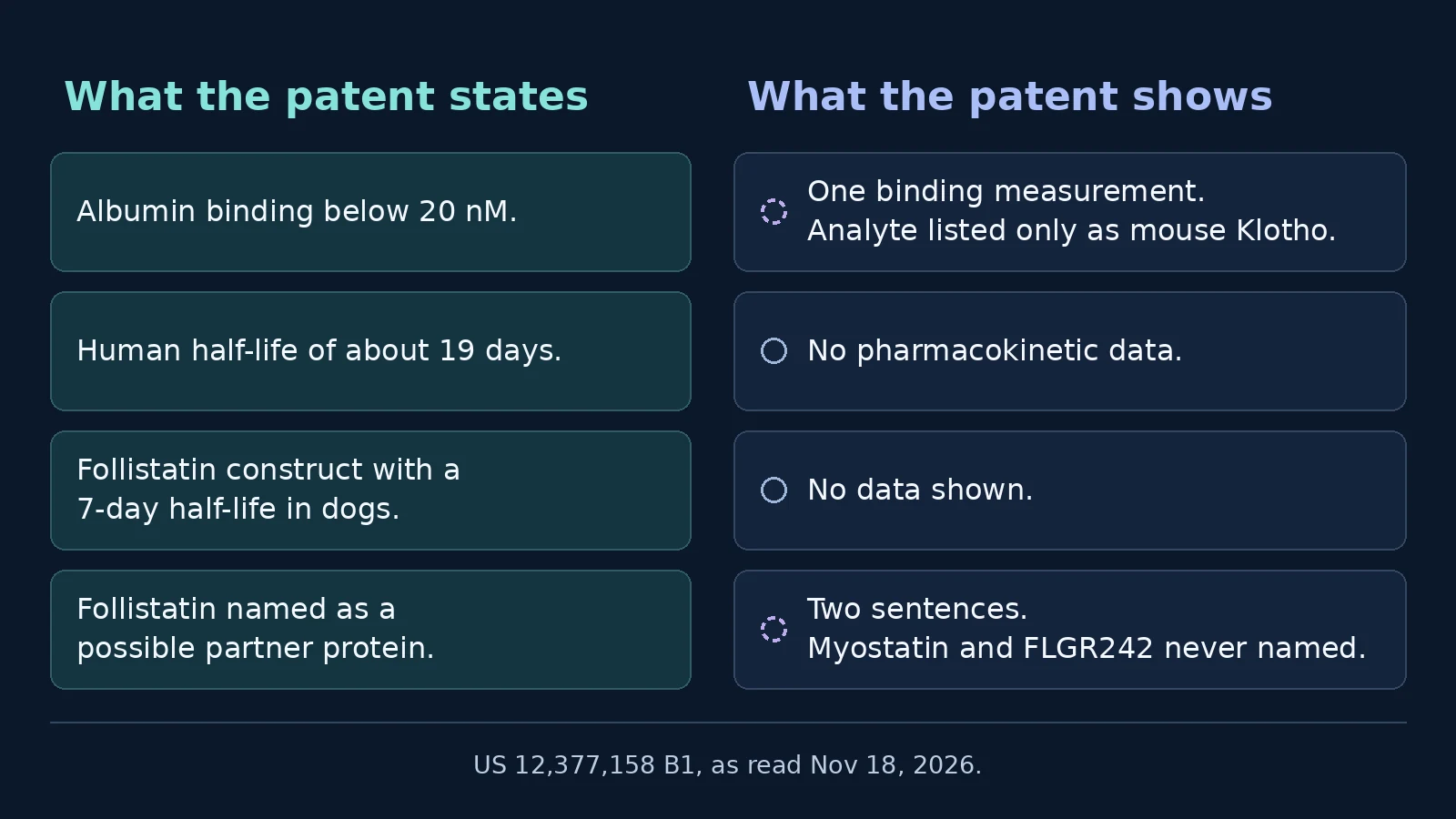
The patent most often cited for FLGR242 is US 12,377,158 B1, “Enhanced peptide constructs for albumin binding,” filed Jan 6, 2025 with a July 5, 2024 priority date. The table lines up its statements against its data.
| What the patent says | What it shows |
|---|---|
| Claim 1: an albumin-binding construct made of an 11-residue core peptide joined to a specific glycine-serine linker, with human albumin binding below 20 nM | One binding measurement, run by an outside lab. The analyte is listed only as mouse Klotho, tested against human albumin. The document does not say the Klotho carried the binding tail, and reports no replicate count |
| Constructs have a half-life of about 19 days in humans, and at least 90 percent of the albumin half-life in the species | No pharmacokinetic data. The 19-day figure is first stated as the human half-life of albumin itself |
| A follistatin construct has a 7-day half-life in dogs | No data. The sentence stands alone |
| Constructs bind canine albumin at about 8 nM | No method or replicate count |
| Fatty-acid albumin binders typically last 4 to 7 days | Background statement without a citation |
Three more points matter. The patent contains the word follistatin twice and never contains the words myostatin or FLGR242. Its claims cover the albumin-binding construct, with dependent claims that add recombinant production and an alpha Klotho version. And the only described experiment is the binding assay above, so every half-life in the document is an assertion or a citation of earlier work.
The second application
A related application from the same inventor, US 2026/0008820 A1, published Jan 8, 2026, describes a broader albumin-binding platform it calls GLYCLOK. It lists GLP-1 based constructs, dual and triple agonists, and growth hormone agonists, and one claim sets a human half-life of at least 18 days. In the text, a semaglutide-like construct is reported at 6 to 8 days in dogs with no sample size, and a human range of 18 to 21 days is stated “based on in vivo pharmacokinetics” with no study design given. It also never mentions follistatin, myostatin or FLGR242.
What published albumin-binding work found
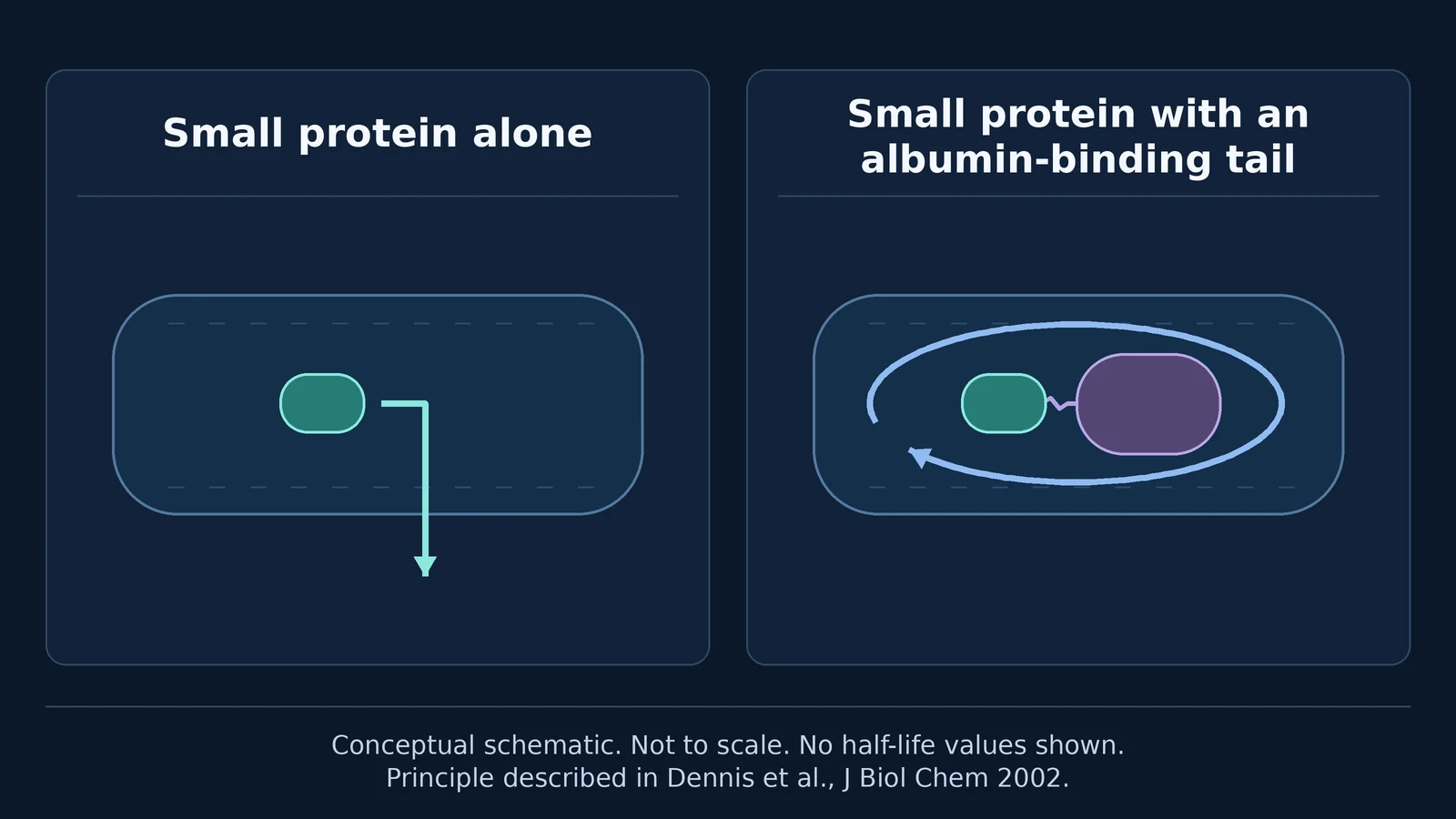
The albumin-binding peptide family is not new. Dennis and colleagues published it in 2002, and the core sequence in the patent, DICLPRWGCLW, comes from that paper. Their peptide SA21 bound human albumin with a dissociation constant of 467 nanomolar. A related sequence fused to an antibody fragment extended its half-life to 32.4 hours in rabbits and 10.4 hours in mice, which was 25 to 43 percent of albumin’s own half-life in those animals.
That is the best public benchmark for the method, and it is well below the 90 percent or more that the patent states. A fusion to a different protein could behave differently, which is exactly why a measurement of the actual construct matters. The patent’s own background says fatty-acid-based albumin binders typically reach 4 to 7 days, so a half-life anywhere between that range and albumin’s own would be unsurprising for a working design.
Why the number matters
Half-life decides how a product behaves after the last dose. If the half-life really were 19 days, a single dose would need about 95 days, five half-lives, to fall by roughly 97 percent, and repeated dosing would keep accumulating for months. There would be no practical way to stop an unwanted effect.
The class history makes that relevant. The injected myostatin-pathway drug ACE-031 was stopped in a Duchenne trial over nosebleeds and dilated blood vessels, and a long-lasting follistatin construct would carry whatever off-target effects it has for far longer. Nobody has published the activin and myostatin binding data for FLGR242, so the exposure and the selectivity are both unknown.
What evidence would settle it
A credible half-life needs a named species, route and dose, a stated number of animals, a validated assay that measures the intact construct instead of total follistatin or albumin, blood samples spanning at least five half-lives, and an independent laboratory. A certificate of analysis for purity answers none of those points.
Frequently asked questions
Does FLGR242 have a 19-day half-life?
Sellers say so. No published study measured it. The patent behind the claim reports no half-life data.
Where does the 19-day number come from?
From a statement in the patent that albumin has a half-life of about 19 days in humans, and from patent language saying albumin-binding constructs behave similarly. Seller pages repeat it for FLGR242.
Is there a study of FLGR242 pharmacokinetics?
Not in PubMed or ClinicalTrials.gov, and the patents I read contain none for follistatin.
Could an albumin-binding follistatin last that long?
It could last longer than native follistatin, and the approach is established. Reaching the full albumin half-life is a stronger claim than the 2002 benchmark supports, and it needs to be measured in the construct itself.
What about the 7-day dog figure?
It is one sentence in the patent, with no data. Dog and human half-lives differ for any albumin-bound protein, so it cannot be converted into a human number.
How long does native follistatin last?
Seller pages say one to two hours and cite nothing. This review did not find a primary measurement. The Follistatin 344 page covers the human gene-therapy data instead.
Bottom line
The 19-day figure describes what the technology is designed to do. The patent offers it as a design property. Sellers state it as fact. Until someone publishes a concentration-over-time curve for FLGR242 itself, the number deserves the label “claimed, not measured.”
For what FLGR242 is claimed to be, what the evidence covers and what remains unverified, see the FLGR242 reference page.
Update history: Reviewed Nov 18, 2026 against Google Patents, PubMed and ClinicalTrials.gov. Updates will be listed here.
Sources
- Farber M. US Patent 12,377,158 B1. Google Patents
- Farber M. US Patent Application 2026/0008820 A1. Google Patents
- Dennis et al. J Biol Chem 2002. PMID 12119302
- Campbell et al. ACE-031 in Duchenne. Muscle Nerve 2017. PMID 27462804
- Nakatani M et al. FASEB J 2008. PMID 17893249