

Quick answer: NVG-291 is an experimental peptide, injected daily, being tested for chronic cervical spinal cord injury. On 12 November 2026 the FDA granted it Breakthrough Therapy designation, which rests on preliminary evidence and is not an approval. The human data are a 20-person chronic cohort reported by the company: a hand-muscle nerve-signal endpoint met its threshold, a leg-muscle endpoint did not, and the main hand-function difference was not statistically significant. A 150-person Phase 3 is under way.
Ask PeptideBlog about any peptide
Updated 15 November 2026. Based on NervGen’s company releases, the ClinicalTrials.gov records for both trials, and the 2015 Nature paper on the underlying approach. No peer-reviewed paper reporting the human results was found, so company statements are labeled as company statements.
What NVG-291 is, and what is not known
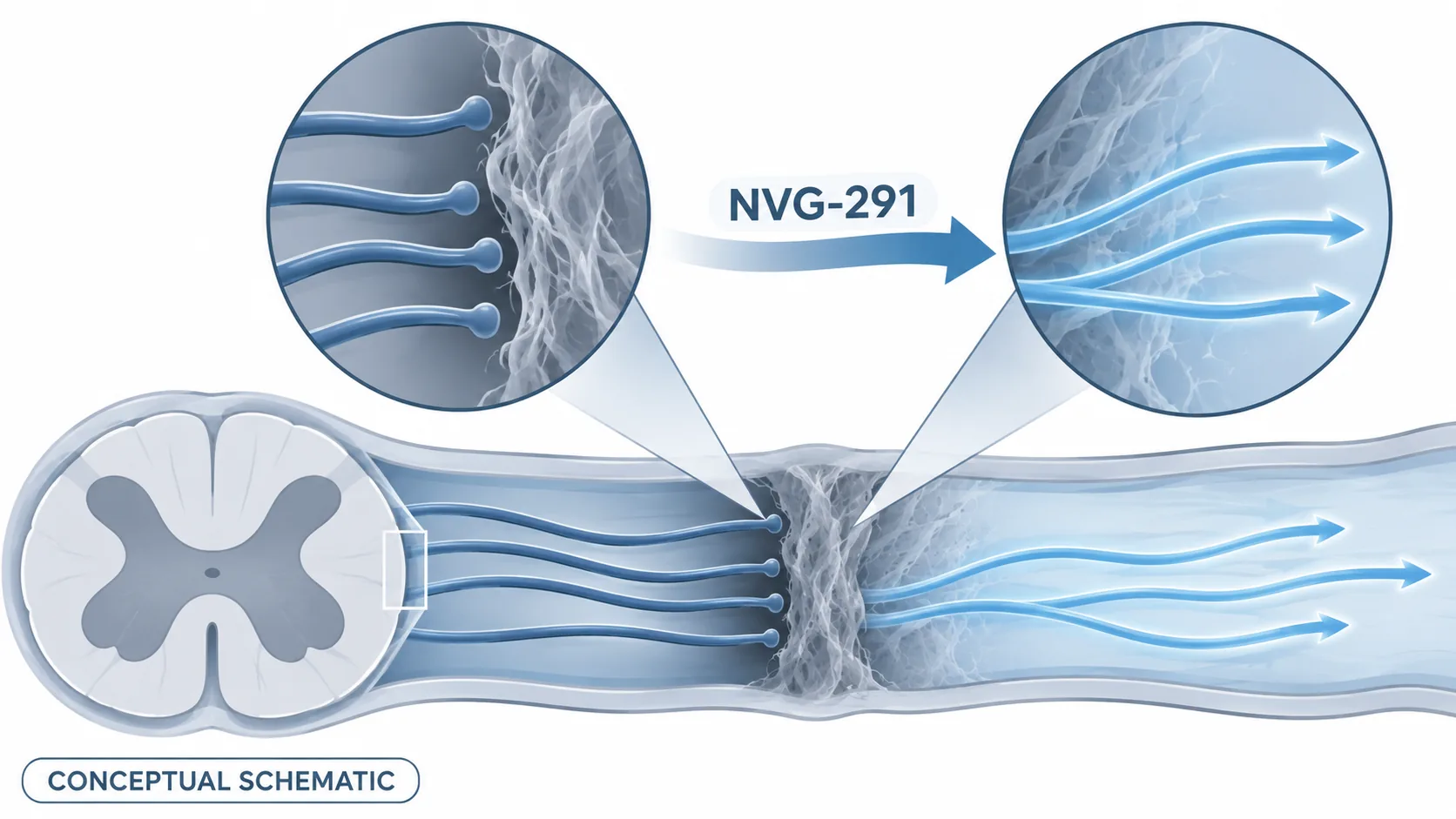
NVG-291 is a peptide developed by NervGen Pharma. According to the company, it is injected under the skin once a day and is designed to block a signal that scar tissue sends to nerve cells after a spinal cord injury. That scar contains molecules called chondroitin sulfate proteoglycans (CSPGs). They bind a receptor on nerve cells called PTPσ and are thought to keep damaged nerve fibers from growing or forming new connections. NVG-291 is described as a copy of a short stretch of that receptor (the wedge domain) joined to a tag that lets it enter cells. A 2022 company slide describes the tag as TAT.
That is the intended mechanism. This page found no human data that confirm the drug works this way. The company reads changes in electrical signals measured through the brain-to-muscle pathway, called motor evoked potentials (MEPs), as a sign of stronger connections. That reading is the company’s.
NVG-291 is not approved anywhere. The sources reviewed describe it only in company-sponsored clinical trials. Its sequence, structure and chemical identifiers are not given here because they could not be traced to a source reviewed for this page. For another investigational peptide studied in a nerve-related condition, see ARA-290; the condition and mechanism are different. A reference listing for ARA-290 that gives its sequence, formula and CAS number, and states a purity figure verified by independent third-party testing, is on a supplier’s ARA-290 page.
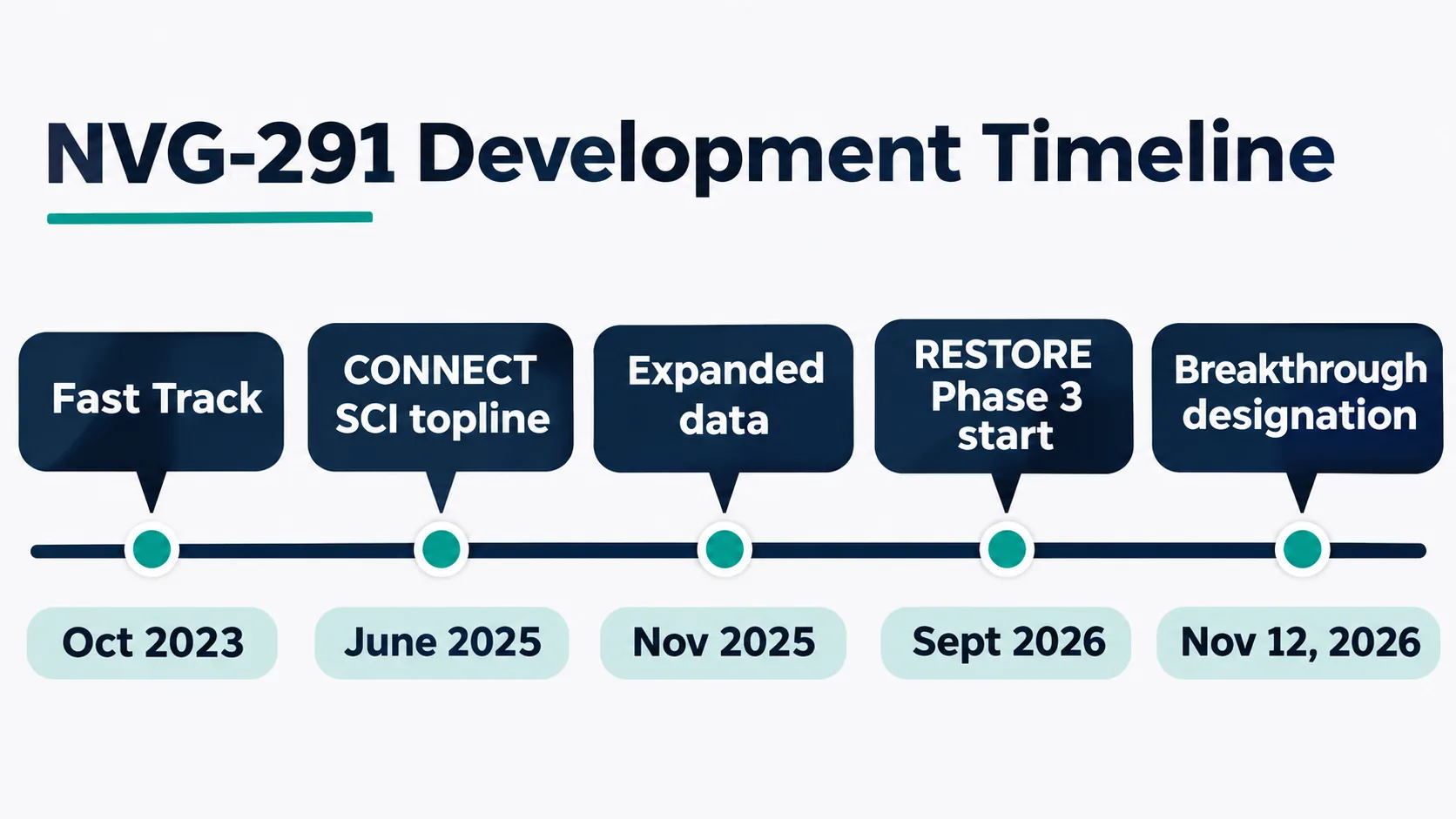
Timeline
| Date | Event | Source |
|---|---|---|
| Dec 2014 (online) | Rat study of a related peptide, ISP, published in Nature in 2015 | Lang et al., Nature |
| 8 Mar 2021 | EMA orphan designation announced for spinal cord injury | Company release |
| 3 Apr 2022 | Phase 1 study in healthy volunteers presented at the American Academy of Neurology (results not reviewed here) | Company slide |
| 8 Aug 2023 | CONNECT SCI (Phase 1/2) starts | ClinicalTrials.gov |
| 23 Oct 2023 | FDA Fast Track designation announced | Company release |
| 2 Jun 2025 | Topline results for the chronic cohort | Company release |
| Sep 2025 | FDA Type C meeting | Company report |
| 24 Nov 2025 | Expanded chronic-cohort data | Company release |
| 7 Apr 2026 | End-of-Phase 2 meeting; company reports FDA alignment on the Phase 3 design | Company release |
| 28 Sep 2026 | RESTORE (Phase 3) start date | ClinicalTrials.gov |
| 12 Oct 2026 | First participant dosed in RESTORE | Company release |
| 12 Nov 2026 | FDA Breakthrough Therapy designation announced | Company release |
| Jul 2027 | RESTORE primary completion date listed in the registry | ClinicalTrials.gov |
| 2H 2027 and 1H 2028 | Company expects enrollment to finish in the second half of 2027 and topline data in the first half of 2028 | Company release |
What the human data show
Every human efficacy figure below comes from NervGen releases about the chronic cohort of CONNECT SCI (NCT05965700). The registry lists no results, and no peer-reviewed paper reporting them was found. The cohort was 20 adults one to ten years after a cervical injury that left some function (an incomplete injury), randomized 10 to NVG-291 and 10 to placebo, with a daily injection for 12 weeks and 4 weeks of follow-up. The registry lists 24 people enrolled in total across the trial; how they divide between cohorts is not stated in the entries read. By the evidence tiers used on this site, this is Tier 2: a registered human trial whose results come only from the sponsor.
| Measure | Result | Reported by | Statistically significant? |
|---|---|---|---|
| Hand muscle (first dorsal interosseus) nerve-signal amplitude, baseline to Week 12 (one of two co-primary endpoints, per the company) | NVG-291 6.207 to 18.773; placebo 6.527 to 7.760 (normalized values as reported) | Company, Jun 2025 | Yes per the company: p=0.0155 against a design threshold of p<0.025 |
| Leg muscle (tibialis anterior) nerve-signal amplitude (the other co-primary endpoint) | Not met | Company, Jun 2025 | No |
| GRASSP Quantitative Prehension (hand function), modeled change at Week 12 | +3.1 vs +1.0 | Company, Jun 2025 | No: p=0.1416. The company calls it a positive trend |
| Same score, raw change from baseline at Week 12 | +3.7 vs +0.4, a 3.3-point difference | Company, Jun 2025 and Apr 2026 | No p-value in the releases read |
| Participants improving by at least 4 points on that score | 5 of 10 (50%) vs 1 of 10 (10%) | Company, Jun 2025 | No p-value in the release read |
| Same score at Week 16, four weeks after the last dose | +4.4 vs +1.2 | Company, Apr 2026 | No p-value in the release read |
| GRASSP Total and Quantitative Prehension, mean improvement relative to placebo, Week 16 | 2.6 times and 3.7 times | Company, Nov 2025 | No p-values or absolute figures in that release |
| 9-hole peg test (post hoc) | Positive trend | Company, Jun 2025 | No |
| Pinch force, 10 meter walk, upper and lower limb strength scores | No clear effect | Company, Jun 2025 | No |
| Patient Global Impression of Change (blinded exit interview) | 6 of 8 (75%) vs 3 of 9 (33%) | Company, Nov 2025 | No p-value reported; self-reported |
| Bladder function improvement (exit interview) | 6 of 9 (67%) vs 2 of 9 (22%) | Company, Nov 2025 | No p-value reported; self-reported |
| Spasticity improvement (exit interview) | 5 of 9 (56%) vs 2 of 9 (22%) | Company, Nov 2025 | No p-value reported; self-reported |
| Startle-reflex nerve-signal reduction | Leg 142% greater reduction than placebo (p=0.0062); hand 48% (p=0.0280) | Company, Nov 2025 | Reported as significant; whether prespecified is not stated |
| Safety | Mostly mild to moderate injection-site reactions; no serious adverse events or discontinuations in the chronic cohort | Company, Jun 2025, Apr 2026, Nov 2026 | Not applicable |
How to read those numbers
One of two co-primary endpoints
The company’s June 2025 release describes two co-primary nerve-signal endpoints, one in a hand muscle and one in a leg muscle. The hand result met the company’s threshold and the leg result did not. The registry lists a single primary outcome naming “key target muscle groups.” Both statements are true at once, and “met its primary endpoint” without that detail would overstate it. In the hand muscle, the NVG-291 group’s amplitude rose to about 3.0 times its baseline and the placebo group’s to about 1.2 times (this page’s arithmetic from the reported values).
A nerve-signal measurement is not a function score. The registry’s primary outcome for CONNECT SCI is electrophysiological. How much a larger MEP matters for what a person can do is the question the Phase 3 trial is built to answer.
Hand function: a gap that was not significant
The score the Phase 3 trial uses as its main endpoint is GRASSP Quantitative Prehension. In RESTORE it is summed across both hands and runs from 0 to 40; the CONNECT releases do not restate the scale, so the figures below assume the same scale. At Week 12 the raw change was +3.7 points on NVG-291 against +0.4 on placebo. The company’s own modeled comparison, +3.1 against +1.0, was not statistically significant (p=0.1416). The company describes the difference as exceeding a 2.0-point minimally important difference; that is a company statement this page did not check.
Relative figures on a small base
The Nov 2025 release reports mean improvements 2.6 times (GRASSP Total) and 3.7 times (Quantitative Prehension) those on placebo at Week 16. The 3.7 matches 4.4 divided by 1.2, the Week 16 means from the April 2026 release (this page’s arithmetic). A relative figure of 825 percent can also be derived from the Week 12 numbers, (3.7 minus 0.4) divided by 0.4. It sounds enormous because the placebo change was close to zero. The absolute difference is 3.3 points, about 8 percent of a 40-point scale (this page’s arithmetic). This page does not use 825 percent as a finding.
Self-reported outcomes and small groups
Patient global impression, bladder and spasticity come from blinded interviews run by a contract research organization up to 364 days after Week 16, not at the end of dosing. The groups are 8 and 9 people for the global impression and 9 and 9 for the other two. On a simple exact test, 6 of 8 against 3 of 9 gives a p-value near 0.15, bladder (6 of 9 against 2 of 9) near 0.15, and spasticity (5 of 9 against 2 of 9) near 0.34. The 5 of 10 against 1 of 10 responder split on the hand score gives about 0.14. These are this page’s own calculations to show how small groups behave. They are not the sponsor’s analysis, they are not a re-analysis of the trial, and the company has not reported its own p-values for these outcomes. The company calls this data hypothesis-generating.
Safety
The company reports mostly mild to moderate injection-site reactions and, in its November 2026 release, no serious adverse events or treatment discontinuations in the chronic cohort. Ten people on the drug for 12 weeks cannot rule out uncommon problems. No safety tables were available in the sources reviewed.
Reported dosing
Figures below summarize amounts and schedules reported in published research or circulating online. Listing a figure documents what is reported; it is not a recommendation and does not show a regimen is safe, effective, or appropriate for any person.
| Setting | Route | Amount reported | Frequency | Duration | Evidence category |
|---|---|---|---|---|---|
| CONNECT SCI, chronic cohort (adults, 1 to 10 years after injury) | Subcutaneous injection | Not found in the sources reviewed | Daily | 12 weeks, plus 4 weeks of follow-up | Registered human trial, company-reported results (Tier 2) |
| RESTORE Phase 3 (adults, 1 to 10 years after injury) | Subcutaneous injection | Not found in the registry record | Daily | 12 weeks, plus 4 weeks of follow-up | Registered human trial, no results yet (Tier 2) |
| Rats with T8 contusion, ISP (a related peptide, not NVG-291) | Subcutaneous injection | 11 µg per day (range tested 3.6 to 44 µg per day) | Daily, first dose 24 hours after injury | 49 days | Published animal research (Tier 3) |
The human amount per injection was not found in either registry record or in any release read. The rat figure belongs to a different peptide in a different species, and this page does not convert it to a human amount.
What the animal work shows
The preclinical paper behind the approach is Lang and colleagues, Nature 2015. It tested ISP (Intracellular Sigma Peptide), a Tat-linked mimic of the PTPσ wedge domain, not NVG-291 itself. The company has described NVG-291 as a wedge-domain mimic with a TAT tag, and a company slide refers to a rodent version, NVG-291-R. This page did not find the company’s own statement of how ISP and NVG-291 relate, and did not review animal studies of NVG-291-R.
In adult female rats with a thoracic (T8) contusion, daily injections started 24 hours after injury and continued for 49 days. Treated rats showed twice the urination frequency of controls, and 10 of 15 regained coordination between the bladder and its sphincter. Thirty percent reached a locomotor score of 13 or higher, against none of the controls, and treated rats made 58 percent fewer foot faults on a grid-walk test. The treatment did not reduce the size of the injury, no long regenerating fibers were seen in the main motor pathway, and the authors saw sprouting of serotonin-producing fibers below the injury. A drug that blocks serotonin receptors partly reversed the benefit. This is Tier 3 evidence.
Two limits matter here. The rats were treated from day one, which is acute-onset treatment, while the human trials enroll people one to ten years after injury. And a thoracic rat contusion is not a chronic cervical injury in people. This page did not review chronic-stage animal work.
What Breakthrough Therapy designation does and does not mean
The FDA grants the designation at a sponsor’s request when two conditions are met: the condition is serious or life-threatening, and preliminary clinical evidence suggests the drug may show substantial improvement over available therapies on a clinically significant endpoint. In its FAQ the agency lists the benefits as the features of Fast Track plus more intensive FDA guidance on efficient development, an organizational commitment from senior managers, and eligibility for rolling review and priority review if the criteria are met.
The same FAQ says that regulatory standards for safety and efficacy must still be met. The designation:
- is not an approval and not a finding that the drug works
- does not lower the standard the Phase 3 trial must meet
- does not predict the Phase 3 result
- is built on the same chronic-cohort data described above, so it is not a separate line of evidence
NervGen’s release says the designation “does not guarantee regulatory approval,” calls the efficacy data “preliminary clinical evidence,” and notes that earlier study results may not predict later ones. The company says the FDA based the designation on its review of the chronic cohort data and describes a “clinically significant endpoint assessing functional hand use.” The FDA’s own reasoning was not available in the sources reviewed, and the release gives no numbers for what the agency looked at.
Limitations
- Size: 10 people on NVG-291 and 10 on placebo.
- Endpoints: one of two co-primary nerve-signal endpoints met; the hand-function difference was not statistically significant.
- Source: every efficacy figure is from the company, with no peer-reviewed human paper found. Company releases choose what to report.
- Self-reported outcomes: global impression, bladder and spasticity come from 8 or 9 people per group, in interviews done up to a year after the end of dosing.
- Relative numbers: fold changes and percentages sit on small bases; absolute differences are modest.
- Durability: the objective measures in the releases read run to Week 16. The company describes benefits as durable.
- Population: adults with chronic, cervical, incomplete injuries who meet the trial’s criteria. Nothing here applies to complete injuries, acute injuries or other conditions.
- Mechanism: the intended mechanism is supported by animal work and not confirmed in humans.
- Single site: the CONNECT registry lists one site (Shirley Ryan AbilityLab, Chicago).
- Safety: too few people for uncommon events.
What to watch
- The RESTORE primary result. Change in GRASSP Quantitative Prehension from baseline to Week 12 in about 150 adults, randomized 1 to 1 to NVG-291 or placebo. The registry’s key secondary outcomes include patient and clinician global impressions, a daily-living independence scale (SCIM-III) and a spasticity scale. Its self-reported interview is set within 14 days after Week 12, not up to a year later as in CONNECT.
- The timing. The registry lists primary completion in July 2027. The company’s October 2026 release expects enrollment to finish in the second half of 2027 and topline data in the first half of 2028. Registry dates are sponsor estimates. This page’s reasoning is that 12 weeks of dosing after enrollment finishes in the second half of 2027 would not fit a July 2027 primary completion, so the company’s later date is the more consistent one. Neither has been confirmed.
- The open-label extension. RESTORE describes an optional extension offering the drug to people assigned to placebo.
- Other data. The subacute cohort of CONNECT, whose enrollment the company said had ended and whose data were being unblinded as of April 2026, and any peer-reviewed publication of the chronic results.
- Funding. The company has said its plans depend on financing. Its Q3 2025 report listed cash of US$11.4 million at 30 September 2025, and a private placement of US$10.05 million closed in November 2025. Later financials were not reviewed.
- FDA actions. The company’s September 2025 Type C meeting report said multiple regulatory pathways are available. The sources reviewed do not specify which.
Questions people ask
What is NVG-291?
An experimental peptide from NervGen Pharma, injected daily in trials, that the company says blocks a scar-tissue signal that inhibits nerve growth. It is investigational and not approved anywhere.
What did the FDA grant on 12 November 2026?
Breakthrough Therapy designation for chronic traumatic cervical motor-incomplete spinal cord injury, according to the company. It follows a Fast Track designation announced in October 2023.
Does Breakthrough Therapy designation mean NVG-291 works?
No. It rests on preliminary evidence that the drug may show substantial improvement. The FDA says safety and efficacy standards must still be met, and the company says the designation does not guarantee approval.
What did the CONNECT SCI trial find?
In a 20-person chronic cohort, the company reported that a hand-muscle nerve-signal endpoint met its threshold (p=0.0155) and a leg-muscle endpoint did not. The hand-function score rose 3.7 points on NVG-291 and 0.4 on placebo at Week 12, and the company’s modeled comparison was not statistically significant.
Does NVG-291 repair or regenerate the spinal cord?
That has not been shown in people. The related rat study found functional improvement without long regenerating fibers in the main motor pathway. The company’s reading of nerve-signal changes as stronger connections is its own interpretation.
What does “3.7-fold” mean?
It is the company’s ratio of mean improvement on the hand score at Week 16 relative to placebo, which matches +4.4 against +1.2 points. The absolute numbers are small on a 40-point scale, and the groups had 10 people each.
What dose is used?
The registry records show a daily subcutaneous injection for 12 weeks. The amount per injection was not found in the sources reviewed.
Are there side effects?
The company reports mostly mild to moderate injection-site reactions and no serious adverse events or discontinuations in the chronic cohort. The groups were too small to detect uncommon events.
When will the Phase 3 results arrive?
The company expects topline data in the first half of 2028. The registry lists primary completion in July 2027. Both are estimates.
Bottom line
The designation reflects a regulator’s view that early data looked promising enough to speed development, not a finding that NVG-291 works. The data behind it are a 20-person, company-reported cohort in which a nerve-signal endpoint in one of two muscle groups met its threshold, the main hand-function comparison was not statistically significant, and the self-reported benefits come from groups of eight or nine. The rat evidence is for a related peptide treated from day one. The Phase 3 trial, RESTORE, is designed to answer the function question directly, with a readout the company puts in the first half of 2028.
What this article did not check
The original wire-service copy of the 12 November 2026 release was not opened; two syndicated copies were read, and several other releases were read through summaries. The Phase 1 healthy-volunteer results, the subacute cohort results, chronic-stage animal work and animal studies of NVG-291-R were not reviewed. How ISP and NVG-291 relate, whether the startle-reflex analysis was prespecified, the company’s minimally important difference claim, the EMA orphan designation beyond the company release, and the FDA’s own reasoning were not verified. The company and authors were not contacted. Arithmetic marked as this page’s own is derived from reported figures and has not been confirmed by the company.
Update history
15 November 2026: drafted from the sources listed below, three days after the designation announcement.
Sources
- NervGen receives FDA Breakthrough Therapy designation for NVG-291 in chronic spinal cord injury. NervGen Pharma, 12 Nov 2026, read via syndicated copy. Company statement.
- First participant dosed in RESTORE. NervGen Pharma, 12 Oct 2026. Company statement.
- Successful End-of-Phase 2 meeting and FDA alignment on RESTORE. NervGen Pharma, 7 Apr 2026. Company statement.
- Expanded CONNECT SCI study data. NervGen Pharma, 24 Nov 2025. Company statement.
- Topline data from the chronic cohort of the Phase 1b/2a trial of NVG-291. NervGen Pharma, 2 Jun 2025. Company statement.
- Third quarter 2025 financial results and business update. NervGen Pharma, 24 Nov 2025. Company statement.
- Fast Track designation for NVG-291. NervGen Pharma, 23 Oct 2023. Company statement.
- Orphan designation from the European Medicines Agency. NervGen Pharma, 8 Mar 2021. Company statement.
- 2022 American Academy of Neurology presentation excerpt. NervGen Pharma company slide via MarketScreener. Company statement.
- ClinicalTrials.gov NCT05965700, CONNECT SCI. Registered human trial, no results posted (Tier 2).
- ClinicalTrials.gov NCT07799532, RESTORE. Registered human trial, recruiting (Tier 2).
- Lang BT, et al. Modulation of the proteoglycan receptor PTPσ promotes recovery after spinal cord injury. Nature 2015;518:404-408. PMID 25470046. Published animal research (Tier 3).
- Frequently asked questions: Breakthrough Therapies. US Food and Drug Administration. Regulatory document.