

A new class of obesity-drug idea targets how many calories the body burns, not how much it wants to eat. Here is what has been shown, in whom, and what has not.
Ask PeptideBlog about any peptide
The short answer
SANA (MVD1) is a small-molecule salicylate derivative, not a peptide. In mice it raised energy expenditure through a creatine-dependent heat pathway that does not require UCP1. A small 2025 Phase 1 trial reported about 3% weight loss over 15 days at its top dose. That figure was exploratory, and no efficacy trial has confirmed it.
- The mystery
- The molecule
- The pathway
- The 2026 paper
- Evidence audit
- Not interchangeable
- What would change it
- FAQ
- Sources
Most obesity-drug headlines are appetite headlines. GLP-1 medicines work largely by changing what the brain asks for, and the weight that comes off follows from eating less. The other half of the energy equation, how many calories the body burns, has been much harder to move with a drug. SANA is one attempt at that second half, and it is also a lesson in how much a 15-day safety study can carry.
The mystery before the molecule
Brown fat keeps mammals warm with a protein called UCP1. It lets mitochondria, the cell’s power plants, burn fuel without making their usual energy currency, ATP, so the energy escapes as heat. For years UCP1 looked like the whole story. Then researchers noticed that mice engineered to lack it could still defend their body temperature in the cold. Something else was producing heat.
In 2015, a team led by Lawrence Kazak at the Spiegelman lab reported a candidate in Cell.3 Beige fat, the heat-producing cells that appear inside white fat when an animal is cold, turned out to be rich in creatine metabolism. Creatine boosted respiration in beige-fat mitochondria when ADP, the spent form of ATP, was scarce. Lowering creatine levels reduced whole-body energy expenditure after a thermogenic stimulus, and in UCP1-deficient mice it lowered core body temperature.
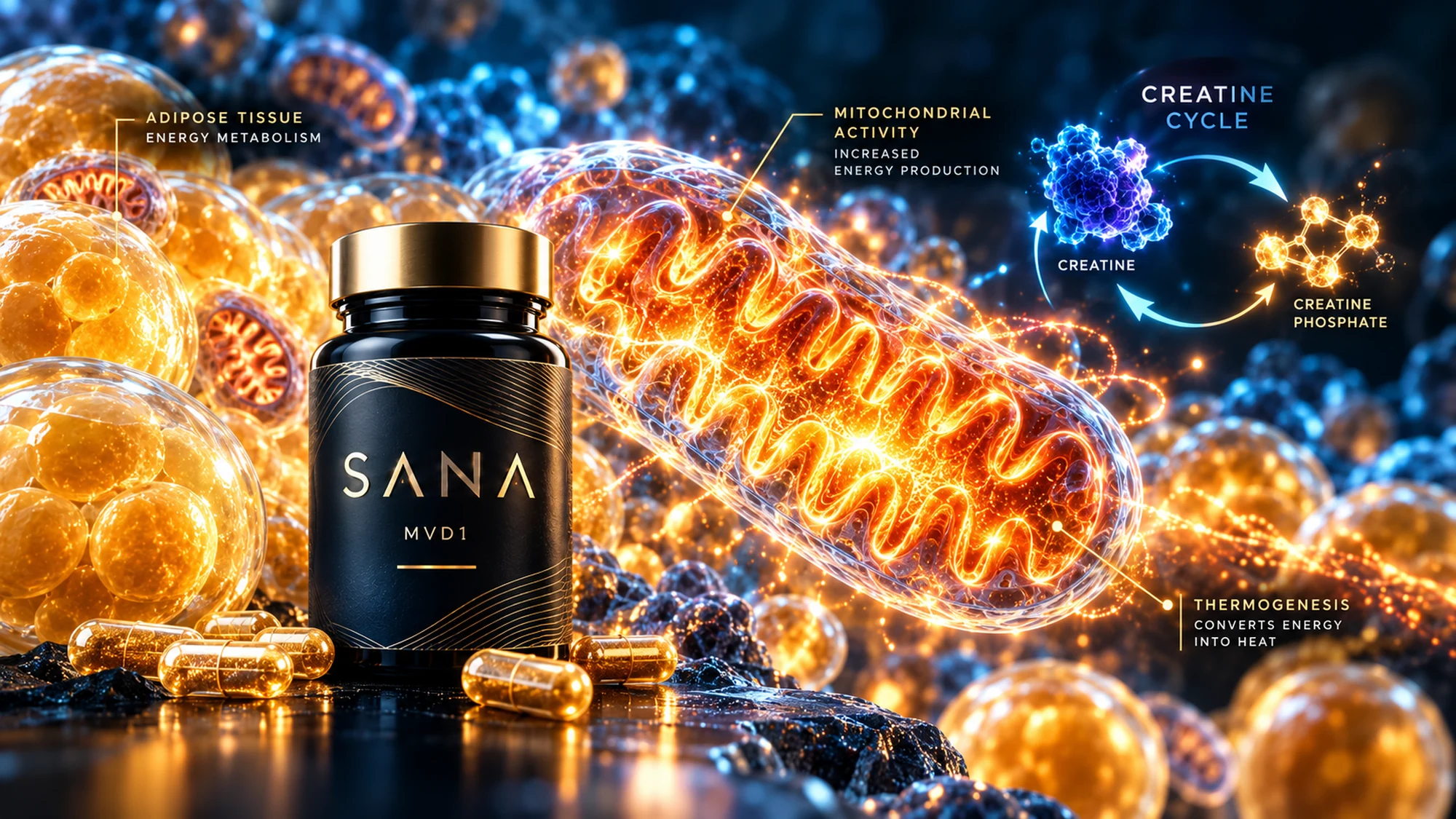
The proposed mechanism is a futile cycle. A cell spends ATP to attach a phosphate to creatine, then strips the phosphate off again, so ATP is burned and rebuilt repeatedly while no useful work is done. The leftover energy leaves as heat. That is a hypothesis from mice, and its details are still argued over. It is also the backdrop for everything below.
What SANA is, and how it was found
SANA stands for salicylic acid nitroalkene. Its chemical name is 5-(2-nitroethenyl)salicylic acid. Take salicylate, the compound aspirin breaks down into, and add a nitroalkene group, a chemically reactive tail that can attach to thiol groups on proteins. There is no chain of amino acids anywhere in it, so it is not a peptide. In clinical development it goes by the name MVD1.1
The 2025 Nature Metabolism paper describes it as the product of phenotypic drug discovery.1 That approach starts from an effect in animals rather than a chosen protein target, and works backward. The upside is that it can surface unexpected biology. The downside is visible in the paper itself: the authors state that SANA’s molecular target remains to be determined.
One clue to the chemistry: when mice were given M1, SANA’s saturated metabolite with the reactive group removed, the metabolic benefit disappeared.1 That points to the nitroalkene group mattering. It does not tell us which protein it touches. Nothing in the paper shows SANA binding CKMT1 or ALKBH5 directly, and this article does not claim it.
How the proposed system works
The plain-English version
Think of a fat cell’s mitochondria as a bank. In the creatine cycle, energy is repeatedly withdrawn and redeposited, and a small fee is lost as heat on every round trip. Run the loop faster and the cell burns more fuel just to keep its books balanced.
In the 2025 mouse experiments, SANA looked like it turned that loop up. Fat tissue from treated mice showed more creatine and more of the enzyme that makes it, and thermal imaging showed warmer surfaces.1 The benefits held in mice lacking UCP1 and in mice lacking the energy sensor AMPK, which rules out two obvious explanations. When the researchers depleted creatine with a blocking compound, SANA’s thermogenic effect disappeared. And it worked at thermoneutral housing temperature, around 28 °C, which matters because people live close to thermoneutrality, not in the cold.
The technical version
CKMT1 is the mitochondrial creatine kinase. It sits inside the mitochondrion, uses ATP to make phosphocreatine and ADP, and the returned ADP feeds respiration. In the SANA paper, mice lacking CKMT1 had impaired temperature control after SANA treatment but not at baseline, and at thermoneutrality they showed no glucose response to the drug. That makes SANA’s effect at least partly CKMT1-dependent in mice.1
The authors are candid about what does not fit. Cold exposure raises the cytosolic kinase CKB, but SANA did not. They suggest SANA may mimic the cold response through different kinases rather than copy it. They also float, as a hypothesis, that pushing fat toward creatine-dependent heat could cost it flexibility to switch on UCP1 when needed. Creatine levels rose in treated mice more broadly, and although mouse muscle function looked normal, the authors say a muscle contribution cannot be ruled out. Mitochondrial number in fat did not measurably change.1
The 2026 paper that is not about SANA
On 10 September 2026, Zhang and colleagues published a separate study in Nature Metabolism.2 They found that ALKBH5, an enzyme that removes chemical tags called m6A from RNA, is switched on in fat by cold and adrenergic signals. It then stabilizes the messenger RNA for CKB, shielding it from a degradation route involving YTHDF2. More CKB means more creatine-driven heat, in both normal and UCP1-knockout mice. Fat-specific loss of ALKBH5 reduced thermogenic capacity, raised obesity susceptibility and disrupted glucose handling. Boosting it did the opposite. In people, ALKBH5 expression in fat was inversely correlated with obesity, which is an association and not a causal finding.
The study did not test SANA, and SANA is not part of this team’s work. CKB is also a different enzyme from CKMT1. What the paper does is show that an independent laboratory, using a different entry point, converged on creatine-driven thermogenesis as a real adipose pathway. That strengthens the biology SANA is built on. It says nothing about whether SANA works through ALKBH5, and nothing about whether SANA works in people.
The evidence audit
PeptideBlog grades each claim separately under its evidence standards, because one compound often carries claims at very different levels. SANA is a good example.
| Claim | Evidence type | Tier | Main limit |
|---|---|---|---|
| Beige fat can generate heat through a creatine cycle, without UCP1 | Mouse and cell work (Kazak 2015)3 | E4 | Cycle details still debated; mouse biology |
| SANA reduces weight gain, liver fat and insulin resistance in diet-induced obese mice | Mouse studies (Cal 2025)1 | E4 | Large oral doses in mice; sponsor-linked authors |
| The effect needs creatine, partly depends on CKMT1, and does not need UCP1 or AMPK | Knockout mice and creatine depletion1 | E4 | Target unidentified; CKB unchanged by SANA |
| Short-term safety and tolerability at the doses tested | Randomized, placebo-controlled Phase 1A/B, 41 people1,9 | E2 | Days to two weeks; kidney signal at highest single dose |
| About 3% weight loss and better glucose markers over 15 days | Exploratory endpoint in the top multiple-dose group (about six on drug)1 | E2 exploratory | Not powered for efficacy; no confirmation |
| ALKBH5 drives creatine-based thermogenesis through CKB | Mouse genetics, human expression correlation2 | E4 | Did not test SANA |
| SANA produces lasting weight loss, preserves lean mass or raises energy expenditure in people | No data identified | None | Unstudied |
Scroll the table sideways on narrow screens.
What the 15-day human trial did and did not do
The study was a randomized, double-blind, placebo-controlled Phase 1A/B first-in-human trial at a single site in Adelaide, registered as ACTRN12622001519741.9 It had two parts. A single-dose part gave 17 healthy lean volunteers oral doses from 200 to 800 mg. A multiple-dose part gave 24 volunteers with overweight or obesity oral doses twice daily for 15 days, as inpatients eating meals the clinic provided. Its primary endpoint was safety.1
On safety, in the single-dose part, the drug was well tolerated up to 400 mg. At 800 mg, two participants had reversible kidney tubular effects, protein and glucose in the urine, judged definitely drug-related, and the safety committee ended escalation there. In the multiple-dose part, no definitely drug-related adverse events were reported. The commonest possibly related complaints were headache and soft stools, there were no severe events, and drug levels did not accumulate between day 1 and day 15.1
On weight, the top group took 200 mg every 12 hours, roughly 2 mg per kg per day, and lost about 3% of body weight over the 15 days while placebo volunteers did not. Insulin resistance (HOMA-IR) and fructosamine also improved. The authors themselves stress that the trial was designed and powered for safety. The top group had about six people on active drug and two on placebo. A protocol error meant weights were not recorded for six volunteers in the first dose cohort. Participants reported no change in appetite or satiety on a questionnaire.1
The paper also compares itself with semaglutide, noting that 3% in 15 days is similar to semaglutide over the same period. That is an indirect comparison across different trials. The pivotal semaglutide trial ran 68 weeks and found a 14.9% mean loss against 2.4% on placebo.8 A two-week weight change in a handful of inpatients is a signal worth chasing, and it is not a forecast of what a longer course would do. The paper also reports body weight and glucose markers, not a direct measure of fat loss, so the composition of that 3% is unknown.
Finally, the registry names Eolo Pharma as sponsor, and several authors list Eolo USA affiliations.1,9 That is normal for early drug development, and it is a reason to want independent replication.
Why these mechanisms are not interchangeable
SANA gets lumped in with other “burn more energy” ideas. They work in different places by different routes, and their evidence is at very different stages.
| Compound | Class and proposed route | Best evidence |
|---|---|---|
| SANA (MVD1) | Nitroalkene salicylate; creatine-dependent adipose energy expenditure, target unknown | Mouse studies plus a small Phase 1A/B1 |
| BAM15 | Mitochondrial protonophore uncoupler; lets protons leak so fuel burns with less ATP made | Mouse: less fat mass without changes in food intake or lean mass4 |
| SLU-PP-332 | Agonist of the ERRα, β and γ nuclear receptors, strongest at ERRα; muscle-centered “exercise mimetic” | Cell and mouse: more oxidative muscle fibers and endurance5 |
| ATX-304 (O-304) | Pan-AMPK activator; a cellular energy-sensor switch | Mouse fatty-liver data6; an earlier small human Phase IIa in type 2 diabetes7 |
| GLP-1 receptor agonists (semaglutide) | Peptide hormone mimics; mainly appetite and intake | Large randomized trials: 14.9% vs 2.4% at 68 weeks8 |
Scroll the table sideways on narrow screens.
The pair most often confused is SANA and BAM15. Both raise energy expenditure in mice, but BAM15 is an uncoupler: it makes mitochondria leak protons. SANA has not been described as a protonophore. Its published evidence points instead to a creatine-dependent route that held up when UCP1 and AMPK were removed. ATX-304 is an AMPK activator, which is a different lever again, and it is not a melanocortin drug. Matching names to mechanisms matters because evidence for one does not transfer to another.
What would change the conclusion
A credible efficacy case for SANA would need, at a minimum:
- A placebo-adjusted effect in a randomized trial built to measure weight, run for months rather than days.
- Long-term follow-up, including whether any loss is kept and whether the kidney signal seen at the highest single dose stays out of the picture at relevant exposures.
- Direct human energy-expenditure data, such as indirect calorimetry. Right now the heat mechanism is shown in mice and inferred in people.
- Objective body composition, including lean mass. Because creatine metabolism also sits in muscle, and because weight-loss drugs raise the lean-mass question generally, this matters. We cover that debate in our piece on GLP-1 drugs and muscle.
- Dose-response data and independent replication, ideally with the molecular target identified.
- A registered trial that anyone can read.
As of 24 October 2026, searches of ClinicalTrials.gov turned up no SANA or MVD1 trial, and the Australian registry lists the Phase 1 study as completed.9 That does not prove no later study exists, since registrations elsewhere or unannounced plans are possible. It does mean we found no confirmed Phase 2 and no approval, and this article does not assume either.
A restrained verdict
The pathway is legitimately interesting. Two independent labs, years apart, have now pointed at creatine-driven heat in fat as a real mechanism, and a molecule that seems to engage it at thermoneutrality in mice is exactly the kind of lead obesity research needs. The Phase 1 data are encouraging as safety data and tantalizing as a hint.
They are not more than that. Nothing here supports anyone trying to source or self-administer an unapproved compound, and the dose figures above describe a supervised trial, not a protocol. The question that matters most is simple: in an adequately sized, placebo-controlled trial lasting months, does a creatine-dependent heat pathway move human weight, and is the lost tissue the right tissue?
Frequently asked questions
Is SANA actually a peptide?
No. SANA is a small organic molecule, a salicylate with a nitroalkene group, with no amino-acid chain. It is sometimes grouped with peptides because it circulates in the same online conversations as peptide research compounds. Its development name is MVD1.1
Is SANA the same as BAM15?
No. BAM15 is a mitochondrial uncoupler that lets protons leak across the mitochondrial membrane. SANA’s published evidence points to a creatine-dependent energy-expenditure pathway instead. Both have shown energy-expenditure effects in mice, but the mechanisms, chemistry and evidence are separate.1,4
Does “UCP1-independent” mean SANA is a classic uncoupler?
No. UCP1-independent only means the effect persisted in animals lacking UCP1. It does not establish a mechanism. Classic uncouplers like BAM15 dissipate the proton gradient directly. SANA has not been shown to do that, and the evidence points toward creatine cycling.1
Why does CKMT1 matter?
CKMT1 is the mitochondrial creatine kinase, an enzyme in the creatine cycle. In the SANA paper, mice lacking it had impaired temperature control after treatment and no glucose response at thermoneutrality. That suggests partial dependence, though the authors say the drug’s direct target is still unknown.1
Did the 2026 ALKBH5 study test SANA?
No. The September 2026 Nature Metabolism paper studied how ALKBH5 stabilizes CKB messenger RNA to drive creatine-based heat in mouse fat. It did not give animals or people SANA, and it does not show SANA acts through ALKBH5.2
What did the 15-day human trial prove?
It supported short-term safety and tolerability at the doses tested, with a kidney-related signal at the highest single dose. It also reported about 3% weight loss in a top group of roughly six people on drug. That was exploratory in a safety-powered trial, so it is a hint, not proof of effectiveness.1
Have larger efficacy trials confirmed the effect?
We found none. Searches of ClinicalTrials.gov returned no SANA or MVD1 study, and the Australian registry lists only the completed Phase 1. Check the registries again before relying on this, since the status can change.9
Sources
- Cal K, et al. A nitroalkene derivative of salicylate, SANA, induces creatine-dependent thermogenesis and promotes weight loss. Nature Metabolism. 17 June 2025;7(8):1550–1569. doi:10.1038/s42255-025-01311-z. Mouse and Phase 1A/B human data.
- Zhang Y, et al. ALKBH5 activates creatine-driven thermogenesis by stabilizing CKB mRNA in response to cold. Nature Metabolism. 10 September 2026;8(9):1990–2006. doi:10.1038/s42255-026-01592-y. Mouse and human-expression data; no SANA.
- Kazak L, et al. A creatine-driven substrate cycle enhances energy expenditure and thermogenesis in beige fat. Cell. 22 October 2015;163(3):643–655. doi:10.1016/j.cell.2015.09.035. Mouse and cell data.
- Alexopoulos SJ, et al. Mitochondrial uncoupler BAM15 reverses diet-induced obesity and insulin resistance in mice. Nature Communications. 14 May 2020;11:2397. doi:10.1038/s41467-020-16298-2. Mouse data.
- Billon C, et al. Synthetic ERRα/β/γ agonist induces an ERRα-dependent acute aerobic exercise response and enhances exercise capacity. ACS Chemical Biology. 29 March 2023;18(4):756–771. doi:10.1021/acschembio.2c00720. Cell and mouse data.
- Holm E, et al. AMPK activator ATX-304 reduces oxidative stress and improves MASLD via metabolic switching. JCI Insight. 8 April 2025;10(7). doi:10.1172/jci.insight.179990. Mouse data.
- Steneberg P, et al. PAN-AMPK activator O304 improves glucose homeostasis and microvascular perfusion in mice and type 2 diabetes patients. JCI Insight. 2018;3(12). doi:10.1172/jci.insight.99114. Mouse data and a small human Phase IIa trial.
- Wilding JPH, et al. Once-weekly semaglutide in adults with overweight or obesity (STEP 1). New England Journal of Medicine. 10 February 2021;384(11):989–1002. doi:10.1056/NEJMoa2032183. Phase 3 randomized trial.
- Australian New Zealand Clinical Trials Registry. ACTRN12622001519741, safety, tolerability, pharmacokinetics and pharmacodynamics of MVD1 (registered 7 December 2022; sponsor Eolo Pharma Pty Ltd; status: completed). anzctr.org.au/ACTRN12622001519741.aspx. Trial registry record.
Editorial note: Evidence labels follow PeptideBlog’s evidence standards and are applied claim by claim. The images in this article are AI-generated conceptual illustrations, not photographs of trial material or direct observations. Trial doses described here come from a named, supervised study and are not recommendations. This is an educational compilation, not medical advice. Spot an error? See our corrections policy.