


Petrelintide is an investigational once-weekly amylin analogue that lost about 8% to 10% of body weight at week 28 (efficacy estimand) in a 493-person Phase 2 trial and is now in Phase 3. It sits in a small, fast-moving group of amylin drugs, and every comparison between them rests on trials that were never designed to be compared.
Ask PeptideBlog about any peptide
The short version. Amylin is a hormone released with insulin after meals that helps signal fullness. Petrelintide (Zealand Pharma and Roche), eloralintide (Eli Lilly) and cagrilintide (Novo Nordisk, in CagriSema) are long-acting versions being tested for obesity. ZUPREME-1 reported mean weight loss of 7.9% to 9.8% at week 28 with petrelintide versus 1.7% with placebo,[1] and the October 2026 ZUPREME-2 topline in type 2 diabetes reported up to 9.2% versus 2.0% at week 28.[3] Eloralintide reported about 20% at 48 weeks in a different trial.[6] That gap does not show eloralintide is stronger, and none of these drugs has been tested head to head. This article is provided for scientific and educational purposes. Petrelintide and several other compounds discussed remain investigational. Clinical findings do not establish regulatory approval, and this content is not medical advice.
Why amylin is a major obesity research target
Most people have heard of GLP-1 drugs such as semaglutide and tirzepatide. Amylin works through a different hormone system, which is why researchers see it as a second route to appetite control rather than a copy of the first. Our GLP-1 and obesity peptide class guide covers the incretin side. This article covers the amylin side, with petrelintide at the center.
Three things make amylin attractive. It is a natural satiety signal, so the biology is familiar. Early amylin analogues showed that the pathway affects food intake and body weight. And the newest long-acting versions have produced double-digit weight loss in mid-stage trials, with a side-effect pattern that sponsors say may differ from incretin drugs. Each of those statements has limits that the sections below spell out.
A note on numbers. Every weight-loss figure here is labeled with its trial, population, time point and analysis method, because the same drug can produce different numbers depending on how participants who stopped treatment are counted. This article gives no dosing guidance.
What is petrelintide?
Petrelintide is a long-acting analogue of human amylin, designed so that one subcutaneous injection a week can do the work native amylin does after each meal. The ZUPREME-1 report in The Lancet Diabetes & Endocrinology calls it “a human amylin analogue” being developed for long-term obesity treatment.[1] Zealand Pharma developed it, and Roche is co-developing it. Our petrelintide entry keeps the running record of identity, trials and status.
It is a peptide drug, a short chain of amino acids, so it is injected. Trial participants in ZUPREME-1 gave themselves weekly subcutaneous injections.[1] It has not been approved by any regulator, and it is not available outside clinical trials. Its Phase 3 program began in late September 2026.[5]
A caution on identifiers. Molecular weight, formula and CAS number for petrelintide differ between databases and vendor listings, and no sponsor disclosure that settles them was found, so none are given here. If a site prints a precise sequence or formula for petrelintide, ask where it came from.
A separate plain-language walkthrough of the Phase 2 program is available as an additional petrelintide research overview.
The biology of amylin
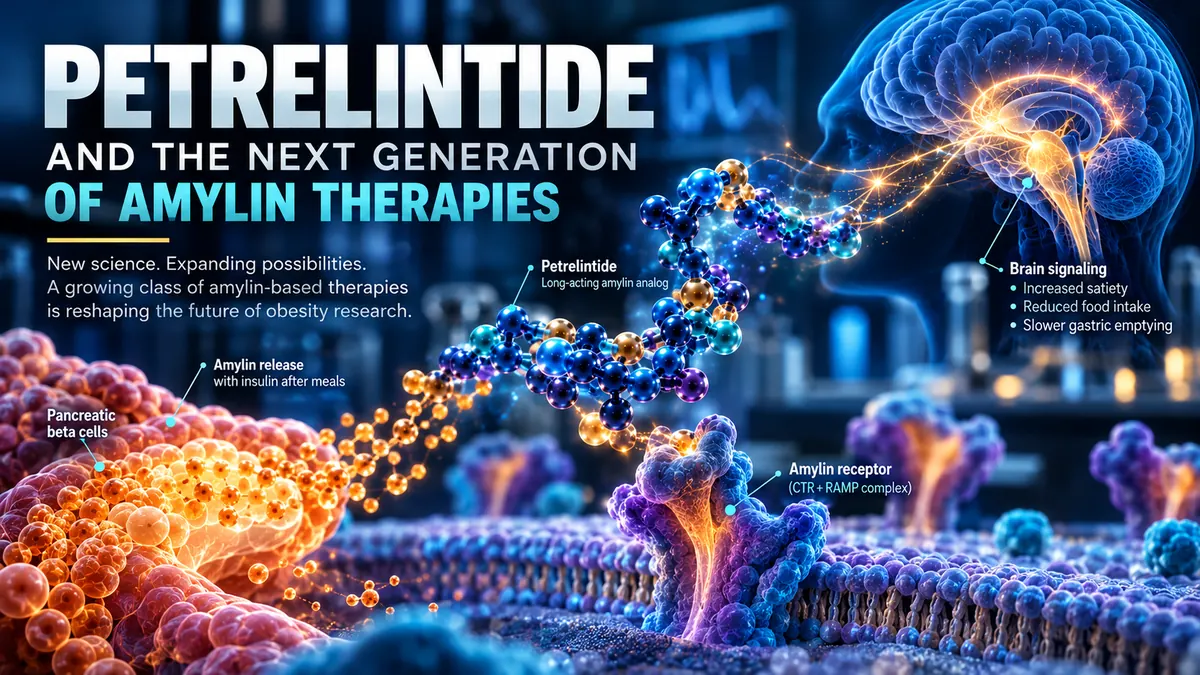
Amylin is a 37-amino-acid hormone made by the pancreatic beta cells and released together with insulin when you eat.[7] It does three jobs that matter here. It acts on the hindbrain to promote fullness and cut appetite, it slows how fast the stomach empties, and it dials down glucagon after meals.[7][18] Together those effects take the edge off a meal.
Amylin’s receptors are built from two parts. The calcitonin receptor (CTR) pairs with one of three helper proteins called RAMPs, giving three receptor types, AMY1, AMY2 and AMY3.[7] The calcitonin receptor on its own responds to calcitonin, a hormone involved in calcium and bone handling. That shared part is the source of a live scientific argument: drugs that hit the calcitonin receptor as well as the amylin receptors may behave differently from drugs that favor amylin receptors, and nobody has settled whether that matters in people.
Why natural amylin cannot be used directly
Native human amylin clumps into fibrils and clears quickly. Pramlintide was built from the non-clumping rat version and needed mealtime injections.[18] Newer analogues use chemical changes that stop clumping and extend half-life, which makes weekly dosing possible.[7]
ZUPREME-1: the Phase 2 weight-loss trial
ZUPREME-1 is the main peer-reviewed human dataset for petrelintide. It was a randomized, double-blind, placebo-controlled Phase 2 trial at 32 sites in Poland, Romania and the United States, published in The Lancet Diabetes & Endocrinology.[1] Of 493 adults randomized 5:1, 485 received at least one dose. They had obesity (BMI 30 or higher) or a BMI of 27 or higher with high blood pressure or abnormal blood fats, and none had type 2 diabetes. Mean age was 47, mean weight 107.1 kg, 53% were female and 86% White.[1]
Participants received one of five fixed weekly maintenance doses (1.0, 2.5, 5.0, 7.0 or 9.0 mg) or placebo for 42 weeks, including dose escalation. The primary endpoint was percent change in body weight at week 28.[1] Every studied amount, including Phase 1, is laid out in our petrelintide dosage guide.
Swipe the table sideways to see every column.
| Arm | Participants dosed | Mean weight change | Difference vs placebo (95% CI) |
|---|---|---|---|
| Petrelintide 1.0 mg weekly | 79 | -7.9% | -6.2% (-7.9 to -4.5) |
| Petrelintide 2.5 mg weekly | 81 | -7.9% | -6.2% (-7.8 to -4.5) |
| Petrelintide 5.0 mg weekly | 83 | -9.8% | -8.1% (-9.7 to -6.5) |
| Petrelintide 7.0 mg weekly | 79 | -9.3% | -7.7% (-9.3 to -6.0) |
| Petrelintide 9.0 mg weekly | 82 | -9.4% | -7.7% (-9.4 to -6.1) |
| Placebo | 81 | -1.7% | not applicable |
Source: published abstract.[1] The efficacy estimand describes results as if participants had stayed on treatment, so it is more favorable than an analysis that counts everyone as randomized. Missing data were assumed to be missing at random.
Two readings matter. First, the dose response flattened: the third arm did slightly better than the highest. That suggests the useful dose range may have been reached, but with about 80 people per arm, small gaps between arms are not reliable.[1] Second, weight kept falling after the primary endpoint. The paper reports reductions “of up to” 10.7% by week 42,[1] and Roche’s release gives the same figure against 1.7% with placebo (efficacy estimand), says the treatment-regimen estimand was “largely consistent,” and reports no vomiting in the maximally effective arm.[2]
On tolerability, the paper reports nausea as the most common adverse event, in 79 of 404 petrelintide participants (20%) versus 5 of 81 on placebo (6%). Vomiting was 3% versus 6%, diarrhea 7% versus 7%, and constipation 7% versus 4%. No deaths were reported.[1] Roche reported discontinuation for adverse events of 4.8% in the maximally effective arm versus 4.9% with placebo, and no treatment discontinuations because of GI adverse events.[2] The companies call the profile “placebo-like,” which is a sponsor characterization. The peer-reviewed wording is more careful: similar GI tolerability to placebo “apart from predominantly mild nausea during dose escalation.”[1]
Limits: the trial was funded by Zealand Pharma and several authors work there, it ran 42 weeks, and it enrolled people without diabetes. It does not show long-term durability, and the abstract does not report body composition.[1] For the full adverse-event breakdown by dose arm, see the petrelintide side effects guide.
ZUPREME-2: the type 2 diabetes trial
ZUPREME-2 (NCT06926842) tested three dose levels of petrelintide against placebo in adults with overweight or obesity and type 2 diabetes who were taking metformin, with or without an SGLT2 inhibitor. It was a US-based Phase 2b trial. Zealand announced topline results on 7 October 2026.[3][4]
Swipe the table sideways to see every column.
| Item | Reported result |
|---|---|
| Population | 220 adults with overweight or obesity and type 2 diabetes; mean BMI 36.3; mean HbA1c 8.0% |
| Design | Randomized, double-blind, placebo-controlled; escalation every 4 weeks for up to 16 weeks, maintenance to week 28, follow-up to week 38 |
| Weight change at week 28 | 7.4% to 9.2% loss across three petrelintide arms versus 2.0% with placebo (efficacy estimand) |
| HbA1c | Placebo-adjusted reductions of 0.61 to 0.88 percentage points; raw change up to -0.65 with petrelintide versus +0.23 with placebo |
| Tolerability | Discontinuation for GI adverse events 1.9% versus 1.7%; mostly mild GI events during escalation; no unexpected safety signals |
| Not disclosed | Dose levels, per-dose weight results, waist, lipids and full GI rates by arm |
Source: Zealand Pharma company announcement 54/2026 and trade coverage.[3] Registry enrollment is listed as 221.[4] Results are not peer reviewed.
These numbers are lower than in ZUPREME-1, and that is expected rather than alarming. People with type 2 diabetes lose less weight than people without it on most obesity drugs. In the CagriSema program, for example, mean loss was 13.7% in people with type 2 diabetes versus 20.4% in people without, in separate trials.[10][11] ZUPREME-2 was also shorter, with a 28-week primary endpoint. A fair summary is that the topline is consistent with ZUPREME-1 in direction, while the missing dose levels, estimates of uncertainty and per-arm data prevent a closer reading until the full presentation. HCPLive’s coverage notes the absent confidence intervals too.[3]
The Weight Loss Atlas keeps a short plain-language summary of this readout, the ZUPREME-2 news page, for readers who want the quick version.
Petrelintide vs eloralintide
Eloralintide (LY3841136) is Eli Lilly’s selective amylin receptor agonist. Its 48-week Phase 2 trial in 263 US adults with obesity or overweight and no diabetes reported mean weight change of about 20% in the 9 mg arm and in a 6 to 9 mg escalation arm (Lilly’s announcement gave 20.1%), compared with 0.4% with placebo, under the efficacy estimand.[6] Lilly has six registered Phase 3 ENLIGHTEN trials.[9] Our eloralintide entry and the sister site’s page on eloralintide clinical research and trial developments go deeper on that program. Eloralintide Research also publishes a petrelintide vs eloralintide comparison of the two trial programs.
It is tempting to set 10.7% beside 20.1% and declare a winner. The numbers cannot support that, for six reasons.
- Different clocks. Petrelintide’s primary endpoint was week 28, with a further reading at week 42. Eloralintide’s was week 48. Weight was still falling in both trials when they were measured, so a longer trial will show more loss.
- Different people. ZUPREME-1 enrolled across three countries with mean BMI 36.7, 53% female. The eloralintide trial was US-only with mean BMI 39.1, 78% female.[1][6] Starting weight and sex both shift percent weight loss.
- Different arms. Petrelintide’s headline figure is its best arm out of five; eloralintide’s is its best out of six, and its arms included escalation schemes with different time at the top dose.[1][6]
- Different placebo responses. Placebo lost 1.7% in ZUPREME-1 and 0.4% in the eloralintide trial, which changes the gap between drug and placebo even for identical drug effects.[1][6]
- Different molecules and units. A milligram of one peptide is not equivalent to a milligram of another, so matching dose labels tells you nothing.
- Different analysis choices. Both figures use an efficacy estimand, which assumes participants stayed on treatment, and neither trial is designed to compare the two drugs.[1][6]
Tolerability gets the same warning. Nausea in the eloralintide trial ranged from 11% to 64% across arms against 14% on placebo, and fatigue from 0% to 46% against 12%.[6] Petrelintide’s pooled nausea rate was 20% versus 6%.[1] Different escalation speeds and arm sizes make those columns incomparable.
There is a real scientific difference worth knowing. In cell experiments, eloralintide was about 12 times more potent at the human AMY1 receptor than at the calcitonin receptor, and its developers hypothesize that sparing calcitonin receptor activity may reduce nausea.[7] The same paper says no minimum selectivity has been shown to matter and that pharmacokinetics could also explain tolerability. No matching published receptor-selectivity table for petrelintide was found, so that comparison cannot be made either.

Petrelintide vs cagrilintide
Cagrilintide, from Novo Nordisk, is a long-acting amylin analogue described in the literature as a dual amylin and calcitonin receptor agonist.[7][18] Its main development path is combined with semaglutide. See our cagrilintide entry for the full profile.
The cleanest cagrilintide-alone dataset is the cagrilintide arm of REDEFINE 1, a 68-week, 3,417-person Phase 3 trial in adults without diabetes. That arm lost 11.5% under the treatment-policy estimand (11.8% if everyone had stayed on drug), against 3.0% (2.3%) with placebo.[10][12] Petrelintide’s 42-week figure of up to 10.7% looks similar on the surface, but it was reached at an earlier time point in a smaller Phase 2 trial, and the two were never tested against each other.
The clearer difference is strategy: cagrilintide is mostly the amylin half of a combination, while petrelintide is being developed as a standalone drug first. Which approach pays off is open.
CagriSema and its regulatory status
CagriSema pairs cagrilintide with semaglutide in one weekly injection. Our CagriSema entry tracks the trials. The results to know:
- REDEFINE 1 (adults without diabetes, 68 weeks): 20.4% weight loss with CagriSema versus 3.0% with placebo under the treatment-policy estimand (22.7% versus 2.3% assuming adherence). GI adverse events affected 79.6% versus 39.9%.[10][12]
- REDEFINE 2 (adults with type 2 diabetes, 68 weeks): 13.7% versus 3.4% (treatment-policy), with GI adverse events in 72.5% versus 34.4%.[11]
- REDEFINE 4 (open-label, 84 weeks, 809 adults): CagriSema 20.2% versus tirzepatide 15 mg 23.6% (treatment-regimen), or 23.0% versus 25.5% (efficacy estimand). CagriSema did not meet the noninferiority criterion. This was reported as a sponsor topline.[13]
Regulatory status. Novo Nordisk filed a new drug application with the FDA in December 2025 (announced 18 December).[14] As of 13 October 2026, a health-information source describes CagriSema as not approved and says a decision is expected in the final three months of 2026.[14] No decision date was confirmed from an FDA source. Treat the status as time-sensitive and check the FDA’s records before relying on it.
CagriSema is the proof of concept for amylin plus incretin, and a cautionary one: it out-lost semaglutide alone in REDEFINE 1, yet trailed tirzepatide in the one head-to-head. For the approved incretin drugs themselves, see petrelintide vs semaglutide and tirzepatide.
Petrelintide vs pramlintide
Pramlintide was the first amylin analogue, built from the non-clumping rat sequence, and it found “limited application as an adjunct to insulin therapy.”[18] It was approved by the FDA in 2005 as an add-on to mealtime insulin in adults with type 1 or type 2 diabetes, and the American Society of Health-System Pharmacists monograph on Drugs.com states it has been discontinued in the United States.[19] It was not approved for obesity. See our pramlintide entry for the history.
The practical difference is the design goal. Pramlintide’s short action meant injections tied to meals. Petrelintide, eloralintide and cagrilintide are built for weekly use. Weight data for pramlintide come from mixed populations and designs (one review cites up to 6.8% at 12 months),[18] so the comparison table below shows no weight figure for it, rather than a borrowed one.
Comparison table: eight compounds, labeled by trial
The table below lines up eight compounds. Read the “Reported weight change” column with the trial, dose arm, population and estimand beside it, and do not read down the column as a ranking. Drug names and doses identify trial arms only.
Swipe the table sideways to see every column.
| Compound | Mechanism | Trial and population | Reported weight change | Study duration | Status |
|---|---|---|---|---|---|
| Semaglutide | GLP-1 receptor agonist | STEP 1; 1,961 adults with overweight or obesity, no diabetes | 2.4 mg arm: -14.9% vs -2.4% placebo; treatment-policy estimand[15] | 68 weeks | Approved for chronic weight management |
| Tirzepatide | GIP and GLP-1 receptor agonist | SURMOUNT-1; 2,539 adults, no diabetes | 15 mg arm: -20.9% vs -3.1% placebo; treatment-regimen estimand[16] | 72 weeks | Approved for chronic weight management |
| Retatrutide | GIP, GLP-1 and glucagon receptor triple agonist | TRIUMPH-1; 2,339 adults with obesity, no diabetes | 12 mg arm: -25.0% vs -3.9% placebo; treatment-regimen estimand[17] | 80 weeks | Investigational; not approved in the sources reviewed |
| Petrelintide | Amylin analogue | ZUPREME-1; 493 adults with obesity, no diabetes. ZUPREME-2: 220 adults with type 2 diabetes | ZUPREME-1, week 28: -7.9% to -9.8% across five arms vs -1.7% placebo (efficacy estimand); up to -10.7% by week 42.[1][2] ZUPREME-2, week 28: -7.4% to -9.2% vs -2.0% (efficacy estimand, sponsor topline)[3] | 42 weeks (primary at 28); ZUPREME-2: 28 weeks (follow-up to 38) | Phase 3 (ZUPREME-3, -4, -5) |
| Eloralintide | Selective amylin receptor agonist | Phase 2; 263 US adults with obesity or overweight, no diabetes | 9 mg arm: about -20% (95% CI -22.7 to -17.5) vs -0.4% placebo; efficacy estimand[6] | 48 weeks | Phase 3 (ENLIGHTEN program) |
| Cagrilintide | Dual amylin and calcitonin receptor agonist | REDEFINE 1 cagrilintide-alone arm (302 participants), no diabetes | 2.4 mg arm: -11.5% vs -3.0% placebo (treatment-policy); -11.8% vs -2.3% (trial-product)[12] | 68 weeks | Not approved as a stand-alone drug |
| CagriSema | Cagrilintide plus semaglutide | REDEFINE 1, no diabetes (3,417). REDEFINE 2, type 2 diabetes (1,206) | 2.4 mg/2.4 mg arm: -20.4% vs -3.0% (treatment-policy); -22.7% vs -2.3% (trial-product). In type 2 diabetes: -13.7% vs -3.4% (treatment-policy)[10][11][12] | 68 weeks | FDA application filed December 2025; not approved as of 13 October 2026[14] |
| Pramlintide | Short-acting amylin analogue | Approved as a mealtime-insulin add-on in diabetes; not approved for weight loss | Not comparable: mixed populations and designs; one review cites up to 6.8% at 12 months[18] | Not applicable | Approved 2005 for diabetes; discontinued in the US[19] |
Estimands in plain terms: “treatment-policy” or “treatment-regimen” counts everyone as randomized, whether or not they stayed on drug. “Efficacy” or “trial-product” assumes everyone stayed on treatment. The second is usually larger. Populations, durations and comparators differ, so differences between rows are not evidence that one drug is stronger.
Safety and tolerability
The short list of what is known. In petrelintide’s published Phase 2 trial, nausea was the main adverse event and was mostly mild and tied to dose escalation, and vomiting was not higher than with placebo.[1] Sponsors report few discontinuations for stomach and bowel symptoms in both ZUPREME trials.[2][3] No deaths were reported in ZUPREME-1.[1] Long-term safety is unknown: the trials are short and the largest petrelintide data set is 493 people.
How other drugs in this comparison behaved
Gastrointestinal events are the shared theme across the class. In STEP 1, 4.5% of semaglutide participants stopped treatment for GI events versus 0.8% on placebo.[15] In SURMOUNT-1, adverse events caused 4.3%, 7.1% and 6.2% of participants on 5, 10 and 15 mg tirzepatide to stop, versus 2.6% on placebo.[16] CagriSema’s GI event rate in REDEFINE 1 was 79.6% versus 39.9% on placebo.[10] Eloralintide’s phase 2 nausea rates swung widely by arm.[6] The honest summary is that petrelintide’s early profile looks gentler than several comparators, but no trial has compared them under the same conditions.
Appetite, satiety and gastric emptying: the brain-gut link
Part of amylin’s appeal is that it acts on both ends of the brain-gut conversation. After a meal, signals from the gut and pancreas reach hindbrain centers that generate fullness, and amylin is one of those signals.[7][18] The same hormone also slows how fast the stomach empties, which prolongs the feeling of fullness and flattens the rise in blood sugar after eating.

Slower emptying cuts both ways. It may help with satiety, and it may also contribute to nausea, early fullness or reflux in some people. It can also change how quickly other oral medicines are absorbed. The best human data on this come from eloralintide: a Phase 1b trial in 100 people found a modest, short-lived slowing of gastric emptying that faded with repeated dosing, and a dedicated study (NCT07738614) is registered to test it.[8][9] No published human gastric-emptying data for petrelintide were found, so the “slower gastric emptying” label that is standard for the amylin class should not be assumed to carry over to it in magnitude. The registered Phase 3 trials record satiety, hunger and appetite scores, and ZUPREME-3 also lists fat mass and lean mass, which will begin to answer these questions.[5]
The Roche and Zealand combination strategy
Roche and Zealand’s plan is to combine petrelintide with enicepatide (CT-388), Roche’s once-weekly GLP-1 and GIP receptor agonist, in a Phase 2 trial. Our enicepatide entry covers that drug on its own. The registered trial (NCT07589686) is a dose-finding study in 486 adults with obesity or overweight, sponsored by Roche. As of 30 October 2026 it is listed as not yet recruiting, with a planned start of 30 September 2026 and primary completion in November 2027.[5] Zealand’s October announcement said the trial was planned for the second half of 2026.[3]
The rationale: amylin and incretins work through separate receptors, so effects might add up while some side effects stay different. CagriSema tested that idea with semaglutide, and Eli Lilly is running parallel Phase 2 trials of eloralintide with tirzepatide and with macupatide.[9] Two individually studied drugs are not a validated combination, and no petrelintide-enicepatide results exist, so any combined figure is a hypothesis.
Phase 3 and regulatory outlook
Roche is the sponsor of the three registered Phase 3 petrelintide trials, all listed as recruiting with start dates of 30 September 2026:[5]
| Trial | Registry ID | Population | Planned size | Primary endpoint | Registered primary completion |
|---|---|---|---|---|---|
| ZUPREME-3 | NCT07843498 | Overweight or obesity, no type 2 diabetes | 3,900 | Percent weight change, week 64 | December 2028 |
| ZUPREME-4 | NCT07843485 | Overweight or obesity with type 2 diabetes | 600 | Percent weight change, week 64 | October 2028 |
| ZUPREME-5 | NCT07843472 | Overweight or obesity with established cardiovascular disease | 2,500 | Percent weight change, week 64 | July 2030 |
Registry dates are projections and are revised often. ZUPREME-3’s secondary endpoints include fat mass and lean mass. ZUPREME-5 enrolls adults aged 40 and older.
The program totals about 7,000 participants, matching Zealand’s announcement.[3] For comparison, Lilly’s six ENLIGHTEN trials plan 8,615 participants, and the earliest registered primary completion is January 2028.[9] Neither sponsor has announced a regulatory submission, and none is predicted here. The earliest an application could follow is after Phase 3 data exist, and sponsors’ timelines change. Our clinical trial tracker follows the registry entries as they update. The petrelintide approval timeline works through what those dates imply, and the news and readouts log tracks each announcement.
What researchers still do not know
- How much weight loss holds at 64 weeks and beyond. ZUPREME-1’s longest reading is week 42.
- Whether the favorable early tolerability survives in thousands of people.
- What proportion of weight lost is fat versus lean mass. ZUPREME-3 will collect it; the Phase 2 reports reviewed for this article did not.
- The dose levels and per-arm results in ZUPREME-2, and the full statistics behind the topline.
- Whether receptor selectivity or pharmacokinetics drives tolerability differences across amylin drugs. The eloralintide developers themselves say that remains open.[7]
- Whether adding petrelintide to an incretin beats the incretin alone by enough to matter.
- Immunogenicity, weight regain after stopping, and cardiovascular outcomes. Phase 3 trials measure anti-drug antibodies and ZUPREME-5 enrolls people with cardiovascular disease, but no results exist.[5]
- Head-to-head performance against any other amylin drug, semaglutide or tirzepatide. No such trial was found in the registry.
Frequently asked questions
What is petrelintide?
Petrelintide is an investigational, long-acting analogue of the hormone amylin, developed by Zealand Pharma with Roche as a once-weekly injection for weight management. It is not approved anywhere and is in Phase 3 testing.
How much weight loss did petrelintide show in ZUPREME-1?
In the 42-week Phase 2 trial of 493 adults with obesity and no diabetes, mean loss at the week 28 primary endpoint was 7.9% to 9.8% across five dose arms versus 1.7% with placebo (efficacy estimand). Roche reported up to 10.7% at week 42.
Is petrelintide better than eloralintide?
That cannot be said. Eloralintide reported about 20% at 48 weeks and petrelintide up to 10.7% at 42 weeks, but the trials differed in duration, population, dose scheme and sponsor, and no head-to-head trial exists.
What did the ZUPREME-2 trial find?
In 220 adults with overweight or obesity and type 2 diabetes, Zealand's 7 October 2026 topline reported weight loss of 7.4% to 9.2% versus 2.0% with placebo at week 28, and placebo-adjusted HbA1c reductions of 0.61 to 0.88 percentage points. The results are company-reported and not peer reviewed.
Is petrelintide approved by the FDA or any regulator?
No. It is investigational. Roche and Zealand started a three-trial Phase 3 program (ZUPREME-3, -4 and -5) in late September 2026, and no marketing application has been announced.
How does petrelintide differ from cagrilintide?
Both are long-acting amylin analogues. Cagrilintide, from Novo Nordisk, is described as a dual amylin and calcitonin receptor agonist and is developed mainly with semaglutide as CagriSema. Petrelintide is being developed alone and as a partner for other drugs. They have not been compared head to head.
What is CagriSema, and is it approved?
CagriSema combines cagrilintide and semaglutide. Novo Nordisk filed it with the FDA on 18 December 2025. A health-information source dated 13 October 2026 describes it as not approved, with a decision expected in the final quarter of 2026. Check FDA records for the current status.
What side effects were reported with petrelintide?
In ZUPREME-1, nausea was the most common adverse event (20% versus 6% with placebo), mostly mild and during dose escalation. Vomiting was 3% versus 6%, and no deaths were reported. In ZUPREME-2, the sponsor reported GI-related discontinuations of 1.9% versus 1.7%.
How is an amylin drug different from semaglutide or tirzepatide?
Semaglutide acts on the GLP-1 receptor and tirzepatide on both GIP and GLP-1 receptors. Petrelintide acts on amylin receptors, a separate hormone system that also affects fullness and stomach emptying.
Why is petrelintide being tested with enicepatide?
Enicepatide (CT-388) is Roche's once-weekly GLP-1 and GIP receptor agonist. Because amylin and incretin hormones use separate pathways, Roche registered a Phase 2 trial (NCT07589686) to see whether the pair does more than either alone. No results exist yet.
Is pramlintide the same as petrelintide?
No. Pramlintide was the first approved amylin analogue, as an add-on to mealtime insulin in diabetes, and it has been discontinued in the United States. Petrelintide is a newer, long-acting design for weekly use in obesity trials.
When could petrelintide be approved?
No approval date has been announced, and any date would be a guess. The Phase 3 trials list primary completion dates from late 2028 to mid 2030, and sponsors revise those dates.
References
- Garvey WT, Ard J, Connery L, et al. Petrelintide, a human amylin analogue for the treatment of obesity (ZUPREME 1): a randomised, double-blind, placebo-controlled, phase 2 trial. Lancet Diabetes Endocrinol. 2026;14(11):914-926. Published 29 September 2026. DOI | PubMed ID 42810355. Peer-reviewed; funded by Zealand Pharma; sponsor-affiliated authors. Read: abstract.
- Roche. ZUPREME-1 topline investor update, 5 March 2026. roche.com. Sponsor announcement; not peer reviewed. Primary media release at roche.com/media was not accessible; figures cited here come from the investor update.
- Zealand Pharma. Company announcement 54/2026: positive Phase 2 ZUPREME-2 topline results for petrelintide in people with overweight or obesity and type 2 diabetes, 7 October 2026 (copy via Inderes); trade coverage: HCPLive, 7 October 2026. Sponsor announcement; not peer reviewed.
- ClinicalTrials.gov. ZUPREME-2, NCT06926842; ZUPREME-1, NCT06662539. Government registry.
- ClinicalTrials.gov. ZUPREME-3, NCT07843498; ZUPREME-4, NCT07843485; ZUPREME-5, NCT07843472; petrelintide with enicepatide Phase 2, NCT07589686. Government registry; no results posted. Read 30 October 2026.
- Billings LK, Hsia S, Bays H, et al. Eloralintide, a selective amylin receptor agonist for the treatment of obesity: a 48-week phase 2, multicentre, double-blind, randomised, placebo-controlled trial. Lancet. 2025;406(10520):2631-2643. DOI | PubMed ID 41207310. Peer-reviewed; funded by Eli Lilly; sponsor-affiliated authors. Read: abstract.
- Briere DA, Qu H, Lansu K, et al. Eloralintide (LY3841136), a novel amylin receptor agonist for the treatment of obesity: from discovery to clinical proof of concept. Mol Metab. 2025;102:102271. DOI | PubMed ID 41109426. Peer-reviewed; sponsor-affiliated authors.
- Bhattachar S, Tham LS, Tidemann-Miller B, et al. Eloralintide, a selective, long-acting amylin receptor agonist for treatment of obesity: Phase 1 proof of concept. Diabetes Obes Metab. 2026;28(4):2651-2660. DOI | PubMed ID 41559929. Peer-reviewed; sponsor-affiliated authors.
- ClinicalTrials.gov. Eloralintide ENLIGHTEN Phase 3 trials: NCT07321886, NCT07282600, NCT07369011, NCT07353931, NCT07392190, NCT07900633; gastric-emptying study NCT07738614; macupatide combination Phase 2 trials NCT07215559 and NCT07589608. Eloralintide plus tirzepatide Phase 2 in type 2 diabetes: NCT06603571. ENLIGHTEN-10 (NCT07900633, 3,000 planned, not yet recruiting) is the sixth Phase 3 entry. Government registry; no results posted for the Phase 3 trials.
- Garvey WT, Blüher M, Osorto Contreras CK, et al. Coadministered cagrilintide and semaglutide in adults with overweight or obesity (REDEFINE 1). N Engl J Med. 2025;393(7):635-647. DOI | PubMed ID 40544433. Peer-reviewed; funded by Novo Nordisk.
- Davies MJ, Bajaj HS, Broholm C, et al. Cagrilintide-semaglutide in adults with overweight or obesity and type 2 diabetes (REDEFINE 2). N Engl J Med. 2025;393(7):648-659. DOI | PubMed ID 40544432. Peer-reviewed; funded by Novo Nordisk.
- Novo Nordisk. CagriSema demonstrates superior weight loss in adults with obesity or overweight in the REDEFINE 1 trial (arm-level results under both estimands). BioSpace copy of the press release. Sponsor announcement.
- Patient Care Online. CagriSema achieves 23% weight loss but misses noninferiority vs tirzepatide in REDEFINE 4. 23 February 2026. patientcareonline.com. Trade-press report of sponsor topline results; No peer-reviewed REDEFINE 4 paper was found.
- Drugs.com. CagriSema FDA approval status and history (drugs.com); Healthline. CagriSema: FDA status, results and uses, 13 October 2026 (healthline.com). Secondary health-information sources; not an FDA record.
- Wilding JPH, Batterham RL, Calanna S, et al. Once-weekly semaglutide in adults with overweight or obesity (STEP 1). N Engl J Med. 2021;384(11):989-1002. DOI | PubMed ID 33567185. Peer-reviewed; funded by Novo Nordisk.
- Jastreboff AM, Aronne LJ, Ahmad NN, et al. Tirzepatide once weekly for the treatment of obesity (SURMOUNT-1). N Engl J Med. 2022;387(3):205-216. DOI | PubMed ID 35658024. Peer-reviewed; funded by Eli Lilly.
- Jastreboff AM, Kaplan LM, Davies MJ, et al. Retatrutide, a triple hormone receptor agonist, for treatment of obesity (TRIUMPH-1). N Engl J Med. Published 29 September 2026. DOI | PubMed ID 42814954. Peer-reviewed; funded by Eli Lilly. Read: abstract.
- Bailey CJ, Flatt PR, Conlon JM. Long-acting amylin-related peptides as therapies for obesity and type 2 diabetes. Peptides. 2026;196:171480. DOI | PubMed ID 41747885. Peer-reviewed review. Read: abstract.
- American Society of Health-System Pharmacists via Drugs.com. Pramlintide monograph (states discontinuation in the US). drugs.com. Reference monograph. The 2005 US approval year is from Drugs.com’s Symlin approval records and was not checked against FDA documents.
Trial results describe groups of study participants and do not establish safety or benefit for any individual. Nothing here is a recommendation to obtain or use any experimental compound. Talk with a qualified, licensed clinician about personal health decisions.