

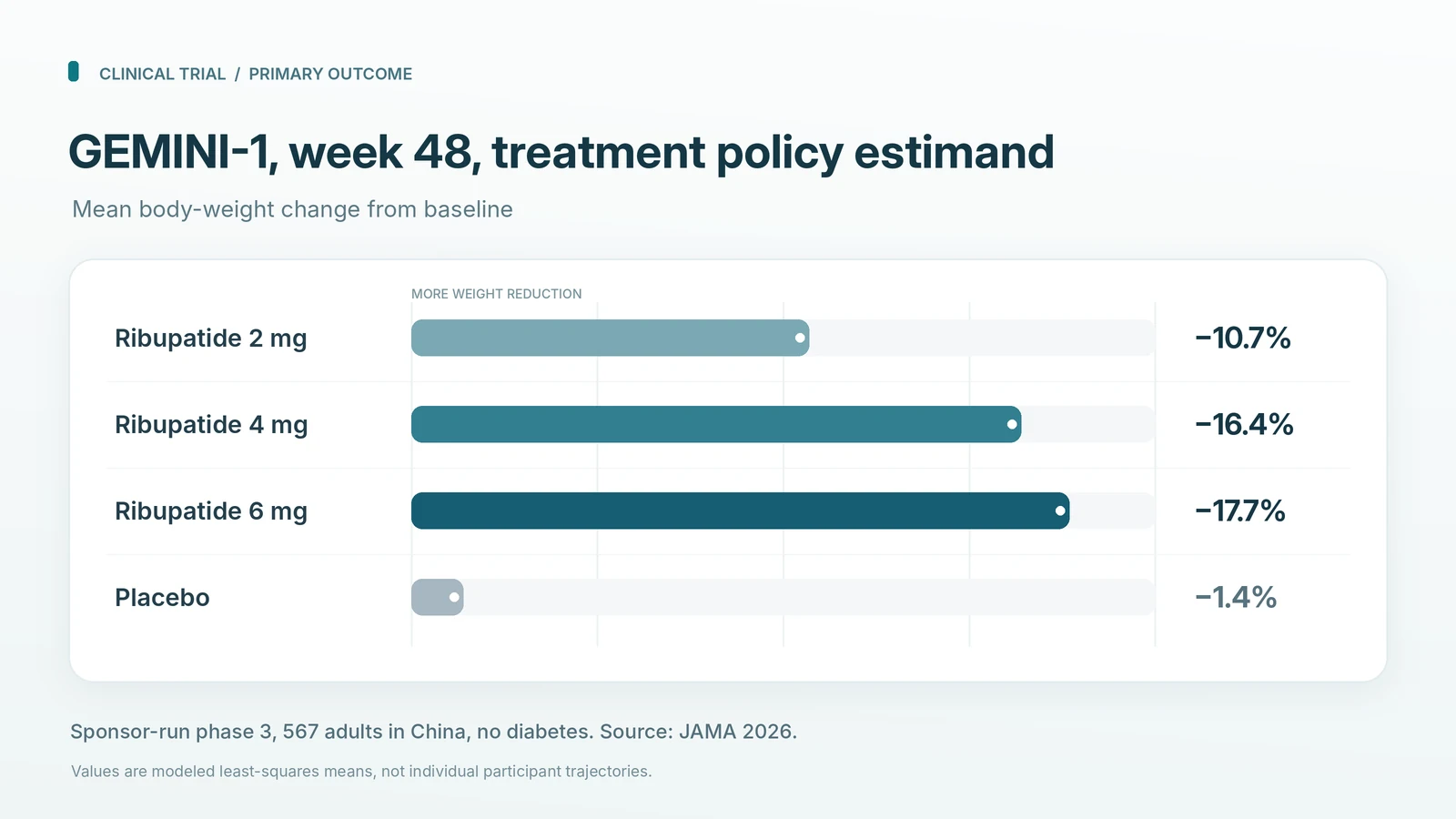
Quick answer: Ribupatide (HRS9531, called KAI-9531 outside Greater China) is a once-weekly injection that activates the GLP-1 and GIP receptors. JAMA published its 48-week Phase 3 trial, GEMINI-1, on 15 November 2026. In 567 adults in China without diabetes, weight fell 10.7%, 16.4% and 17.7% on 2, 4 and 6 mg, against 1.4% on placebo, counting everyone as randomized. The 19.2% figure quoted earlier comes from a different analysis. The trial says little about other populations, higher doses or time past 48 weeks.
Ask PeptideBlog about any peptide
Updated 16 November 2026, a day after the paper appeared online. Based on the JAMA article text, its editorial, the ClinicalTrials.gov record and company releases. The JAMA supplement was not read.
What was studied
Figures below summarize amounts and schedules reported in published research or circulating online. Listing a figure documents what is reported; it is not a recommendation and does not show a regimen is safe, effective, or appropriate for any person.
| Item | What the paper reports |
|---|---|
| Trial | GEMINI-1 (also HRS9531-301), registered as NCT06396429 |
| Design | Phase 3, randomized, double-blind, placebo-controlled, 55 sites in China |
| Sponsor | Jiangsu Hengrui Pharmaceuticals. The paper says the sponsor took part in design, conduct, data collection, analysis and interpretation |
| Who | 567 randomized from 751 screened. Adults without diabetes with BMI 28 or higher, or 24 or higher with at least one weight-related condition |
| Group averages at the start | Age 34.4 years, 54.5% women, weight 93.0 kg, BMI 33.3 |
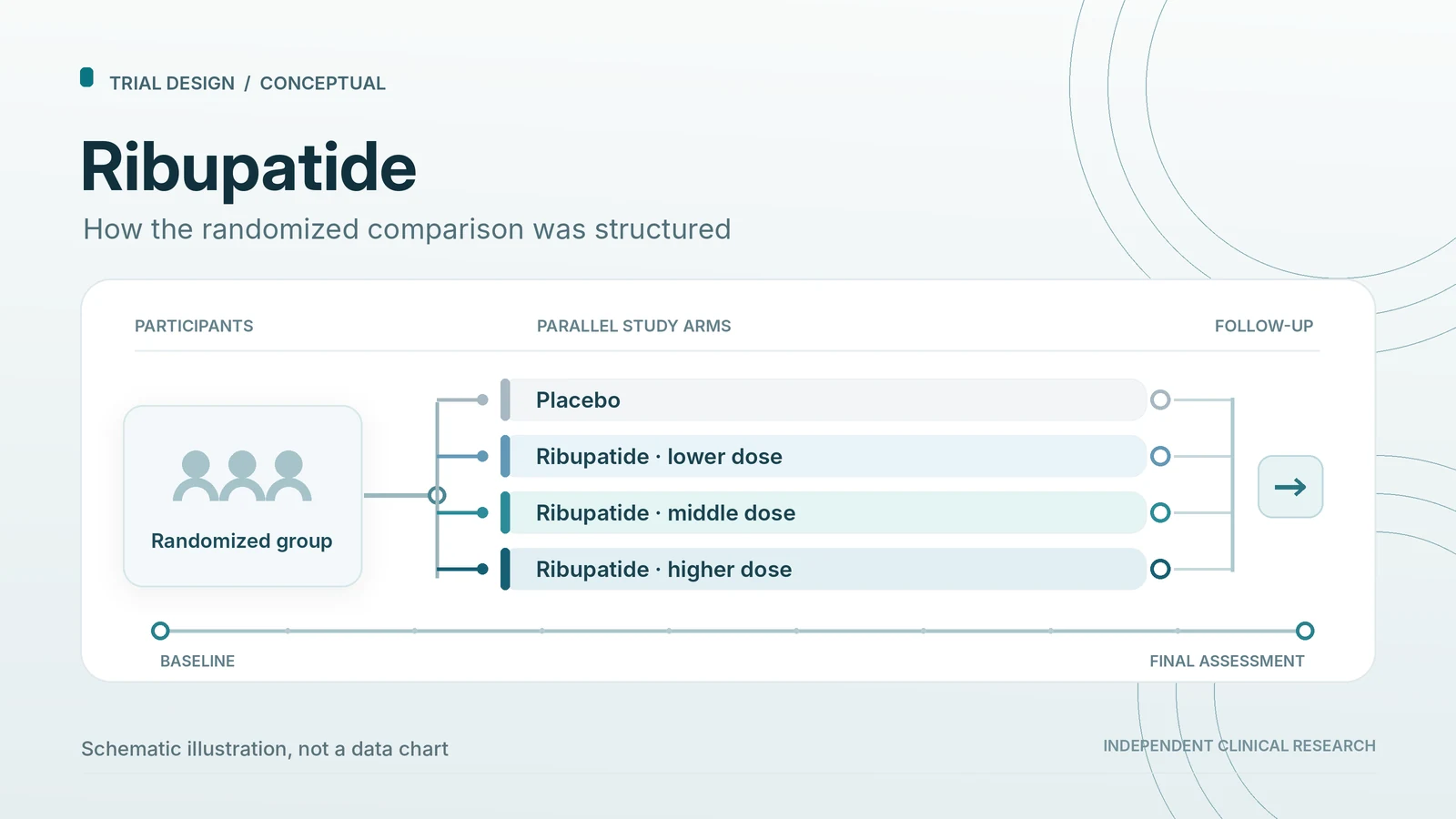
| Arms | Ribupatide 2 mg (142 people), 4 mg (141), 6 mg (141) or placebo (143), once weekly under the skin |
| Dose schedule | Started at 1 mg, raised by 1 mg every four weeks up to the target dose, over up to 20 weeks |
| Length | 48 weeks of treatment, then 4 weeks of safety follow-up |
| In every arm | A lifestyle program: fewer calories and at least 150 minutes a week of moderate exercise |
| Main outcomes | Percent weight change at week 48, and the share losing at least 5% |
| Main analysis | Treatment policy estimand, with missing data filled in by multiple imputation. A hypothetical estimand was a supplemental analysis |
| Finished the 48 weeks | 514 people (90.7%) |
The schedule has a side effect worth noticing. With 1 mg steps every four weeks, the 6 mg group reached its target around week 20 and spent roughly 28 of the 48 weeks at that dose. The 4 mg group spent about 36 weeks at target and the 2 mg group about 44. That is this page’s arithmetic from the stated schedule, and the paper may count it differently.
The results, with the method named
Everything in this table is the primary analysis, the treatment policy estimand, at week 48. In plain terms: everyone counts in the group they were randomized to, including people who stopped the drug or started another weight treatment.
| Outcome at week 48 | 2 mg | 4 mg | 6 mg | Placebo |
|---|---|---|---|---|
| Weight change, average (95% CI) | -10.7% (-12.2 to -9.3) | -16.4% (-17.9 to -14.9) | -17.7% (-19.2 to -16.2) | -1.4% (-2.9 to 0.1) |
| Difference from placebo, percentage points | -9.3 (-11.4 to -7.3) | -15.0 (-17.1 to -12.9) | -16.3 (-18.4 to -14.2) | n/a |
| Lost at least 5% | 68.1% | 88.0% | 85.7% | 16.0% |
| Lost at least 10% | 50.7% | 73.8% | 75.4% | 9.2% |
| Lost at least 15% | 30.2% | 52.8% | 63.8% | 7.1% |
| Lost at least 20% | 13.6% | 37.1% | 44.4% | 3.5% |
| Waist change, cm | -8.9 | -13.4 | -14.4 | -2.5 |
Source: Zhao et al., JAMA 2026. Company-sponsored. The P values for secondary outcomes are nominal and were not adjusted for testing many outcomes.
Every dose beat placebo on weight (P below .001). The more interesting reading is the gap between 4 and 6 mg. Average loss was close (16.4% and 17.7%), and the share reaching at least 5% was slightly lower at 6 mg than at 4 mg. The deeper thresholds separate more: 52.8% against 63.8% reaching 15%, and 37.1% against 44.4% reaching 20%. The intervals for these 4 and 6 mg figures overlap, and the paper’s main comparisons are each dose against placebo, so the data do not settle whether 6 mg is meaningfully better than 4 mg.
Secondary measures also favored ribupatide. Compared with placebo, systolic blood pressure was lower by 7.1, 8.7 and 8.4 mm Hg on 2, 4 and 6 mg, and triglycerides fell 28.6%, 35.3% and 36.6%. Those are clinic and lab measurements, not heart attacks or strokes, and these secondary P values are nominal.
One dose, several numbers
Anyone searching this drug will meet more than one figure for the 6 mg dose. They answer different questions.
| Figure | What it is | Where it comes from |
|---|---|---|
| 19.2% | Average weight loss if people who stopped treatment or used other weight drugs are set aside (hypothetical estimand) | Company releases, 2025. The paper calls its hypothetical results consistent with the primary analysis; its own figure was not checked for this article |
| 17.7% | Average weight loss, everyone counted as randomized (treatment policy) | JAMA primary result |
| 17.7% | Placebo-subtracted loss under the hypothetical estimand | Company posters and July 2025 coverage |
| 16.3 points | Gap from placebo, everyone counted as randomized | JAMA primary result |
Two different quantities share the number 17.7, which is easy to miss. Coverage of the July 2025 topline quoted 19.2% in some places and 17.7% in others for the same dose.
JAMA’s statisticians put it plainly in an editorial, “Tale of Two Estimands: Distinguishing What Is Observed From What Is Inferred” (Heagerty and Lewis). In short, the treatment policy result reflects what happened in the randomized groups. The hypothetical result is inferred, and it depends on assumptions about what would have happened to people who stopped, assumptions that cannot be checked. The editorial treats the treatment policy figure as the more relevant one for someone starting therapy and the hypothetical figure as a best-case, full-adherence scenario.
In this trial the two methods sit fairly close: 11.2% against 10.7% at 2 mg, 17.4% against 16.4% at 4 mg, and 19.2% against 17.7% at 6 mg. A company poster from ObesityWeek 2025 offers a likely reason. About 9% stopped treatment in both the ribupatide groups (9.4%) and the placebo group (9.1%), so few people’s data are handled differently. Compare the CagriSema case, where the placebo average more than doubled between methods; the REDEFINE 9 analysis walks through it. The lesson here is the label. Quote the number with its method, or do not quote it.
Safety and tolerability
| Event (share of people) | 2 mg | 4 mg | 6 mg | Placebo |
|---|---|---|---|---|
| Any adverse event | 91.5% | 91.5% | 93.6% | 89.5% |
| Any stomach or bowel event | 47.9% | 58.2% | 63.1% | 23.1% |
| Diarrhea | 29.6% | 31.9% | 35.5% | 7.0% |
| Nausea | 16.2% | 17.0% | 27.0% | 4.9% |
| Vomiting | 14.1% | 19.1% | 24.1% | 2.1% |
| Decreased appetite | 19.7% | 19.9% | 24.8% | 3.5% |
| Severe adverse event | 0.7% | 3.5% | 2.1% | 0.7% |
| Serious adverse event | 1.4% | 5.0% | 4.3% | 5.6% |
| Stopped treatment for an adverse event | 0.7% | 0.7% | 1.4% | 0% |
| Dose lowered for an adverse event* | 1.4% | 11.3% | 19.9% | 0% |
Source: Zhao et al., JAMA 2026. *The dose-reduction row comes from the company’s ObesityWeek 2025 poster, not from the JAMA text.
No one died. Stomach and bowel events rose with dose and were mostly mild to moderate, the authors say. The row that deserves attention is the dose reduction: about one in five people in the 6 mg group had their dose lowered at some point, and among people who finished, 85.8% were on the 6 mg target at their last dose (92.2% at 4 mg, 99.2% at 2 mg). Under the treatment policy method those people still count in the 6 mg group, so the 6 mg result partly describes “6 mg or a bit less.” Serious events were not higher on drug than on placebo here, but the numbers are small and the trial was not built to detect uncommon harms. The registry also lists exclusions such as diabetes, a PHQ-9 depression score of 15 or higher and recent serious heart or brain blood vessel disease, so these figures describe a screened group.
Body composition: an exploratory substudy
A DXA body scan substudy enrolled 76 people at 8 sites (30 on 4 mg, 30 on 6 mg, 16 on placebo), and 67 had scans at the start and at week 48. The paper reports medians, descriptively, with no formal comparison between groups.
| Median change at week 48 | 4 mg | 6 mg | Placebo |
|---|---|---|---|
| Total fat mass | -26.1% | -34.9% | +0.5% |
| Total lean mass | -12.0% | -15.2% | -3.3% |
The authors name the small sample and the absence of muscle strength testing as limits. DXA “lean mass” includes water and organ tissue as well as muscle, so these numbers cannot be read as muscle loss, and they do not show what share of the weight lost was lean tissue. Treat this box as a prompt for bigger studies, not as an answer.
What the trial cannot tell us
People outside China
Participants averaged 34 years old, and the authors call them relatively young. The BMI thresholds are the Chinese ones, and the authors limit their conclusion to adults in China with overweight or obesity and no diabetes. Kailera’s global KaiNETIC program (about 5,000 participants, company-reported) is the planned answer. A single-dose Phase 1 poster from Kailera at ADA 2026 reported similar exposure and similar percent weight reduction in Asian and non-Asian participants. That is company-reported, one dose, and short term, so it does not substitute for a titrated trial.
Doses above 6 mg and time past 48 weeks
The authors say 48 weeks “may not have captured the full weight loss effect” at 4 and 6 mg, and the company describes no plateau. Part of that is the titration arithmetic above: the higher-dose groups had less time at target. In a separate 36-week Phase 2 trial, company-reported, the 8 mg dose gave 23.6% on the hypothetical (efficacy) estimand. A different trial with a different duration and method cannot be lined up against 17.7%. Nothing in the paper’s main text covers what happens after treatment stops, or weight maintenance.
Head-to-head questions
GEMINI-1 compared ribupatide with placebo only. For context, STEP 1 reported -14.9% on semaglutide 2.4 mg against -2.4% on placebo at 68 weeks (treatment policy), and SURMOUNT-1 reported -20.9% on tirzepatide 15 mg against -3.1% at 72 weeks (treatment regimen). Those trials differ from GEMINI-1 in length, population, lifestyle program and dose range, so they should not be ranked against it. Direct comparisons are registered: a Chinese open-label trial of ribupatide against semaglutide (NCT07285902, 572 enrolled, 52 weeks, listed completion March 2027), and a KaiNETIC arm with open-label semaglutide 2.4 mg, per Kailera.
Muscle, bone and other body composition questions
See the DXA box. Seventy-six people, medians only, no strength testing.
Rare harms and long-term safety
Four hundred twenty-four people took ribupatide for 48 weeks. That can show common effects, such as the stomach and bowel pattern above. It cannot rule out rarer ones, and it says nothing about years of use. The paper reports no heart, kidney or mortality outcomes.
Independence
The sponsor helped design the trial, ran it, analyzed the data and helped decide to submit the paper, and seven authors list Hengrui affiliations. The paper’s disclosure line reports no conflicts of interest. Company sponsorship is normal for phase 3 trials, but it means no outside group has yet analyzed the data. Data sharing terms sit in the supplement, which this article did not read.
Where the program stands
Company-reported unless marked.
| Date | Event | Type |
|---|---|---|
| May 2024 | Hengrui licenses rights outside Greater China to Kailera | Company |
| 15 Jul 2025 | GEMINI-1 topline released | Company |
| 2025 | Chinese marketing application for weight management accepted by the NMPA | Company (Hengrui) |
| 4 Nov 2025 | Detailed GEMINI-1 data at ObesityWeek, both estimands | Company |
| Dec 2025 | KaiNETIC Phase 3 starts; China head-to-head vs semaglutide registered | Registry |
| 10 Feb 2026 | Oral ribupatide, 26-week Phase 2 in China: up to 12.1% (efficacy estimand), 166 adults | Company |
| 4 Nov 2026 | Kailera: KaiNETIC fully enrolled, data expected mid-2028; Phase 2b at 10 to 20 mg (about 260 US adults, BMI 35 or higher, 48 weeks) expected mid-2027; oral Phase 3 start expected first half of 2027 | Company |
| 15 Nov 2026 | GEMINI-1 published in JAMA | Peer-reviewed |
All timelines are company expectations and can move. For other China-first obesity programs and how they differ from global trials, see the triple agonist overview and the UBT251 Phase 2 results. More coverage sits in the GLP-1 and obesity peptide hub and the obesity pipeline archive. A plain-language profile of ribupatide and a short news summary of the JAMA paper are also available on The Weight Loss Atlas.
Regulatory status
Ribupatide is not approved anywhere found as of 16 November 2026. Hengrui’s application in China for long-term weight management was accepted in 2025 and later company documents still describe it as pending, and Kailera’s SEC filing treats the Chinese application as pending. Kailera’s global program is still in Phase 3. Date verified: 16 November 2026.
Questions people ask
What is ribupatide?
A once-weekly injected dual GLP-1 and GIP receptor agonist, the same receptor pairing as tirzepatide. Hengrui developed it; Kailera has rights outside Greater China.
Are ribupatide, HRS9531 and KAI-9531 the same thing?
Yes. Kailera’s own materials describe ribupatide as formerly KAI-9531 and HRS-9531.
What did GEMINI-1 find?
At 48 weeks, average weight change was -10.7%, -16.4% and -17.7% on 2, 4 and 6 mg against -1.4% on placebo, counting everyone as randomized.
Why do I see both 19.2% and 17.7%?
19.2% is the 6 mg result when people who stopped treatment are set aside. 17.7% is either the primary result for everyone counted as randomized or the placebo-subtracted figure under the other method.
What doses were studied?
In GEMINI-1, 2, 4 and 6 mg weekly after step-up from 1 mg. Company-reported programs list up to 10 mg weekly in KaiNETIC and 10 to 20 mg in a Phase 2b. Community and vendor figures were not reviewed for this article.
Is it approved?
No approval found, in China or elsewhere.
Does this apply to people outside China?
The paper limits its conclusion to adults in China without diabetes. Global trials are running.
What is a treatment policy estimand?
The question “what happened to everyone as randomized, whatever they did afterward.” A hypothetical estimand asks what would have happened without those events.
Bottom line
GEMINI-1 is a properly designed, placebo-controlled, peer-reviewed trial, and it shows large average weight loss at 48 weeks in young Chinese adults without diabetes: 10.7% to 17.7% against 1.4%, with stomach and bowel effects rising with dose. The headline 19.2% is a best-case analysis, not the primary one. The trial is sponsor-run, 48 weeks long, limited to one population, and silent on higher doses, maintenance, muscle and rare harms. Global answers are expected from 2027 and 2028, company-reported.
What this article did not check
The JAMA supplement (week 24 results, the hypothetical-estimand tables, DXA figures, data sharing terms), the JAMA research summary, any NMPA decision documents, and community or vendor dosing.
The same estimand question comes up for oral pills. Corxel’s CX11 headline figure comes from a per-protocol set at 36 weeks; see what the CX11 11.5% weight loss figure measures.
Sources
- Zhao L, Chen Y, Cheng Z, et al. Once-weekly ribupatide for weight loss in adults in China with overweight or obesity: the GEMINI-1 randomized clinical trial. JAMA. Published online 15 Nov 2026. https://doi.org/10.1001/jama.2026.24796 (PMID 43035098). Peer-reviewed; sponsor-run. Tier 1.
- Heagerty PJ, Lewis RJ. Tale of two estimands: distinguishing what is observed from what is inferred. JAMA. 15 Nov 2026. https://doi.org/10.1001/jama.2026.24386. Editorial.
- ClinicalTrials.gov NCT06396429. https://clinicaltrials.gov/study/NCT06396429. Registry.
- Hengrui and Kailera. Additional data from Phase 3 obesity trial in China of HRS9531. 4 Nov 2025. https://investors.kailera.com/node/6651/pdf. Company release.
- Jiangsu Hengrui Pharmaceuticals. HRS9531 Phase 3 clinical trial results in Chinese adults with overweight or obesity (ObesityWeek 2025 poster). https://www.kailera.com/wp-content/uploads/2025/11/Hengrui_ObesityWeek-2025_HRS9531_Phase_3_Clinical_Trial_Results.pdf. Company-presented poster.
- Kailera Therapeutics. Third quarter 2026 results, Exhibit 99.1. 4 Nov 2026. https://www.sec.gov/Archives/edgar/data/0002096997/000119312526447232/ck0002096997-ex99_1.htm. Company release.
- Kailera Therapeutics. KaiNETIC program page. https://www.kailera.com/clinical-trial/kai-9531/. Company.
- ClinicalTrials.gov NCT07285902 (HRS9531 vs semaglutide, China), https://clinicaltrials.gov/study/NCT07285902, and NCT07284875 (KaiNETIC-1), https://clinicaltrials.gov/study/NCT07284875. Registry.
- He K, et al. Preclinical and first-in-human evaluation of ribupatide (HRS9531). Diabetes Obes Metab. 2026. https://doi.org/10.1111/dom.71218 (PMID 42764407). Peer-reviewed; Hengrui-affiliated authors.
- Hengrui and Kailera. Phase 2 oral ribupatide topline. 10 Feb 2026. https://www.biospace.com/press-releases/kailera-therapeutics-and-hengrui-pharma-report-positive-topline-data-from-phase-2-obesity-trial-of-oral-ribupatide. Company release.
- Kailera. Ribupatide Phase 1 poster, ADA 2026 (22 May 2026 file). https://www.kailera.com/wp-content/uploads/2026/06/ADA_2026_KAI-9531-1701_pos_22May26_HR.pdf. Company poster.
- Hengrui. Media page on ribupatide NDA status. https://www.hengrui.com/en/media/detail-991.html. Company.
- Wilding JPH, et al. Once-weekly semaglutide in adults with overweight or obesity (STEP 1). N Engl J Med. 2021;384:989-1002. https://doi.org/10.1056/NEJMoa2032183. Peer-reviewed.
- Jastreboff AM, et al. Tirzepatide once weekly for the treatment of obesity (SURMOUNT-1). N Engl J Med. 2022;387:205-216. https://doi.org/10.1056/NEJMoa2206038. Peer-reviewed.
- MedCity News (https://medcitynews.com/2025/07/hengrui-pharma-kailera-obesity-drug-weight-loss-glp1-gip-agonist) and BioPharma Dive (https://www.biopharmadive.com/news/kailera-hengrui-obesity-drug-results-china/753050/), July 2025 topline coverage. Trade press.