

Quick answer
CX11 is an investigational, once-daily oral GLP-1 pill from Corxel that works by activating the GLP-1 receptor. The 11.5% weight loss in its headlines is the top result at week 36 of a 246-person U.S. Phase 2 trial, calculated in a per-protocol set that handles events like stopping treatment with a hypothetical strategy. The 12.4% figures shown beside it in investor material come from a 52-week China Phase 3 and a 72-week Foundayo trial, so the three numbers measure different things and do not rank the drugs.
Ask PeptideBlog about any peptide
What was tested
Corxel US presented the full Phase 2 results as a poster at ObesityWeek 2026 and summarized them in a release on 16 November. The “up to 11.5%” figure first appeared in a top-line release on 23 June 2026. All of it is company-reported, and no peer-reviewed paper exists yet.
Figures below summarize amounts and schedules reported in published research or circulating online. Listing a figure documents what is reported; it is not a recommendation and does not show a regimen is safe, effective, or appropriate for any person.
| Item | What is reported | Source |
|---|---|---|
| Trial | Randomized, double-blind, placebo-controlled Phase 2 (CX11201, NCT07011797) at 17 U.S. sites | Corxel release; ClinicalTrials.gov |
| Participants | Adults with BMI 30 or higher, or 27 or higher with at least one weight-related condition. The registry excludes any diabetes (HbA1c below 6.5%) | ClinicalTrials.gov |
| How many | The release says 246 adults. The registry lists an enrollment of 250. Neither source explains the gap | Corxel release; ClinicalTrials.gov |
| Arms | CX11 120 mg, 160 mg, 200 mg with fast titration, 200 mg with slow titration, or placebo, once daily for 36 weeks, assigned 1:1:1:1:1. The release does not describe the titration schedules | Corxel release |
| Primary endpoint | Percent weight change at week 26 | ClinicalTrials.gov; Corxel release |
| Week 36 weight change | A secondary endpoint in the registry | ClinicalTrials.gov |
| Registry status | Completed, with a completion date of 9 April 2026 | ClinicalTrials.gov |
At week 26, the primary endpoint, CX11 produced mean weight loss of 8.0% to 9.0% across doses against 2.8% on placebo. At week 36, loss reached 9.3% to 11.5% against 3.1% on placebo, P below 0.0001. The release gives ranges, not a figure for each arm, so this post cannot say which dose produced 9.3% and which produced 11.5%.
That makes the number in every headline a secondary endpoint, measured ten weeks after the primary one. Plenty of trials report this way. It does mean the week 36 comparison sits outside the endpoint the registry names as primary.
| Week 36 responders | 120 mg | 160 mg | 200 mg slow | 200 mg fast | Placebo |
|---|---|---|---|---|---|
| At least 5% weight loss | 81% | 89% | 88% | 85% | 44% |
| At least 10% weight loss | 45% | 66% | 50% | 53% | 12% |
| At least 15% weight loss | 14% | 16% | 20% | 15% | 0% |
The 160 mg arm had the highest share losing at least 10% (66%), while the two 200 mg arms sat at 50% and 53%. With arms of roughly 50 people and no confidence intervals in the release, differences of that size between doses may reflect chance, and the table does not show a clean dose order.
Three yardsticks behind the headline numbers
A slide in Corxel’s investor presentation puts three weight loss figures side by side. Each one measures something different.
| Study | Length | Analysis | Number shown | Placebo | Source quality |
|---|---|---|---|---|---|
| CX11 U.S. Phase 2 (NCT07011797) | 36 weeks | Per-protocol set with a hypothetical strategy in the poster release; labeled efficacy estimand on the investor slide | 11.5%, the top of a 9.3% to 11.5% range across four arms. The slide’s range is 10.3% to 11.5% across the 160 mg and two 200 mg arms | 3.1% | Company poster and release, no paper |
| CX11 (VCT220) China Phase 3 (NCT06939296) | 52 weeks | Efficacy estimand, per the investor slide | 12.4%, in a 12.2% to 12.4% range across 120 mg and 160 mg | 1.3% | Vincentage top-line release, 840 adults in China, no paper |
| Foundayo (orforglipron), ATTAIN-1 | 72 weeks | Not labeled on the slide. Lilly’s release gives 12.4% under the efficacy estimand and 11.2% under the treatment-regimen estimand for the 36 mg dose | 12.4% on the slide | 0.9% (efficacy estimand) or 2.1% (treatment-regimen estimand) | Published in NEJM; figures here are from Lilly’s release |
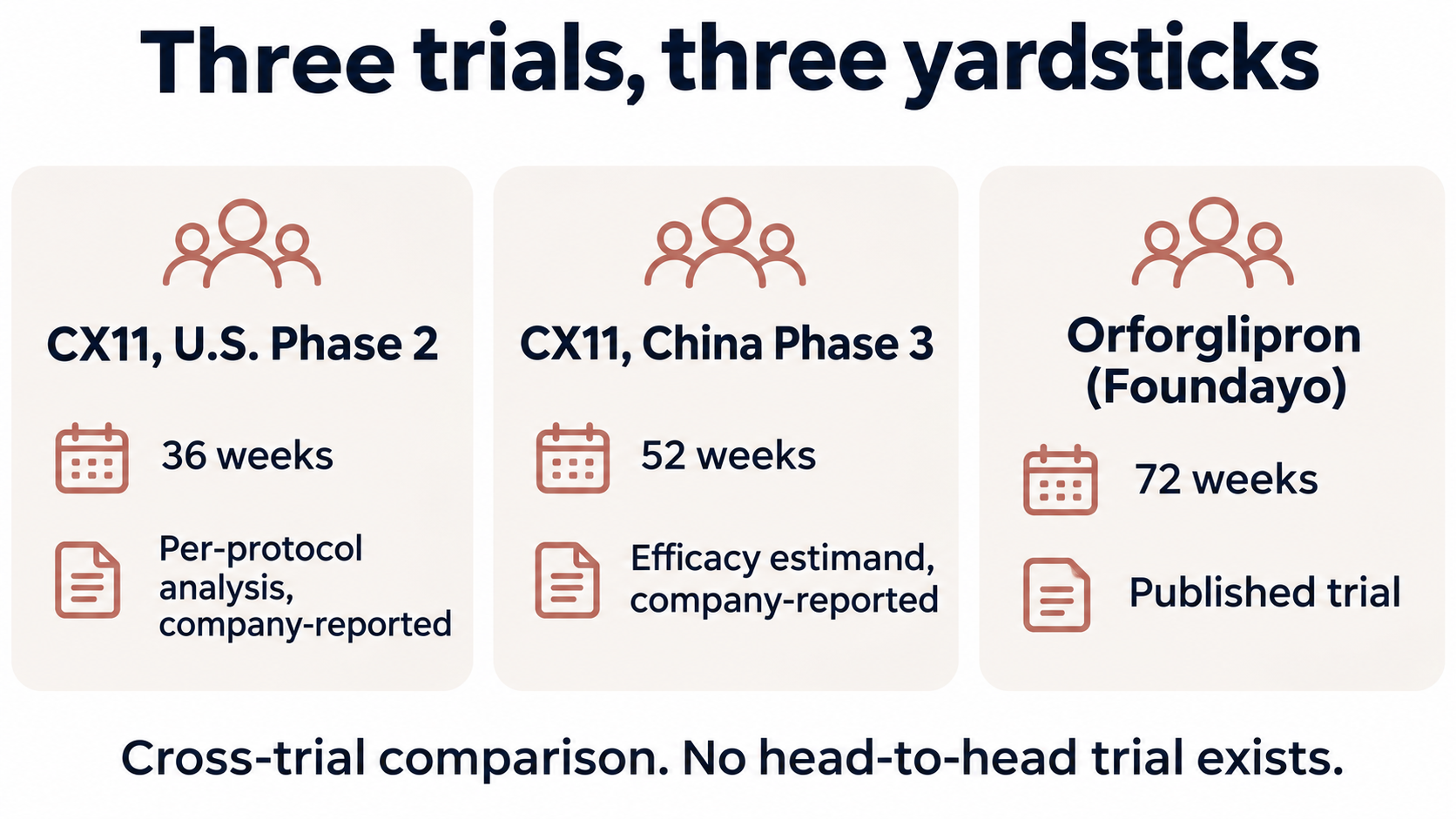
Length changes the picture by itself. The U.S. trial stopped at 36 weeks, the China trial at 52 and ATTAIN-1 at 72. Corxel says its poster shows no plateau at week 36, which is the company’s observation and not a forecast of where the loss would stop.
Populations differ too. The U.S. trial and ATTAIN-1 both enrolled adults without diabetes. Vincentage’s release describes the China trial as adults with a BMI of 28 or higher, or 24 to under 28 with a weight-related condition.
Placebo groups lost 3.1% in the U.S. trial, 1.3% in China, and 0.9% or 2.1% in ATTAIN-1 depending on the method. A drug figure means little without its own placebo figure beside it, and these three trials do not share a comparator.
The slide itself says there are no head-to-head trials and that “strong caution should be exercised when comparing data across unrelated studies.” That caution is Corxel’s own, printed on the slide.
What a per-protocol hypothetical analysis does and does not tell you
A per-protocol set keeps participants who followed the trial plan closely enough to count. A hypothetical strategy then estimates what weight change would have looked like if events such as stopping the drug had not happened. Together they describe the effect of CX11 in people who stay on it.
That is a legitimate question for a Phase 2 trial, whose job is to help pick doses. Corxel’s chief medical officer, Bo Liang, called the data a foundation for dose selection in the planned Phase 3 program.
It is not a treatment-policy analysis, which counts everyone as randomized whatever they did next and answers a different question: what happens on average when a group of people is offered the drug. The two answers can differ. ATTAIN-1 shows how, with 12.4% under the efficacy estimand and 11.2% under the treatment-regimen estimand for 36 mg, while the placebo figure moved from 0.9% to 2.1%. The same split appears in the ribupatide GEMINI-1 analysis and, with a bigger gap, in the CagriSema REDEFINE 9 analysis.
What the CX11 release leaves out matters more here. It does not report how many participants were in the per-protocol set, how many in each arm stopped treatment for any reason, or the result under a treatment-policy analysis. It does give GI discontinuation, 5.0% on CX11 against 2.2% on placebo, but not stopping for other reasons. The poster itself would hold those counts, and this post did not read it.
Tolerability and liver data
Corxel says most GI events came during dose escalation through week 16 and were mild to moderate. Everything below is company-reported. CX11 doses are combined unless a range is shown.
| Event | CX11 | Placebo |
|---|---|---|
| Any treatment-emergent adverse event | 60.8% to 70.0% across CX11 arms | 63.0% |
| Nausea | 32.7% to 34.0% across CX11 arms | 10.9% |
| Vomiting | 13.5%, averaged across doses | 4.3% |
| Constipation | 8.0%, averaged across doses | 4.3% |
| Diarrhea | 8.0%, averaged across doses | 2.2% |
| Stopped treatment for a GI event | 5.0% | 2.2% |
| Serious adverse events | 5 participants (2.5%), none judged treatment related | Not stated |
| ALT above 3 times the upper limit of normal | 3.5% | 2.2%* |
| AST above 3 times the upper limit of normal | 1.5% | 2.2%* |
Corxel states that no participant met Hy’s law criteria, that most enzyme elevations were transient, and that no hepatic safety signal has appeared across more than 1,500 participants in the CX11 program. Those are the company’s statements, and this post did not see the underlying data. Under 1:1:1:1:1 randomization the CX11 group is about 200 people and the placebo group about 50 (this page’s arithmetic), so the liver percentages describe a handful of participants.
A separate Corxel release dated 26 October 2026 gave per-cohort ranges: nausea 33% to 34%, vomiting 12% to 16%, diarrhea 4% to 12% and constipation 2% to 12%. A chart on the investor slide shows each symptom by arm, but the text of the filing does not tie each value to its arm, so this post does not assign them.
Why the Foundayo comparison is cross-trial
Corxel gave an investor presentation on 9 November 2026 and filed it with the SEC. It frames CX11 as a potential best-in-class oral small molecule GLP-1, and its comparison slide sets CX11 against Foundayo’s 72-week figure, cited to the 2025 NEJM paper by Wharton and colleagues. For label and trial doses of the approved pill, see the Foundayo (orforglipron) dosage page.
The slide labels the CX11 figures as efficacy estimand and gives no label for Foundayo. The 12.4% matches the efficacy estimand in Lilly’s release, so the slide appears to line up the methods. It still sets a 36-week trial against a 72-week one, with separate populations and separate placebo groups.
The deck also says vomiting was markedly lower across CX11 dose cohorts than for oral GLP-1 receptor agonists. That is another cross-trial claim. Judging it takes the comparator trials’ vomiting rates under similar titration, which Corxel’s text does not lay out and this post did not compile.
Context matters when reading a slide like this. Corxel US signed a definitive agreement on 25 October 2026 to merge with Amanat Acquisition Corp (Nasdaq: AMAN), a special purpose acquisition company, with a private placement expected to bring in about $300 million and a close expected in the first half of 2027, according to the SEC filings. The 9 November deck is investor material prepared in that setting. That does not make any figure on it wrong, and the slide carries its own caution. It does mean the audience was investors weighing a financing, which differs from readers weighing a trial.
What would settle it
- Phase 3 results under a treatment-policy estimand, reported beside the efficacy one. Corxel’s deck targets a Phase 3 start in the first quarter of 2027 and NDA submissions by 2029, both company plans.
- All-cause discontinuation by arm. The poster release gives only GI discontinuation, 5.0% on CX11 against 2.2% on placebo.
- Peer-reviewed China data. Vincentage reported the 52-week result in a May 2026 release, and Corxel’s deck says Vincentage announced an NDA submission to China’s NMPA in July 2026. This post did not find Vincentage’s own announcement.
- Higher-dose data. Corxel’s October release says a Phase 1b study of higher doses is expected to report in the first half of 2027.
- A reconciled participant count and the full per-arm tables. The release says 246 participants and the registry says 250.
Until then, CX11 is an investigational drug with a promising, company-reported Phase 2 result, and no approval turned up in the sources reviewed. For another oral pill with company-reported Phase 2 data, see the ASC30 post, or browse the GLP-1 and obesity peptides class guide.
Update history
17 November 2026: first version. Based on Corxel’s 16 November poster release, the ClinicalTrials.gov record, Corxel’s investor presentation as filed with the SEC on 9 November, Vincentage’s May 2026 release and Lilly’s ATTAIN-1 release. Not checked: the poster itself, the NEJM full text, and Vincentage’s own announcement of its NDA submission.
Sources
- Corxel US. Corxel US Presents Full Phase 2 Results for CX11 in Adults with Overweight and Obesity at ObesityWeek 2026. GlobeNewswire, 16 November 2026. globenewswire.com. Company release, poster data not peer reviewed.
- ClinicalTrials.gov. NCT07011797, a Phase 2 study of CX11 tablets in overweight and obese participants. clinicaltrials.gov/study/NCT07011797. Trial registry.
- Corxel Pharmaceuticals, Inc. Investor presentation of 9 November 2026, filed by Amanat Acquisition Corp under Rule 425. sec.gov. Company investor material in an SEC filing.
- Corxel US and Amanat Acquisition Corp. Definitive business combination agreement release, 26 October 2026, Exhibit 99.1. sec.gov. Company release in an SEC filing.
- Amanat Acquisition Corp. Form 8-K reporting an event dated 25 October 2026. sec.gov. SEC filing.
- Corxel Pharmaceuticals. Top-line results from the Phase 2 trial of CX11, 23 June 2026. biospace.com. Company release.
- Vincentage Pharma. Positive top-line results from the pivotal Phase 3 trial of VCT220 in Chinese adults, 18 May 2026. globenewswire.com. Company release.
- Eli Lilly and Company. Detailed ATTAIN-1 results for orforglipron, 16 September 2025. lilly.gcs-web.com. Company release.
- Wharton S, et al. Orforglipron, an oral small-molecule GLP-1 receptor agonist for obesity treatment. N Engl J Med, online 16 September 2025. doi.org/10.1056/NEJMoa2511774. Peer-reviewed. Full text not read for this post.