

FLGR242 is a product name sellers use for a follistatin-based protein they say carries an albumin-binding tail. No journal article, trial registration or regulatory filing uses the name. The one primary document tied to it is a US patent on the albumin-binding tail, which reports no pharmacokinetic study and never mentions myostatin or FLGR242. The biology FLGR242 borrows from is real and published. The compound itself has no public data.
Ask about FLGR242
Research snapshot
| Item | Status |
|---|---|
| Category | Follistatin-based myostatin inhibitor, as described by sellers |
| Evidence level | Seller and inventor statements only |
| Human data | None |
| Animal data | None published for FLGR242. A different follistatin variant, FS I-I, has mouse data |
| Registry records | None naming FLGR242 on ClinicalTrials.gov (checked Nov 18, 2026) |
| Approval | Not approved anywhere. Sold as a research chemical |
Technical identity
| Item | What is documented |
|---|---|
| Name | FLGR242, also written FLGR-242, sold as “Follistatin (FLGR242)” |
| Seller description | A fragment of follistatin 344 modified so it does not bind activin, fused through a glycine-serine linker to an albumin-binding peptide |
| Developer named by sellers | Michael Farber, the inventor on US patent 12,377,158 B1 |
| Albumin-binding element | The patent’s preferred construct is GGSGGSGGSGGRLIEDICLPRWGCLWEDD, 29 residues. A promotional article prints the same sequence |
| Follistatin portion | Sequence and domain boundaries not public |
| Form and size | Sellers disagree. One describes a glycosylated recombinant protein of about 40 kDa made in mammalian cells. Another says it synthesizes the product in its own US lab and lists no molecular weight |
| CAS, formula, PubChem | None assigned |
| Independent characterization | None found: no mass spectrometry, sequence confirmation or binding assay from a party other than a seller |
The patent’s abstract prints that albumin-binding sequence with one residue missing, so the body text is the version to trust.
What FLGR242 is claimed to be
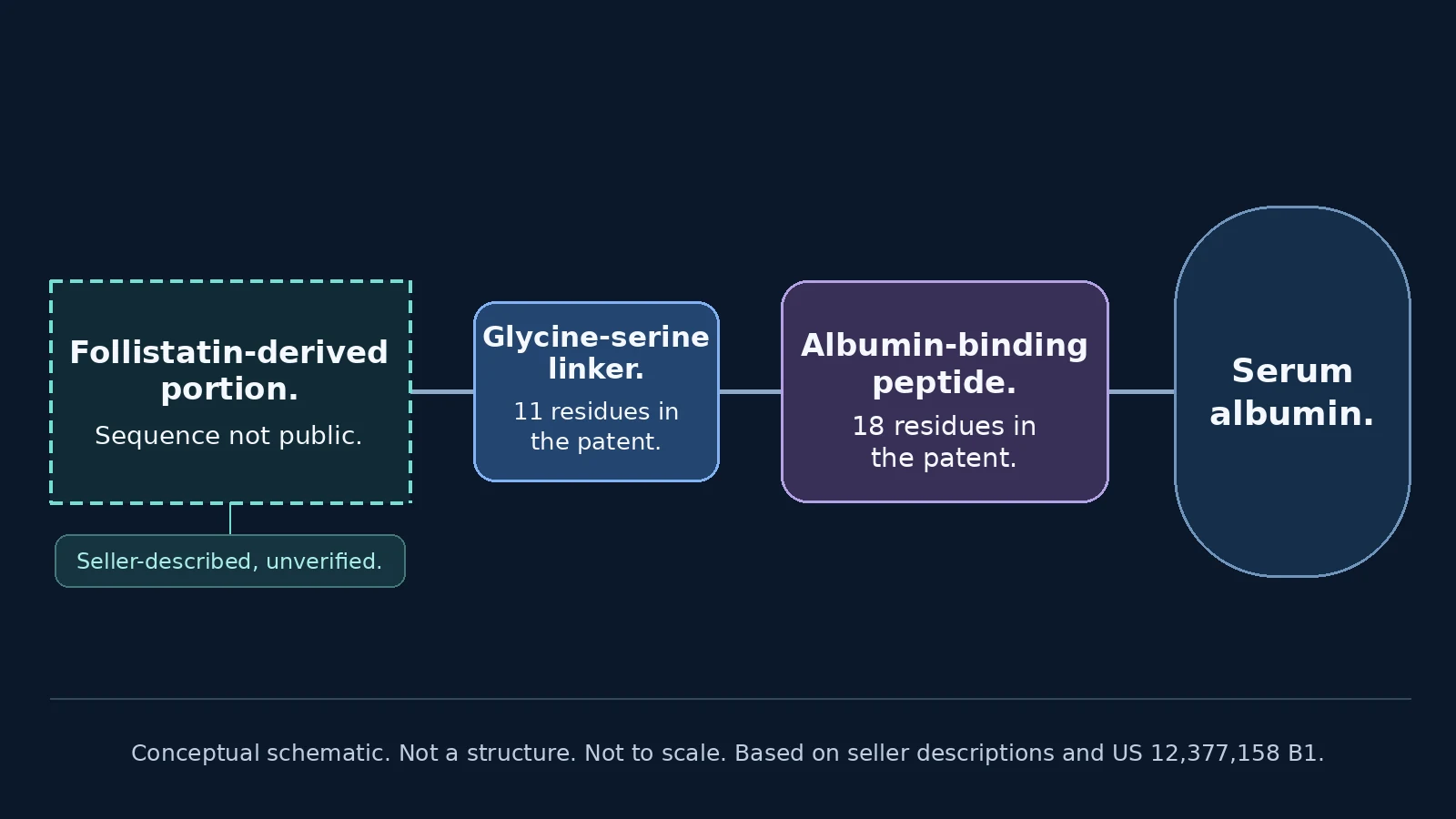
Seller pages describe three engineering features. The first is a follistatin fragment that no longer binds activin, a related signaling protein, so that it neutralizes myostatin more selectively. The second is a hydrophilic glycine-serine linker. The third is an albumin-binding peptide meant to keep the protein in circulation far longer than native follistatin, which sellers put at one to two hours without citing a source.
One promotional article says FLGR242 is based on FS I-I, a published activin-sparing follistatin variant, and says the product is protected by US patent 12,377,158 B1. The first statement cannot be checked because the follistatin sequence is not public. The second needs care, and the next section explains why.
What the patent covers
US 12,377,158 B1, titled “Enhanced peptide constructs for albumin binding,” was filed in January 2025 with a July 2024 priority date and lists Michael Farber as inventor and individual owner. Its single independent claim covers an albumin-binding construct: an 11-residue core peptide from the published SA21 family, attached to the end of a specific 11-residue glycine-serine linker, with a human albumin dissociation constant below 20 nM. The dependent claims add recombinant production and an alpha Klotho version.
A claim to a follistatin construct does not appear. Follistatin shows up in two sentences of the description, one listing it as a protein the tail could be used with and one stating that the result is a follistatin with a 7-day half-life in dogs. No data accompany that sentence. The patent reports one binding experiment, run by an outside lab. It tested mouse Klotho against human albumin, and the document does not say whether the Klotho carried the binding tail. A second application from the same inventor, US 2026/0008820 A1, covers a related albumin-binding platform with GLP-1 and other constructs and does not mention follistatin or myostatin either.
The half-life claims get their own article, FLGR242’s 19-day half-life: what the patent actually establishes.
Where the underlying biology comes from
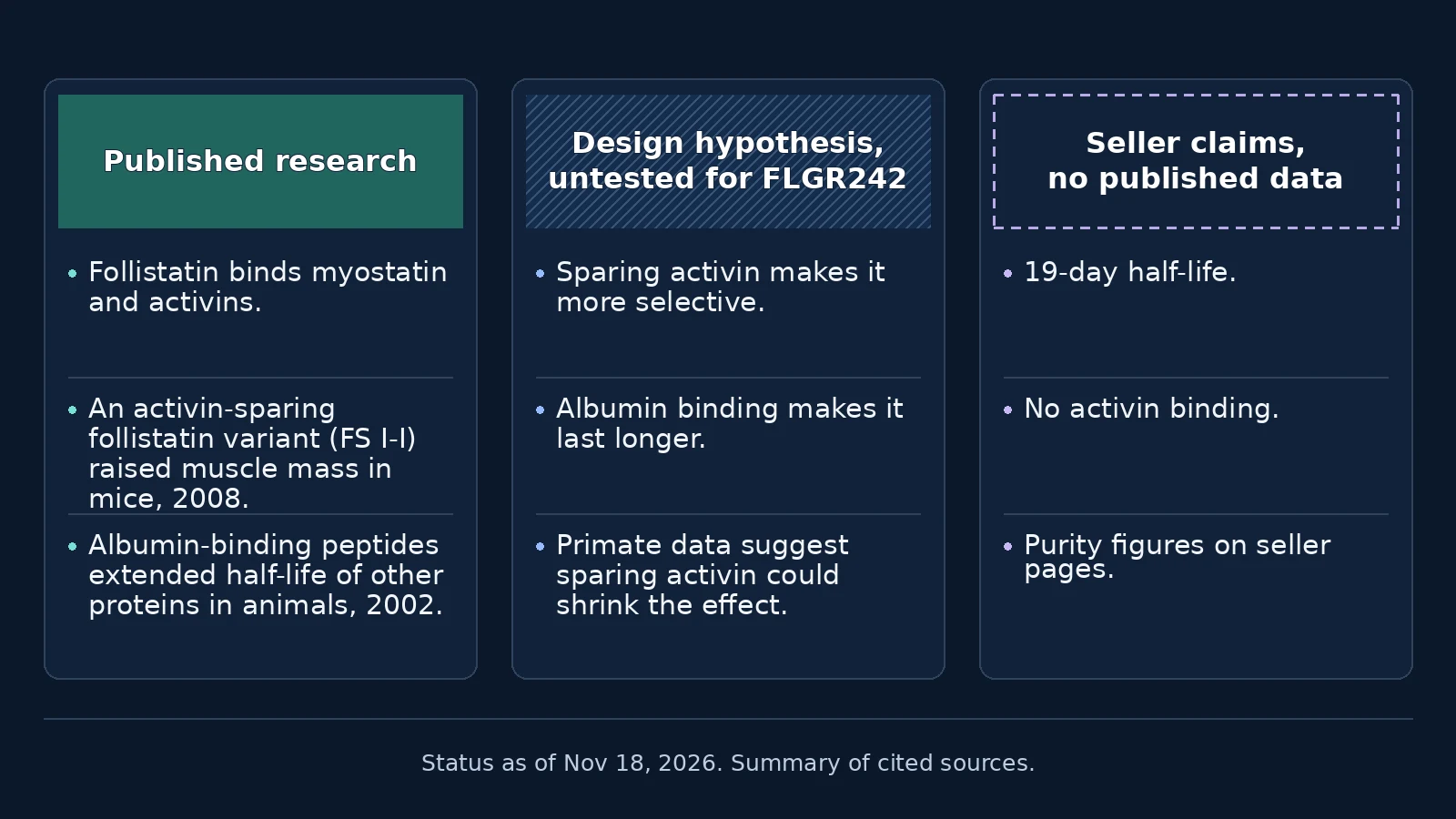
Follistatin neutralizes myostatin and the activins, and myostatin limits muscle growth in mice. In 2008 Nakatani and colleagues described FS I-I, a follistatin-derived inhibitor whose dissociation constant for activin was 64.3 micromolar against 1.72 nanomolar for follistatin itself, while its myostatin constant was 46.8 nanomolar against 12.3 nanomolar. Mice expressing it in muscle gained muscle mass and strength. That is the published precedent for an activin-sparing design, and it says nothing about FLGR242 specifically.
The selectivity goal has a catch. A 2017 Nature Communications paper from Latres and colleagues found that activin A regulates muscle mass in primates more prominently than myostatin does, and that blocking both produced pronounced growth in mice and monkeys where myostatin blockade alone had been modest. A construct built to spare activin could therefore give up part of the effect that matters in primates. That is an inference from the Latres data, not a finding about FLGR242.
The albumin-binding idea is also published. Dennis and colleagues reported in 2002 that peptides with the core DICLPRWGCLW bind albumin, with SA21 showing dissociation constants of 266, 320 and 467 nanomolar for rat, rabbit and human albumin. Fused to an antibody fragment, a related sequence extended half-life 37-fold in rabbits (to 32.4 hours) and 26-fold in mice (to 10.4 hours), reaching 25 to 43 percent of albumin’s own half-life in those animals.
What human research exists
The human follistatin record is gene therapy, in which viral vectors make follistatin inside the patient’s muscle. Six patients with Becker muscular dystrophy and six people with sporadic inclusion body myositis received it in small uncontrolled studies, and a published critique disputes the functional claims in the myositis paper. The Follistatin 344 page covers those trials, and none involves an injected, albumin-bound protein.
Two injected myostatin-pathway agents give a sense of the class. ACE-031 was stopped in a Duchenne trial over nosebleeds and dilated blood vessels. ACE-083, injected directly into muscle in facioscapulohumeral dystrophy, raised muscle volume by 16.4 percent in the biceps group and 9.5 percent in the tibialis anterior group without consistent gains in function. Neither is FLGR242, and both show why muscle size is not the same as benefit. Antibodies aimed at the same pathway, such as bimagrumab and trevogrumab, have their own pages.
Dose, safety and quality
No dose has been established for FLGR242 in any species. Schedules circulate on seller and promoter pages, and none traces to a published study, so this page does not repeat them. There is no safety data on the construct. The patent makes statements about antigenicity and shows no data for them.
Product quality is its own question. A 2019 analysis of 17 black-market products labeled follistatin 344 found follistatin in only nine, with growth-promoting peptides such as MGF and GHRP-2 in some of the others. Seller certificates of analysis for FLGR242 describe purity. They do not establish what the protein is.
Regulatory and developmental status
FLGR242 is not approved by the FDA or any regulator that I could find, and no trial is registered under the name. Sellers label it for research use. The World Anti-Doping Agency’s prohibited list covers myostatin-pathway agents under its S4 category, so athletes subject to testing should check the current list before assuming any follistatin-based product is allowed.
Frequently asked questions
What is FLGR242?
A seller-used name for a follistatin-based protein with an albumin-binding tail. The name appears in commerce and promotion. It does not appear in PubMed, ClinicalTrials.gov or patent text that I could find.
Is FLGR242 the same as Follistatin 344?
Sellers describe it as a modified fragment of follistatin 344, so it is a different molecule. Follistatin 344 is the 344-residue isoform with human gene-therapy data. FLGR242 has no data of its own.
Has FLGR242 been tested in people or animals?
Not in any public study. The patent attributed to it reports no animal or human dosing.
Is FLGR242 patented?
The albumin-binding tail is the subject of US 12,377,158 B1. The follistatin portion is not claimed in that patent.
Does FLGR242 really last 19 days?
The figure comes from sellers and from a statement about albumin in the patent’s background. No measurement of FLGR242 has been published. The full breakdown is in the half-life article.
Does avoiding activin make it safer?
That is the design hypothesis, and the mouse precedent for FS I-I supports it for FS I-I. For FLGR242, nobody has published the activin-binding data, and the primate data suggest less activin blockade may also mean a smaller muscle effect.
Is FLGR242 approved?
No. It is sold as a research chemical.
What is still unknown?
The follistatin sequence, the intact mass, the activin and myostatin binding values, the half-life in any species, the immunogenicity, and what any given vial contains.
Bottom line
FLGR242 is a name, an engineering description and a patent on a tail. It is not yet a characterized compound. The pieces it is built from have real literature behind them, and that literature does not transfer to a product whose follistatin portion, activity and pharmacokinetics nobody has published. Until a sequence, an analytical package and a measured half-life appear, treat every specific number attached to it as a seller claim.
Update history: Reviewed Nov 18, 2026 against PubMed, ClinicalTrials.gov and Google Patents. Updates will be listed here.
Sources
- Farber M. US Patent 12,377,158 B1, “Enhanced peptide constructs for albumin binding.” Google Patents
- Farber M. US Patent Application 2026/0008820 A1. Google Patents
- Nakatani M et al. FASEB J 2008. PMID 17893249
- Latres et al. Nat Commun 2017. PMID 28452368
- Dennis et al. J Biol Chem 2002. PMID 12119302
- Mendell JR et al. Mol Ther 2015. PMID 25322757
- Mendell JR et al. Mol Ther 2017. PMID 28279643, and the critique by Greenberg, PMID 28927986
- Campbell et al. ACE-031 in Duchenne. Muscle Nerve 2017. PMID 27462804
- Statland et al. ACE-083 in FSHD. Muscle Nerve 2022. PMID 35428982
- Reichel et al. Detection of black market follistatin 344. Drug Test Anal 2019. PMID 31758732
What circulates E5
Schedules circulate on seller and promoter pages. None traces to a published study, so none is repeated here.
Recorded as an observation about what is published elsewhere. No figure here is a dose, a protocol, or a recommendation, and nothing in this section is evidence that any amount is safe or effective.
Research area: Growth hormone axis, Tissue repair and recovery.