

Ask PeptideBlog about any peptide
On 30 October 2026 HHS published a notice describing how it intends to treat six peptides when licensed pharmacies and physicians compound them. It is not an approval, and it is not a free-for-all. This page walks through exactly what the documents say, peptide by peptide, and what they leave open.
The answer in 30 seconds. On 30 October 2026 HHS published a notice in the Federal Register describing a draft enforcement-discretion policy for six peptides: BPC-157, TB-500, KPV, MOTS-c, Semax and Epitalon.[2][1] HHS says it does not intend to take enforcement action against state-licensed pharmacies, federal facilities and licensed physicians that compound them, but only when ten conditions are met, only in the listed salt or form, and only by the listed routes. It is not an FDA approval, and none of the six has been added to the 503A bulks list, which still requires FDA rulemaking. The policy is not binding, can be revised, is open for public comment until 13 November 2026,[3] and does not authorize research-use-only retail sales. For readers, the practical point is that six peptides have six different rules, and a route missing from a row is outside the policy, not proven unsafe.
Read the source documents
Search interest in the HHS peptide policy took off the moment the document went public on 28 October. Much of the early coverage compressed it into one line. The text itself is more precise, and the precision matters, because the rules differ for each peptide. This page is written for readers who want the actual structure: what was published, what it covers, what it does not, and how the evidence behind each compound compares with the way it is sometimes described. It documents what is reported. It does not tell any reader what to take, and it is not medical advice.
Timeline: how we got here
Dates below separate when something happened from when it was reported. The difference matters, because several steps were first visible only through press coverage or a document posted later.
Swipe the table sideways to see every column.
| When it happened | What happened | When it was reported or published | Source |
|---|---|---|---|
| September 2023 to 22 April 2026 | BPC-157 sat in FDA’s interim Category 2 for bulk substances that may present significant safety risks, until it was removed on 22 April 2026. Removal did not make it eligible for compounding. | Recorded in HHS Appendix B, published 30 October 2026 | [1] |
| Spring to July 2026 | FDA staff evaluated the nominated peptides. Reviewers reported little or no human safety data for several of them, and recommended against adding BPC-157, KPV, TB-500 and epitalon to the list. | Briefing documents made public ahead of the 23 to 24 July meeting | [6][7][8][9] |
| 23 July 2026 | FDA’s Pharmacy Compounding Advisory Committee (PCAC) voted to recommend BPC-157, KPV and TB-500 in a single grouped vote, eight to six with one abstention, against FDA staff. | Reported by trade press in July; the vote count has not been checked against official minutes | [10] |
| 24 July 2026 | Second meeting day. The panel recommended epitalon, seven to five with one abstention. Across the two days it recommended six of the seven peptides reviewed and voted against emideltide. | Reported by trade press in July | [11][10] |
| 7 October 2026 | The Washington Post reported, citing people familiar with the plan, that the administration was preparing a stopgap to allow temporary sales of some unapproved peptides. The report did not name the peptides. | Reported 7 October; a secondary summary followed the next day | [12] |
| 15 October 2026 | The Associated Press reported that the administration had advanced the plan. | Reported 15 October | [13] |
| 28 October 2026 | HHS made the policy public and the notice was filed for public inspection at the Federal Register. | Same day (law-firm analyses appeared 28 and 29 October) | [2][15][16] |
| 30 October 2026 | Official publication as 91 FR 68526. Docket HHS-OASH-2026-0496 opened. Comments run to 13 November 2026, 11:59 PM EST. | Same day | [2][3] |
| Around February 2027 (scheduled) | FDA’s committee is reported to be scheduled to review five more peptides. | Reported by legal and news coverage; check FDA’s calendar for the confirmed date | [14][16] |
Evidence category: government documents for the 28 and 30 October rows; trade press and news reports for the rest. A press account is not the same as the underlying record.
What section 503A actually means
Section 503A of the Federal Food, Drug, and Cosmetic Act is the part of federal law that lets a licensed pharmacist or physician make a customized medicine for one identified patient, based on a valid prescription, without going through FDA approval for that product.[4] Because the product is built from raw ingredients, the law is strict about which ingredients are allowed. A bulk drug substance has to meet one of three tests: it complies with a United States Pharmacopeia or National Formulary monograph, it is a component of an FDA-approved drug, or it appears on a list FDA develops through regulations.[4] The six peptides in this policy are not on that list, which is why HHS used a different tool.[1]
Six terms get mixed up in headlines, and the whole story turns on keeping them apart.
Swipe the table sideways to see every column.
| Term | What it means | Where the six peptides stand |
|---|---|---|
| FDA-approved drug | A finished medicine FDA reviewed for safety, effectiveness and manufacturing quality for a stated use. | None of the six is approved for any use. |
| Compounded drug | A customized preparation made by a licensed pharmacist or physician for an identified patient from a prescription. FDA does not review each product for safety or effectiveness before it is dispensed. | The pathway the HHS notice addresses, with conditions. |
| Bulk drug substance | The active ingredient itself, before it is made into a finished product. 503A limits which ones a compounder may use. | The notice treats these six as substances not yet on the 503A bulks list. |
| Advisory committee recommendation | A vote by outside experts that advises FDA. It does not bind the agency. | PCAC voted to recommend the six in July 2026. FDA had not acted on the list. |
| Enforcement discretion | An agency choosing not to take enforcement action in described circumstances. It does not change the underlying law, and it can be withdrawn. | The mechanism HHS chose. It is described as a draft and as not binding. |
| Final rulemaking | A proposed rule, public comment, then a final rule published in the Federal Register. This is how a substance is formally added to the 503A bulks list. | Not yet done for these six. The notice says FDA’s future rulemakings may propose adding some or all of them. |
Sources: the statute and the HHS notice.
The notice itself says the policy is a draft, that it is not binding on HHS or the public, and that it does not create rights for anyone.[1][2] It also says HHS may revisit the approach if a safety signal or a product quality problem arises.[1] Put plainly, HHS is saying it does not intend to enforce against qualifying compounders under the listed conditions. A pharmacy that does not meet them gets no protection from this document. A state that restricts compounding of these peptides is not displaced by it either.[15]
One more distinction. The policy was issued by HHS, the department above FDA, and it covers compounding by state-licensed pharmacies, federal facilities and licensed physicians under section 503A. It does not extend to 503B outsourcing facilities.[1][15] Every compounded product still needs a patient-specific prescription, and a pharmacy still has to satisfy its state board.[1][15]
The six peptides, exact forms and routes
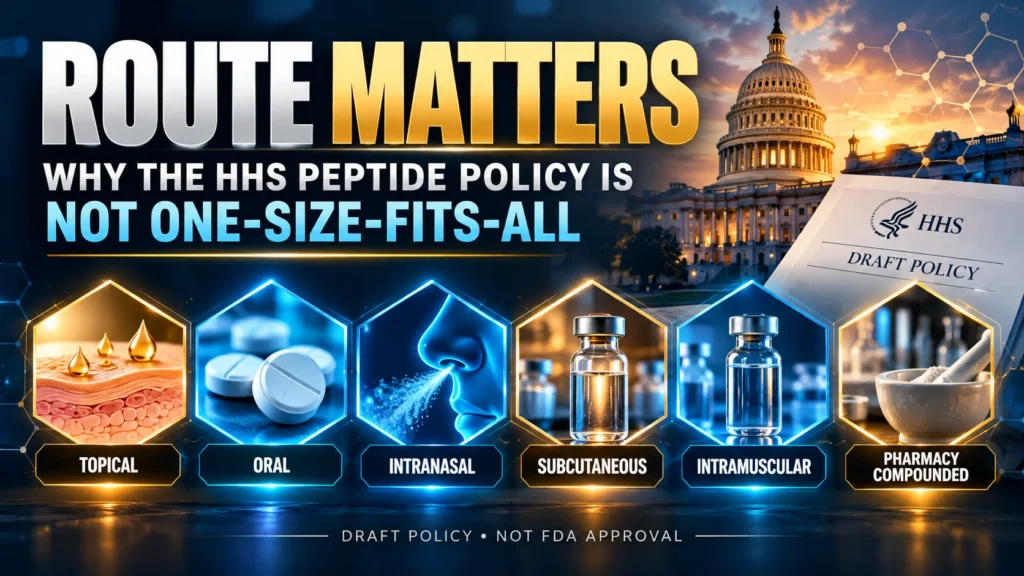
Appendix B of the HHS document names a specific chemical form and specific routes for each peptide. Both are part of the identity HHS describes. A compounder using a different salt, or a route not listed, is outside what the notice describes.[1]
Swipe the table sideways to see every column.
| Compound named in the policy | Routes described | Other limits stated | Formula and molecular weight HHS gives |
|---|---|---|---|
| BPC-157 acetate | Subcutaneous, intramuscular, oral, topical | Oral products also face the oral bioavailability documentation condition. | C62H98N16O22 x CH3COOH; 1419.54 + x(60.05) g/mol |
| TB-500 acetate | Subcutaneous or intramuscular injectable | The listed molecule is the acetylated seven-amino-acid fragment, not full-length thymosin beta-4. | C38H68N10O14 x CH3COOH; 949.1 g/mol |
| KPV acetate | Topical, oral | Subcutaneous is not listed. Oral products face the bioavailability documentation condition. | C16H30N4O4 x CH3COOH; 402.5 g/mol |
| MOTS-c acetate | Subcutaneous or intramuscular | None beyond the general conditions. | C101H152N28O22S2 x CH3COOH; 2234.64 g/mol |
| Semax free base | Intranasal | Free base only, not an acetate or other modified form. | C37H51N9O10S; 813.9 g/mol |
| Epitalon acetate | Subcutaneous or intramuscular, dispensed in intermittent courses | The intermittent-course limit is part of the listing. | C14H22N4O9 x CH3COOH; 450.40 g/mol |
Evidence category: primary government document (HHS Appendix B). Routes were checked against the PDF on 31 October 2026. The policy contains no amounts or schedules for readers, and this page does not either.
What the route words mean
- Topical
- Applied to the surface of the skin or another surface of the body, not taken into the bloodstream by design.
- Oral
- Swallowed and absorbed through the digestive tract. Peptides are generally broken down there, which is why oral peptide products need a separate bioavailability argument. See the guide to why peptides are injected and how oral and nasal routes differ.
- Intranasal
- Delivered through the lining of the nose.
- Subcutaneous
- Injected into the fatty layer just under the skin.
- Intramuscular
- Injected into muscle tissue.
These are definitions, not instructions. Nothing on this page explains how to prepare or give any peptide to anyone.
A missing route is not a rejection. If a route is not listed for a peptide, it means that route is outside the scope HHS described for that substance. It does not mean HHS tested it and found it unsafe, and it does not mean anyone ruled it out. It means no protection under this notice, and often a lack of evidence either way.
The six explainers below use the encyclopedia’s evidence grading: Tier 1 published human clinical evidence, Tier 2 human observational evidence or registered trials without complete results, Tier 3 published animal research, Tier 4 laboratory or mechanistic work, Tier 5 practitioner reports, Tier 6 community or vendor information. Each full entry has more detail.
BPC-157 acetate: four routes, thin human evidence
Swipe the table sideways to see every column.
| Item | What the sources show |
|---|---|
| Form in the HHS policy | BPC-157 acetate. Sequence H-GEPPPGKPADDAGLV-OH, 15 amino acids.[1] |
| Routes described | Subcutaneous, intramuscular, oral, topical.[1] |
| Strongest human evidence | Three small uncontrolled papers from one clinic, about 31 patients in all.[18][19][20] Two placebo-involved studies are visible only as conference abstracts described in FDA’s briefing material.[6] |
| Animal and cell evidence | A large rodent literature across gut, tendon and blood-vessel models. An independent 2026 review calls it heterogeneous, mostly single-dose and short-term.[22] |
| Encyclopedia tier | Tier 2, uncontrolled human case series from a single clinic. See the BPC-157 entry. |
What it is
BPC-157 is a synthetic chain of 15 amino acids. The name is shorthand for “body protection compound,” and the compound is usually described as a fragment of a protein found in stomach juice. That description traces to a single sentence in a 1993 paper from the group that named it,[21] and the full encyclopedia entry covers why the claim is hard to verify. The policy names the acetate salt. A different form sold online, pentadeca arginate (PDA), uses the same sequence with arginine as the counter-ion. The policy does not name it, and the encyclopedia entry found no peer-reviewed study of it. A different salt can change how a lot dissolves, how stable it is and what impurities appear, so the two should not be treated as interchangeable.
What has been investigated
The published human papers are a retrospective review of knee-pain patients treated with an injection into the joint, a single-arm bladder-pain pilot of 12 women, and a two-person intravenous safety pilot. All three share a first author and a journal, none had a control group, and the outcomes were self-reported.[18][19][20] Independent 2026 reviews describe human data as limited to a handful of uncontrolled investigations and the rodent evidence as a hypothesis-generating base, not an established therapy.[23][22] This page makes no claim that BPC-157 treats anything. Nothing in the policy says it does either.
What HHS listed, and why four routes is unusual
BPC-157 is the only one of the six with four routes. HHS justifies the listing by documented use, “multiple human studies,” a lot-specific certificate of analysis from an FDA-registered facility, and the policy’s conditions.[1] Counting published papers that report an outcome in people, the encyclopedia entry finds three, which is a narrower reading than “multiple studies,” and none tested oral or topical use. FDA’s reviewers noted that no study in the nominated indication used the oral, subcutaneous, nasal or transdermal route.[6] The only human measurement of whether BPC-157 reaches the bloodstream that FDA’s briefing material describes, a small rectal-administration study in healthy volunteers, reported that it was not detected in plasma.[6] The policy’s oral condition asks for documentation of adequate human oral bioavailability, and the notice does not say what documentation would satisfy it.[1]
Gaps and safety
The encyclopedia entry finds no human safety data beyond two weeks by any route. FDA staff’s gap list adds no carcinogenicity study identified and no assessment of immunogenicity in any species, and its 28-day intramuscular animal studies showed changes in a blood-clotting measure and raised liver enzyme, glucose and triglyceride readings.[6] The originating research group reports no observed toxicity, and FDA reviewed the same material without accepting it as adequate.[6]
Why this is narrower than an approval
BPC-157 acetate under this policy is a compounded preparation for an identified patient, from a registered manufacturer, on listed routes, under conditions that can change. It is not FDA-approved for any use, it has no approved label, and its place on the 503A bulks list still depends on rulemaking.[1][2]
TB-500 acetate: a seven-amino-acid fragment, not thymosin beta-4
Swipe the table sideways to see every column.
| Item | What the sources show |
|---|---|
| Form in the HHS policy | TB-500 acetate. Ac-Leu-Lys-Lys-Thr-Glu-Thr-Gln-OH, seven amino acids with an acetyl group on the front end.[1] |
| Routes described | Subcutaneous or intramuscular injectable.[1] |
| Strongest human evidence | None for TB-500 itself. Full-length thymosin beta-4 has human trials, which are a different molecule.[8][27][28] |
| Animal and cell evidence | A 2003 mouse wound study used a non-acetylated fragment.[25] A 2026 rat tendon study tested TB-500 itself in eight animals per group.[24] |
| Encyclopedia tier | Tier 4. See the TB-500 entry. |
What it is, and what the name means
“TB-500” is a trade and community label, not a chemical name. The molecule HHS describes corresponds to residues 17 to 23 of thymosin beta-4, a natural 43-amino-acid protein, with an acetyl group added.[1][26] Thymosin beta-4 has a drug name, registered trials and published human safety data. TB-500 has none of those, and FDA says the profile of the non-acetylated fragment cannot be extrapolated to the acetylated one.[8] The two are not interchangeable, and a product labeled with one name may not contain the other. A racing-industry consortium reported testing products sold as TB-500 and finding that many held no thymosin beta-4 or any related peptide, as summarized in the TB-500 entry.
What has been investigated
The full-length protein has a real human record: a placebo-controlled intravenous study in healthy volunteers[27] and a phase 2 trial in dry eye,[28] followed by later larger programs that did not meet their main goals, as covered in the entry. The preclinical basis for TB-500 itself is thinner. The 2003 mouse study showed a seven-amino-acid fragment promoted wound repair, but the fragment was not acetylated.[25] The best in vivo data on TB-500 itself is a 2026 rat Achilles tendon study using eight animals per group, one model and one species.[24]
What HHS listed
HHS lists the acetate for subcutaneous or intramuscular use. It points to the parent protein’s human safety record across several routes, and it notes that the fragment is rapidly truncated in human serum.[1] That last point leaves a question the evidence does not answer: whether what is studied is the fragment itself or a breakdown product of it.
Gaps and safety
FDA staff found no human study of TB-500 given to patients for any condition, no human pharmacokinetic data by any route, and no nonclinical toxicity study of any kind.[8] Thymosin beta-4 is also overexpressed in some cancers, and no TB-500 oncology data exists either way, as discussed in the entry. Blends that include TB-500, such as Wolverine, GLOW and KLOW, are not covered by the single-ingredient condition described below.
Why this is narrower than an approval
Even for the listed acetate, the notice sets out identity, sourcing and reporting conditions, and it makes no claim about effectiveness. Full-length thymosin beta-4 is a separate subject, covered in the thymosin beta-4 entry.
KPV acetate: oral and topical, but not subcutaneous
Swipe the table sideways to see every column.
| Item | What the sources show |
|---|---|
| Form in the HHS policy | KPV acetate. H-Lys-Pro-Val-OH, a tripeptide.[1] |
| Routes described | Topical and oral. Subcutaneous is not listed.[1] |
| Strongest human evidence | None. No published or registered human trial of KPV itself, and FDA reached the same conclusion.[7] |
| Animal and cell evidence | Mouse colitis models,[29][30] a mouse colitis-associated cancer model,[31] rabbit corneal healing with surface application,[32] and a human-skin laboratory study on delivery.[33] |
| Encyclopedia tier | Tier 3, published animal research. See the KPV entry. |
What it is
KPV is lysine-proline-valine, the last three amino acids of alpha-melanocyte-stimulating hormone, so it also appears as alpha-MSH(11-13). It lacks the pigment activity of the parent hormone. Several papers headed “KPV” actually studied other molecules, including an amide form, a D-amino-acid analogue and a linked dimer called CZEN-002, and findings from those are routinely cited as KPV findings. The KPV entry sorts them out.
What has been investigated
The mouse colitis work centers on KPV uptake through PepT1, a transporter in the intestinal lining.[29][30] In a colitis-associated cancer model KPV was protective in normal mice and the effect disappeared in mice lacking PepT1, but the same transporter, when overexpressed, increased tumor burden.[31] A rabbit study applied KPV to the surface of the cornea.[32] Every colitis model was chemically induced, and none reproduces how human inflammatory bowel disease arises. On delivery, passive skin permeation of KPV fell below the detection limit in a human-skin laboratory study.[33]
Why oral and topical but not subcutaneous?
The honest answer is that the HHS document does not explain the exclusion. What it does say is that the listing rests on documented use, characterization of the acetate lots, and CDER’s conclusion that its safety finding reflects an absence of information rather than an observed signal.[1] Beside that, several facts are on the record. FDA found that outsourcing facilities reported no KPV products at all from 2017 to 2025, and the nomination concerned topical use.[7] The animal work clusters around gut uptake and surface application. FDA also flagged immunogenicity and aggregation as unaddressed for these peptides, and injectable products add sterility and endotoxin questions.[7][1] These are context, not HHS’s stated reasoning, and none of them shows that a subcutaneous route was tested and rejected. The accurate reading is that subcutaneous KPV is outside the policy.
Gaps and safety
There is no human pharmacokinetic or safety data of any kind for KPV. The animal and cell studies reported no overt toxicity at the concentrations used, but none was designed as a toxicology study. Much of the encouraging literature is evidence that an engineered delivery system works, since free KPV reaches the colon poorly, according to the entry.
Why this is narrower than an approval
The oral listing carries the extra bioavailability documentation condition, and a topical product still has to meet the identity, sourcing and reporting conditions. Nothing in the notice says KPV works for any condition.[1]
MOTS-c acetate: strong in mice, one human trial still recruiting
Swipe the table sideways to see every column.
| Item | What the sources show |
|---|---|
| Form in the HHS policy | MOTS-c acetate. H-MRWQEMGYIFYPRKLR-OH, 16 amino acids.[1] |
| Routes described | Subcutaneous or intramuscular.[1] |
| Strongest human evidence | No completed trial of MOTS-c itself. One registered phase 2a trial (NCT07505745) is recruiting.[37] Observational studies measure the body’s own MOTS-c.[36][35] |
| Animal and cell evidence | Mouse studies on diet-induced obesity, insulin resistance and exercise capacity.[34][35] |
| Encyclopedia tier | Tier 3, published animal research. See the MOTS-c entry. |
What it is
MOTS-c stands for mitochondrial open reading frame of the twelve S rRNA type-c. It is a 16-amino-acid peptide encoded in mitochondrial DNA, first described in 2015.[34] It belongs to a group called mitochondrial-derived peptides. Why it interests people who follow obesity and exercise science is simple: the original mouse work reported that it reduced diet-induced obesity and insulin resistance,[34] and a later study reported improved physical performance in young, middle-aged and old mice, along with a finding that exercise raises the body’s own MOTS-c in human muscle and blood.[35]
Three separate questions
Preclinical evidence. The animal and cell literature is detailed and positive, but it is mouse and cell data, and it does not establish that treatment works in people.[34][35]
Human evidence. A pooled analysis of 602 participants found circulating MOTS-c higher in obesity and lower in type 2 diabetes, so the two conditions moved it in opposite directions.[36] That is the body’s own MOTS-c, not a treatment result. The one registered trial of MOTS-c itself is a placebo-controlled phase 2a study of 120 adults with prediabetes and overweight or obesity, run at a single site in Shenzhen, China, with no results posted.[37]
The policy question. HHS cites “a randomized placebo-controlled trial of a MOTS-c analogue” with no serious adverse events, plus rodent studies.[1] An analogue is a different molecule. The notice does not name the trial in the text read for this page. A company announcement exists for a randomized, double-blind, placebo-controlled study of the MOTS-c analogue CB4211 in people with obesity and fatty liver disease, which reported reductions in liver enzymes and glucose versus placebo after four weeks. It is a company release, not peer-reviewed data, and the notice does not say it is the study HHS means.[38]
Gaps and safety
Human safety data for MOTS-c itself are essentially absent, as no interventional trial has completed. No dedicated toxicology study or human pharmacokinetic study was located, and immunogenicity is untested. The entry also notes that a common blood assay for MOTS-c does not agree with a more specific mass-spectrometry method.
Why this is narrower than an approval
The policy covers one acetate salt, two injection routes and compounding for an identified patient. It does not establish that MOTS-c is safe or that it improves any metabolic outcome in people.[1]
Semax free base: why intranasal is the whole point
Swipe the table sideways to see every column.
| Item | What the sources show |
|---|---|
| Form in the HHS policy | Semax free base. H-Met-Glu-His-Phe-Pro-Gly-Pro-OH, a heptapeptide. Not an acetate.[1] |
| Routes described | Intranasal only.[1] |
| Strongest human evidence | Published Russian studies in stroke patients, controlled against standard care but not blinded or placebo-controlled.[39][40] |
| Animal and cell evidence | Rodent and cell work, which is where most consumer claims about focus and mood trace to; see the entry. |
| Encyclopedia tier | Published human studies of limited design. See the Semax entry. |
What it is
Semax is a synthetic seven-amino-acid peptide built from a fragment of ACTH with a Pro-Gly-Pro tail added. It was developed in Moscow in the 1980s and is registered in Russia as a prescription drug given as nasal drops. It has never been approved by FDA or the European Medicines Agency. The added tail is described as what removed the hormonal activity of the parent fragment, as covered in the entry.
What has been investigated
The human record is in post-stroke care. A 1997 study compared 30 stroke patients given Semax with 80 on conventional therapy,[39] and a 2018 study followed 110 post-stroke patients through rehabilitation with or without Semax, reporting higher blood levels of a growth factor called BDNF and better functional scores.[40] Both were controlled against standard care, not placebo, were not shown to be blinded, were published in Russian journals and have not been independently replicated outside Russia. Claims about focus, mood or cognition in healthy people mostly trace to rodent and cell work, not to these stroke studies.
Why the intranasal restriction matters
HHS lists intranasal use only. In its notes, HHS says the intranasal human record CDER compiled covers several hundred subjects with no reported adverse outcome.[1] That ties the permission to the route the human experience actually used. An injected Semax product would rest on none of that record, and the notice does not list one. The route is not a footnote, it is the evidentiary basis for the listing.
Free base versus modified forms
HHS lists Semax free base, the unmodified heptapeptide. N-Acetyl Semax Amidate is a different molecule: it adds an acetyl group at one end and converts the other end to an amide, which changes the chemistry. A PubMed search on 31 October 2026 for N-acetyl Semax and Semax amidate returned only unrelated papers and no study of N-Acetyl Semax Amidate. It is marketed online, but no published evidence on it was found. Because Appendix B ties the policy to a stated identity, a modified form or a different salt would not match the listing.[1]
Gaps and safety
No placebo-controlled trial, no healthy-volunteer cognition trial and no long-term human safety study were located. The several-hundred-subject safety statement comes from HHS’s reading of a Russian-language record that has not been independently reproduced.
Why this is narrower than an approval
Semax remains unapproved in the United States. The policy covers one form and one route for compounding for an identified patient, nothing more.[1]
Epitalon acetate: one name, two spellings, and intermittent courses
Swipe the table sideways to see every column.
| Item | What the sources show |
|---|---|
| Form in the HHS policy | Epitalon acetate. H-Ala-Glu-Asp-Gly-OH, four amino acids.[1] |
| Routes described | Subcutaneous or intramuscular, dispensed in intermittent courses.[1] |
| Strongest human evidence | Human studies from one research network, mostly of the older extract Epithalamin.[42][43] |
| Animal and cell evidence | Cell work reporting telomerase activation.[41] Rodent work from the same network. |
| Encyclopedia tier | Tier 2, human observational research. See the Epithalon entry. |
Epitalon, Epithalon and Epithalamin
Epitalon and Epithalon are two spellings of the same synthetic tetrapeptide, alanine-glutamate-aspartate-glycine (AEDG). HHS and FDA use “epitalon,” while this site’s entry URL uses “epithalon.” Both spellings point to the compound made by the St. Petersburg gerontologist Vladimir Khavinson to imitate an older preparation called Epithalamin, a mixed extract from bovine pineal gland. The extract and the synthetic peptide are not the same material, and the human studies most often cited tested the extract.[42][43]
What has been investigated
Every human study reporting a clinical outcome for these names comes from Khavinson or from close collaborators, and the Epithalamin studies lack stated blinding or placebo arms and are not registered in any trial registry.[42][43] The mechanism often repeated online, telomerase activation, comes from cell culture work by the same network.[41] The entry notes that FDA’s briefing material describes one small randomized trial of the synthetic form in healthy women, with a melatonin-related outcome.
What HHS listed, and the intermittent-course limit
HHS lists the acetate for subcutaneous or intramuscular use dispensed in intermittent courses. In its notes, HHS says limited controlled human exposure reported no side effects and that documented regimens are intermittent.[1] The limit therefore follows how the compound was used in the published record, not a finding that continuous use is harmful. FDA staff weighed against listing epitalon, citing the absence of studies in people with insomnia, none using the proposed subcutaneous route, limited nonclinical safety data, and a concern that telomerase activation raises carcinogenicity questions.[9] The advisory committee nonetheless recommended it on 24 July, seven to five with one abstention.[11]
Gaps and safety
Structured human safety data are essentially absent. No immunogenicity, long-term follow-up or cancer-outcome data in humans was found. The compound has also turned up in illegally sold preparations identified by independent forensic chemists, which shows identity can be confirmed analytically but says nothing about safety.[44]
Why this is narrower than an approval
The listing is one salt, two routes, intermittent courses and a patient-specific prescription. It is not a statement that Epitalon slows aging or lengthens life, and no approved product exists.[1]
The fine print: why this is not a free pass for compounders
HHS describes the policy as a more controlled alternative to the research-use-only market.[1] The conditions are what make it controlled. HHS says it does not intend to take enforcement action only when all of them are met.
- A listed substance, in the listed form. The peptide must be in Appendix A and its identity and route must match Appendix B. No other peptide, salt or route qualifies.[1]
- A registered, CGMP-compliant original manufacturer. The facility that made the ingredient must be registered under section 510, comply with current good manufacturing practice, and have its location stated on the certificate of analysis. If a repacker or reseller sits between the manufacturer and the compounder, the original manufacturer and its certificate must be validated.[1][15]
- Traceable sourcing. Product reports include the active ingredient and strength, the original manufacturer and facility identifier, dosage form and route.[1]
- A certificate of analysis with test results. The results must be consistent with FDA criteria, from the testing standard in Appendix B.[1]
- A single active ingredient. One listed peptide per product. This is why blends are not covered.[1][15]
- Oral bioavailability documentation. Oral forms need documentation of adequate human oral bioavailability.[1]
- Device limits. The only co-packaged device allowed is an FDA 510(k)-cleared syringe.[1]
- Adverse-event and quality reporting. Compounders report products compounded, serious adverse events and quality issues to FDA through MedWatch and to the relevant states, and patient labeling carries reporting information.[1]
- Required labeling. Each product must carry the statement “This is a compounded drug product. Not for resale.”[1]
- A patient-specific prescription and everything else the law requires. All other FD&C Act requirements apply, there can be no insanitary conditions, and state law still governs.[1][4]
Why a purity percentage is not a quality assessment
Appendix B sets a testing standard that goes well beyond a single number. It calls for orthogonal methods to confirm the molecule’s properties, identification and primary sequence, higher-order structure and aggregates for larger peptides, an assay against a reference standard, net peptide content, peptide-related impurities, nitrosamines, residual solvents, elemental impurities, trifluoroacetic acid and fluoride, the counter-ion, water content, bioburden and bacterial endotoxin testing for injectables.[1]
Here is why that list exists. A “99% purity” line on a certificate usually describes one chromatography method: how large the main peptide peak is compared with other peaks that method detected. It does not say whether the sequence is right, how much of the powder is peptide rather than water and salt, which impurities sit under the peak, or whether an injectable lot is sterile and low in endotoxin. A certificate also describes one lot, and it is only as useful as the lab, the method named and the raw data behind it. Certificates vary a lot in that respect. For a practical walk through, see the guide to reading a peptide test report.
None of this changes the central fact that these are still unapproved substances. The conditions reduce certain risks. They do not turn compounded peptides into FDA-reviewed medicines.
What it means for the research-use-only market
The notice is about section 503A compounding. It does not authorize retail sales of research-use-only products, and it does not say a “for research use only” label makes a sale lawful or unlawful.[1][16] HHS’s stated aim is to give patients a more controlled alternative to the widespread use of certain research-use-only peptides from foreign manufacturers.[1]
The legal question for any product turns on its intended use. FDA’s rule says intended use is judged from objective evidence, including how an article is labeled, advertised and sold, not only from a disclaimer.[5] Genuine laboratory research, such as an analytical standard used in an assay, is one thing. Marketing a product in a way that points to human use is another, and a research-use-only label does not by itself settle which one a seller is doing.
What could change is uncertain, so these are possibilities, not predictions:
- Some interest may shift toward the prescription route where state law and a qualifying pharmacy make it available. State rules differ, and at least one education company reports that Alabama, Mississippi and South Carolina boards have told licensees that non-approved peptides may not be compounded, a claim not independently verified here.[17]
- Some manufacturers might seek to qualify as registered, CGMP-compliant ingredient makers. One law firm expects most research-market manufacturers will not, because the requirements call for large changes to sourcing, quality systems and documentation.[15]
- The conditions turn on registration, manufacturing compliance and documentation. Country of manufacture is not one of the ten stated conditions, so this page does not assume that overseas supply is unsafe or that every research supplier will disappear.[1]
- Enforcement posture toward the research-use-only market could move in either direction, and neither the notice nor the coverage read for this page says which.
Disclosure. The six links below go to research-use-only catalog pages. They are commercial links, and they sit in this section on purpose, away from the sections on routes, evidence and effects. A research-use-only listing is not a compounded prescription product, is not an FDA-approved drug, and is not covered by the HHS policy. Nothing on this page recommends buying or using any product.
What happens next
- Public comment. Docket HHS-OASH-2026-0496 on Regulations.gov is open, with the comment period ending 13 November 2026 at 11:59 PM EST. On 31 October the docket showed five submissions.[3]
- Possible revision. HHS says it may revisit the approach if a safety signal or a product quality issue arises.[1]
- Rulemaking. Adding a substance to the 503A bulks list requires regulations.[4] The notice says FDA’s future rulemakings may propose adding some or all of the six.[1] One law firm estimates 12 to 24 months, which is the firm’s estimate, not an agency timeline.[15]
- More committee review. The committee is reported to be scheduled to review five more peptides around February 2027.[14][16]
- State differences. The notice does not displace state pharmacy law, so what a pharmacy may do varies by state.[15]
- Legal challenges. Courts have generally been reluctant to review an agency’s decision not to enforce, according to one legal analysis, which also notes that state boards are not bound.[16]
What would count as a material development: a revised or withdrawn policy notice; any change to Appendix A or Appendix B; an FDA proposed rule that lists one of the six; an FDA or HHS safety communication or a pattern in MedWatch adverse-event reports; warning letters or state board actions aimed at compounders; and a later PCAC outcome. Any of these should be checked at the Federal Register, the docket and FDA’s own pages.
Frequently asked questions
Is BPC-157 FDA-approved in 2026?
No. BPC-157 is not FDA-approved for any use. The 30 October 2026 HHS notice describes enforcement discretion for compounding BPC-157 acetate under listed conditions. That is not an approval, and BPC-157 is not on the 503A bulks list.[1][2]
What did HHS actually publish on 30 October 2026?
A notice of availability in the Federal Register describing a draft enforcement-discretion policy for six peptides under section 503A, with Appendix A (the six compounds) and Appendix B (the forms, routes and testing standard). The notice says the policy is not binding.[2][1]
Is this a new law?
No. It does not change the statute or add anything to the 503A bulks list. It is a statement of how HHS intends to use its enforcement discretion, and it can be revised.[1][16]
Is the policy final?
The notice calls it a draft, invites public comment through 13 November 2026, and says HHS may revisit it. The documents read for this page do not describe a later “final” version. Check the docket for updates.[2][3]
What does enforcement discretion mean?
It means an agency chooses not to take enforcement action in described circumstances. It does not make the underlying conduct lawful under the statute, it does not bind states or courts, and it can be withdrawn.[1][16]
What is the 503A bulks list?
It is the list of bulk drug substances that FDA has allowed pharmacists and physicians to compound with under section 503A when no monograph or approved-drug component applies. Adding a substance requires rulemaking.[4]
Can any pharmacy compound these peptides?
No. HHS describes protection only for state-licensed pharmacies, federal facilities and licensed physicians that meet ten conditions, including a patient-specific prescription. State law also applies, and 503B outsourcing facilities are outside the notice.[1][15]
Is KPV injection included?
No. Appendix B lists KPV acetate for topical and oral routes only. Subcutaneous KPV is not listed. HHS does not explain the exclusion, and it does not say the route was tested and rejected.[1]
Why is Semax intranasal?
Appendix B lists Semax free base for intranasal use only. HHS ties the listing to an intranasal human record that CDER says covers several hundred subjects with no reported adverse outcome. Other forms and routes are not listed.[1]
Is TB-500 the same as thymosin beta-4?
No. TB-500 is a seven-amino-acid acetylated fragment, while thymosin beta-4 is a 43-amino-acid protein with its own human trials. The policy covers the TB-500 acetate, and evidence for one does not transfer to the other.[1][8]
Are Epitalon and Epithalon the same thing?
Yes, they are two spellings of the same four-amino-acid peptide. Epithalamin is different: it is an older pineal gland extract, and many of the human studies tested that extract.[42][43]
Are these peptides proven safe or effective?
No. The evidence differs for each one, ranging from a few small uncontrolled human papers to none, and human safety data are limited or absent for most. The HHS notice does not declare any of them safe or effective.[1][8][7]
Are peptide blends covered?
No. One of the ten conditions limits each product to a single listed active ingredient, so combinations such as BPC-157 with TB-500 are not covered.[1][15]
What happens to research-use-only retailers?
The notice does not authorize research-use-only sales and does not change their legal treatment. What happens to the market is uncertain and depends on enforcement choices, state action and supplier decisions.[1][16]
Does FDA approval apply to these peptides?
No. None of the six is FDA-approved, and none has been added to the 503A bulks list. Placement on that list would take FDA rulemaking, and approval would require a separate drug application.[1][4]
When is the public comment deadline?
The Regulations.gov document for the notice lists the comment period ending on 13 November 2026 at 11:59 PM EST, as read on 31 October 2026. Confirm on the official docket.[3]
Bottom line
HHS published a draft, nonbinding enforcement-discretion policy that describes how it intends to treat six peptides compounded by qualifying pharmacies and physicians, in listed forms, by listed routes, under ten conditions. It is not an approval, not a change in the law and not an authorization for research-use-only sales. The evidence behind the six is uneven: a few small uncontrolled human papers for BPC-157, none for TB-500, KPV or MOTS-c themselves, limited non-blinded Russian studies for Semax, and one research network for Epitalon. Whether any of them becomes a formally listed bulk substance depends on FDA rulemaking that has not started.
Update note, 31 October 2026. Checked against the Federal Register notice, the HHS PDF and the Regulations.gov docket. No revised policy and no later HHS or FDA notice was found. This page will be updated if the policy, the docket or the encyclopedia entries change.
Keep reading
Sources and primary documents
- U.S. Department of Health and Human Services. Enforcement Discretion Policy Regarding 503A Compounding Using Certain Peptide Bulk Drug Substances, with Appendix A and Appendix B (16 pages). October 2026. https://www.hhs.gov/sites/default/files/hhs-503a-peptide-enforcement-discretion-policy-appendix-b.pdf Primary source: government policy document. The notice calls it a draft. Read in full on 31 October 2026.
- HHS. Enforcement Discretion Policy Regarding 503A Compounding Using Certain Peptide Bulk Drug Substances (notice of availability). Federal Register, 91 FR 68526, document 2026-22192, published 30 October 2026. https://www.federalregister.gov/documents/2026/10/30/2026-22192/enforcement-discretion-policy-regarding-503a-compounding-using-certain-peptide-bulk-drug-substances Primary source: official notice. Filed for public inspection 28 October 2026.
- Regulations.gov. Docket HHS-OASH-2026-0496 and document HHS-OASH-2026-0496-0001. https://www.regulations.gov/docket/HHS-OASH-2026-0496 Primary source: public docket. Read 31 October 2026: open for comment, comment period ends 13 November 2026 at 11:59 PM EST.
- 21 U.S.C. 353a, Pharmacy compounding (section 503A of the FD&C Act). https://www.law.cornell.edu/uscode/text/21/353a Primary source: statute (Cornell Legal Information Institute copy).
- 21 CFR 201.128, Meaning of “intended uses.” Electronic Code of Federal Regulations. https://www.ecfr.gov/current/title-21/chapter-I/subchapter-C/part-201/subpart-D/section-201.128 Primary source: regulation.
- U.S. Food and Drug Administration. Pharmacy Compounding Advisory Committee, 23 and 24 July 2026: meeting page and briefing documents. https://www.fda.gov/advisory-committees/human-drug-advisory-committees/pharmacy-compounding-advisory-committee Primary source: FDA advisory committee materials (BPC-157 briefing document).
- FDA briefing document, Pharmacy Compounding Advisory Committee, 2026: KPV. https://www.fda.gov/media/193346/download Primary source: FDA staff evaluation.
- FDA briefing document, Pharmacy Compounding Advisory Committee, July 2026: TB-500 (free base and acetate). https://www.fda.gov/media/193349/download Primary source: FDA staff evaluation.
- FDA briefing document, Pharmacy Compounding Advisory Committee, July 2026: epitalon (free base and acetate). https://www.fda.gov/media/193345/download Primary source: FDA staff evaluation.
- American Journal of Managed Care. FDA Panel Backs 6 Peptides for Compounding. July 2026. https://www.ajmc.com/view/fda-panel-backs-6-peptides-for-compounding Trade press report. Used for event dates and vote counts, which the official minutes were not checked against.
- Regulatory Affairs Professionals Society. FDA advisory committee backs two more peptides, rejects one for compounding list. July 2026. https://www.raps.org/resource/fda-advisory-committee-backs-two-more-peptides-rejects-one-for-compounding-list.html Trade press report. Used for event dates and vote counts.
- Becker’s Hospital Review. HHS plans stopgap to allow sales of some unapproved peptides: Washington Post. October 2026. https://www.beckershospitalreview.com/glp-1s/hhs-plans-stopgap-to-allow-sales-of-some-unapproved-peptides-washington-post/ Secondary summary of Washington Post reporting that relied on unnamed sources (reported 7 October 2026).
- Associated Press (via KSAT). Trump administration advances plan for peptide drugs favored by RFK Jr. 15 October 2026. https://www.ksat.com/business/2026/10/15/trump-administration-advances-plan-for-peptide-drugs-favored-by-rfk-jr/ News report. Used for the 15 October step only.
- Medical Daily. HHS Lets Pharmacies Compound BPC-157 and Five Other Unapproved Peptides Despite FDA Scientists’ Safety Concerns. October 2026. https://www.medicaldaily.com/hhs-allows-compounding-six-unapproved-peptides-480563 News report. Used for the reported schedule of the next committee review.
- Frier Levitt. HHS Peptide Compounding Enforcement Discretion Policy. 28 October 2026. https://www.frierlevitt.com/articles/hhs-peptide-compounding-enforcement-discretion-policy/ Law-firm analysis (interpretation, not a primary source). Its timing estimate is the firm’s own.
- Lumalex Law. HHS Opens A Temporary Door For Peptides. 29 October 2026. https://www.lumalexlaw.com/2026/10/29/hhs-opens-a-temporary-door-for-peptides/ Law-firm analysis (interpretation, not a primary source).
- PracticalCME. Update on the October 30 HHS peptide enforcement discretion policy: what it means for prescribers. 30 October 2026. https://www.practicalcme.com/blog/update-on-the-october-30-hhs-peptide-enforcement-discretion-policy-what-it-means-for-prescribers/ Tier 6: education company marketing blog (it sells a peptide course). Used only for a state-board claim that was not independently verified here.
- Lee E, Padgett B. Intra-articular injection of BPC 157 for multiple types of knee pain. Altern Ther Health Med. 2021. https://pubmed.ncbi.nlm.nih.gov/34324435/ Tier 2: uncontrolled human case series, one clinic (PMID 34324435).
- Lee E, Walker C, Ayadi B. Effect of BPC-157 on symptoms in patients with interstitial cystitis: a pilot study. Altern Ther Health Med. 2024. https://pubmed.ncbi.nlm.nih.gov/39325560/ Tier 2: single-arm human pilot, no control group (PMID 39325560).
- Lee E, Burgess K. Safety of intravenous infusion of BPC157 in humans: a pilot study. Altern Ther Health Med. 2025. https://pubmed.ncbi.nlm.nih.gov/40131143/ Tier 2: two-person human pilot (PMID 40131143).
- Sikiric P, et al. A new gastric juice peptide, BPC. An overview of the stomach-stress-organoprotection hypothesis and beneficial effects of BPC. J Physiol Paris. 1993. https://doi.org/10.1016/0928-4257(93)90038-u Originating group’s review (PMID 8298609). Tier 3 to 4 for its claims.
- Demirtas H. BPC 157 in rodent ischemia-reperfusion injury: a critical review of preclinical evidence. Int J Mol Sci. 2026;27(18). https://doi.org/10.3390/ijms27188344 Independent review of published animal research (Tier 3).
- Tewari K, et al. Peptide supplements and their therapeutic applications in sports medicine. Am J Sports Med. 2026. https://doi.org/10.1177/03635465261464420 Independent scoping review of human and animal data.
- Comparison of BPC-157 and TB-500 on Achilles tendon healing in a rat model. Jt Dis Relat Surg. 2026. https://doi.org/10.52312/jdrs.2026.2951 Tier 3: published animal research (PMID 42542926). Eight animals per group.
- Philp D, et al. Thymosin beta4 and a synthetic peptide containing its actin-binding domain promote dermal wound repair in db/db diabetic mice and in aged mice. Wound Repair Regen. 2003. https://doi.org/10.1046/j.1524-475x.2003.11105.x Tier 3: published animal research (PMID 12581423). The fragment used was not acetylated.
- Esposito S, et al. Characterisation of the peptide in a TB-500 formulation by HPLC and high-resolution mass spectrometry. Drug Test Anal. 2012. https://doi.org/10.1002/dta.1402 Analytical chemistry study (PMID 22962027). Identifies Ac-LKKTETQ.
- Ruff D, et al. A randomized, placebo-controlled, single and multiple dose study of intravenous thymosin beta-4 in healthy volunteers. Ann N Y Acad Sci. 2010. https://doi.org/10.1111/j.1749-6632.2010.05474.x Tier 1: published human trial of full-length thymosin beta-4, not TB-500 (PMID 20536472).
- Sosne G, et al. Thymosin beta 4 ophthalmic solution for dry eye: a randomized, placebo-controlled, phase II clinical trial. Cornea. 2015. https://doi.org/10.1097/ICO.0000000000000379 Tier 1: published human trial of full-length thymosin beta-4 (PMID 25826322).
- Dalmasso G, et al. PepT1-mediated tripeptide KPV uptake reduces intestinal inflammation. Gastroenterology. 2008. https://doi.org/10.1053/j.gastro.2007.10.026 Tier 3: published mouse research (PMID 18061177).
- Kannengiesser K, et al. Melanocortin-derived tripeptide KPV has anti-inflammatory potential in murine models of inflammatory bowel disease. Inflamm Bowel Dis. 2008. https://doi.org/10.1002/ibd.20334 Tier 3: published mouse research (PMID 18092346).
- Viennois E, et al. Critical role of PepT1 in promoting colitis-associated cancer and therapeutic benefits of the anti-inflammatory PepT1-mediated tripeptide KPV. Cell Mol Gastroenterol Hepatol. 2016. https://doi.org/10.1016/j.jcmgh.2016.01.006 Tier 3: published mouse research (PMID 27458604).
- Bonfiglio V, et al. Effects of the COOH-terminal tripeptide alpha-MSH(11-13) on corneal epithelial wound healing. Exp Eye Res. 2006. https://doi.org/10.1016/j.exer.2006.07.014 Tier 3: published rabbit research (PMID 16965771).
- Pawar KR, et al. Transdermal delivery of KPV across human skin. J Pharm Sci. 2017. https://doi.org/10.1016/j.xphs.2017.03.017 Tier 4: laboratory study on human skin outside the body (PMID 28343991).
- Lee C, Zeng J, Drew BG, et al. The mitochondrial-derived peptide MOTS-c promotes metabolic homeostasis and reduces obesity and insulin resistance. Cell Metab. 2015;21(3):443-454. https://doi.org/10.1016/j.cmet.2015.02.009 Tier 3 and 4: mouse and cell research (PMID 25738459).
- Reynolds JC, et al. MOTS-c is an exercise-induced mitochondrial-encoded regulator of age-dependent physical decline and muscle homeostasis. Nat Commun. 2021;12:470. https://doi.org/10.1038/s41467-020-20790-0 Tier 3 (mice) plus human measurements of the body’s own MOTS-c, not treatment (PMID 33473109).
- Zhou et al. Systematic review and meta-analysis of circulating MOTS-c levels in obesity and diabetes. Diabetol Metab Syndr. 2024. https://doi.org/10.1186/s13098-024-01405-w Tier 2: human observational evidence, 602 participants (PMID 39160573).
- ClinicalTrials.gov. NCT07505745: a phase 2a, randomized, double-blind, placebo-controlled study of MOTS-c in adults with prediabetes and overweight or obesity (“MOTS-MET”). Run by Hudson Biotech. https://clinicaltrials.gov/study/NCT07505745 Tier 2: registered human trial, recruiting, no results.
- CohBar. CohBar announces CB4211 phase 1a/1b results selected for late breaker presentation at The Liver Meeting 2021. 13 October 2021. https://www.cohbar.com/news-media/press-releases/detail/160/cohbar-announces-cb4211-phase-1a1b-results-selected-for Company press release (not peer reviewed). Concerns an analogue of MOTS-c, not MOTS-c itself.
- Gusev EI, et al. Effectiveness of Semax in acute period of hemispheric ischemic stroke. Zh Nevrol Psikhiatr Im S S Korsakova. 1997;97(6):26-34. https://pubmed.ncbi.nlm.nih.gov/11517472/ Published human study, Russian journal. Controlled, not placebo-controlled (PMID 11517472).
- Gusev EI, et al. Efficacy of Semax in the treatment of patients at different stages of ischemic stroke. Zh Nevrol Psikhiatr Im S S Korsakova. 2018;118(3-2):61-68. https://doi.org/10.17116/jnevro20181183261-68 Published human study, 110 patients, Russian journal, no placebo (PMID 29798983).
- Khavinson VKh, Bondarev IE, Butyugov AA. Epithalon peptide induces telomerase activity and telomere elongation in human somatic cells. Bull Exp Biol Med. 2003. https://doi.org/10.1023/a:1025493705728 Tier 4: laboratory cell research, one research group (PMID 12937682).
- Korkushko OV, Khavinson VKh, Shatilo VB, Antonyuk-Shcheglova IA. Geroprotective effect of the pineal peptide preparation Epithalamin in elderly people with coronary disease and accelerated aging. Bull Exp Biol Med. 2006. https://doi.org/10.1007/s10517-006-0365-z Tier 2: human observational research on the extract Epithalamin, same research network (PMID 17426848).
- Korkushko OV, Khavinson VKh, Shatilo VB, Antonyuk-Sheglova IA. Effect of peptide preparation Epithalamin on indicators of functional activity of the pineal gland and the pituitary in elderly people. Bull Exp Biol Med. 2011. https://doi.org/10.1007/s10517-011-1332-x Tier 2: human research on the extract Epithalamin, same research network (PMID 22451889).
- Vanhee C, et al. Identification of Epitalon in illegally sold preparations. Drug Test Anal. 2014. https://doi.org/10.1002/dta.1771 Analytical chemistry study by independent forensic chemists (PMID 25535022).
Educational reference only, not medical advice. This page documents what government documents, published research and press reports say. It does not tell any reader what to take, and inclusion of a compound does not mean it is safe, effective or suitable. Talk to a qualified, licensed clinician about personal medical decisions.